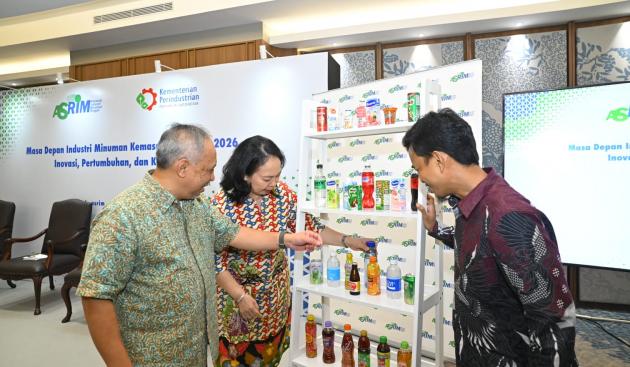
(From left to right) Chairman of ASRIM Triyono Prijosoesilo, Director of Beverage, Tobacco, and Refreshment Products Industry at the Ministry of Industry Merrijantij Punguan Pintaria, and Senior Researcher at CORE Indonesia Muhammad Ishak Razak.
The national food and beverage industry, particularly the packaged beverage sector, continues to show resilience as one of the mainstays of manufacturing in Indonesia.
This sector is a key driver of domestic consumption amid global economic uncertainty, geopolitical tensions, and the weakening of the rupiah exchange rate.
According to data from the Central Statistics Agency (BPS) recorded by the Center of Reform on Economics (CORE) Indonesia, the national economy in the first quarter of 2026 grew by 5.61 percent year-on-year.
The processing industry still holds the largest share of contribution to the national GDP, reaching 19.07 percent, with the food and beverage subsector contributing about 7.31 percent of that.
Despite recording positive macroeconomic growth, the reality on the ground shows that the recovery of this industry has not been ideal.
Chairman of the Association of Packaged Beverage Companies (ASRIM), Triyono Prijosoesilo, revealed that the food and beverage industry indeed posted positive growth of 6.38 percent throughout 2025. However, this figure is still below pre-pandemic levels, which usually reached between 7 and 9 percent.
Senior Researcher at CORE Indonesia Muhammad Ishak Razak explained that the market surge in the first quarter of this year was largely driven by seasonal factors such as the Ramadan and Eid al-Fitr periods, as well as high public mobility. Behind that, the industry is still overshadowed by significant structural pressures.
“This growth is still overshadowed by a number of structural challenges, including the weakening of the rupiah, which once broke through Rp17,900 per US dollar (Wednesday, June 3, 2026), rising production costs, inflationary pressures, and weak public purchasing power, which are real challenges for industry players,” explained Ishak.
The high dependence of businesses on imported raw materials and packaging materials has caused production costs to swell due to exchange rate fluctuations. The impact is seen in the inflation data for April 2026, where the food, beverage, and tobacco group experienced inflation of 3.06 percent year-on-year. This figure is above the national general inflation rate of 2.42 percent.
Encouraging Adaptive Policies
In response to this situation, the government, through the Ministry of Industry, has affirmed its commitment to maintaining a conducive manufacturing business climate through strategic measures.
Merrijantij Punguan Pintaria, Director of Beverage, Tobacco, and Refreshment Products Industry at the Ministry of Industry, conveyed the form of industrial ecosystem support from regulators. According to her, the processing industry sector contributed about 19 percent to the national GDP in the first quarter of 2026, with the food and beverage industry as the main subsector supporting national manufacturing growth.
“We understand that global economic pressures also pose challenges for the food and beverage industry to continue growing. Therefore, the government remains committed to strengthening industrial structure, developing downstreaming, and increasing the competitiveness of the food and beverage sector,” she explained.
Furthermore, Merrijantij added that they will also continue to strengthen synergy with business players to maintain industrial sustainability and job creation amid global economic dynamics.
ASRIM appreciated these government steps and hopes that future policy or regulatory implementation, including issues related to excise and import duties, can proceed adaptively without imposing additional burdens on business players. This step is considered crucial so that the industry can maintain investment and protect national employment.
“We encourage adaptive and consistent policies, including strengthening domestic raw materials, regulatory certainty, and a balance between public purchasing power and business sustainability,” concluded Triyono.