Fugitive US Sex Offender’s Hideout in Sawangan Bunker Comes to an End
Depok City –
The escape of AW, the perpetrator who was a fugitive from US authorities, has ended. You can run but you can’t hide.
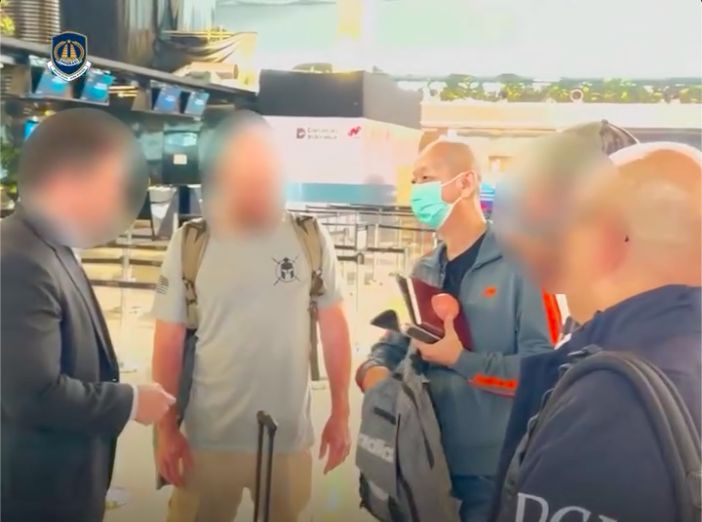
AW was arrested by members of the Directorate General of Immigration in Sawangan, Depok City, West Java. Immigration apprehended AW who was hiding in a bunker at his home.
AW had been a fugitive from US law enforcement for 15 years. The man fled to Indonesia just as he was about to face legal proceedings in his home country.
“AW is known to have entered Indonesia since 2011 to avoid legal process for a sexual abuse case he committed in the United States,” stated a post on the Instagram account @ditjen_imigrasi, Saturday (6/6/2026).
AW’s escape ended on Thursday, April 23, 2026, when Immigration officers arrested him at his home in the Sawangan area, Depok City. Officers dismantled the access to the bunker in the house.
AW then came out with both hands extended. The walls of the bunker appeared to be lined with black sheets, a type of soundproofing material.
“Securing a foreign national from the United States with the initials AW in a bunker at his residence in Sawangan, Depok,” he said.
Hendarsam Marantoko emphasized that this success demonstrates the effectiveness of immigration supervision. He said Immigration is committed to maintaining state security and sovereignty through the application of a selective policy principle and the spirit of “Immigration for the People.”
Falsified Identity
During his escape in Indonesia, AW falsified his identity. It is suspected that this was done by AW to avoid detection by law enforcement for the case he committed.
After being examined, it was also discovered that AW had committed other immigration violations, namely misuse of travel documents.
“From an immigration standpoint, AW was proven to have committed serious violations, namely using a false identity and misusing travel documents,” he said.
Deported to the US
The Directorate General of Immigration arrested AW after receiving a request for assistance from the US Embassy. Indonesian Immigration then conducted a series of investigations and intelligence operations.
After being intensively examined, the fugitive in the sexual abuse case in the US was deported to his home country.
“The individual concerned has been subjected to immigration administrative actions including detention, deportation, and blacklisting,” he stated.
Uncovering the US Fugitive
took action against AW after a woman with the initials NM reported him. NM claimed that she and her two children were also victims of AW.
The Directorate General of Immigration then facilitated the victim NM and her children to return to the US. After that,
Depok City
Depok City, located in West Java, Indonesia, has a history dating back to the colonial era when it was established as a private estate by a Dutch East India Company official in the 18th century. It later became known for its unique Christian community and the historic Depok Lama area. Today, Depok has grown into a bustling satellite city of Jakarta, known for its educational institutions, particularly the University of Indonesia.
Sawangan
Sawangan is a coastal district in Depok, West Java, Indonesia, known for its scenic beaches and fishing villages. Historically, it was a small settlement that grew as a trading and fishing hub, and today it is a popular destination for seafood and weekend getaways, with attractions like Sawangan Beach offering sunset views.
West Java
West Java is a province in Indonesia known for its rich cultural heritage, including the Sundanese traditions and the famous angklung bamboo music. Its history dates back to ancient kingdoms like Tarumanagara and Pajajaran, with colonial influence from the Dutch East Indies era. Today, it remains a vibrant region blending natural beauty, such as volcanic landscapes and tea plantations, with modern urban centers like Bandung.
United States
The United States is a large, diverse country in North America, founded in 1776 with the Declaration of Independence from Britain. Its history includes westward expansion, the Civil War over slavery, industrialization, and its rise as a global superpower in the 20th century. Today, the U.S. is known for its cultural influence, democratic institutions, and iconic landmarks like the Statue of Liberty and Grand Canyon.
Indonesia
Indonesia is a vast archipelago nation in Southeast Asia, composed of over 17,000 islands, known for its rich cultural diversity and history as a major trading hub since ancient times. Its history includes powerful Hindu-Buddhist kingdoms like Srivijaya and Majapahit, followed by centuries of Dutch colonial rule, and a struggle for independence proclaimed in 1945. Today, Indonesia is the world’s largest Muslim-majority country, with iconic sites like Borobudur Temple, Bali’s terraced rice fields, and the capital Jakarta blending tradition with modernity.
US Embassy
The US Embassy is the official diplomatic mission of the United States government in a foreign country, serving as a key site for bilateral relations, visa services, and citizen support. Historically, embassies have evolved from simple consulates to fortified complexes, especially after events like the 1979 Iran hostage crisis and the 1998 embassy bombings, which reshaped security protocols. Each embassy reflects the host country’s relationship with the U.S., with notable examples including the heavily fortified Baghdad Embassy and the historically significant London Embassy, designed by Eero Saarinen.
Instagram
Instagram is a photo and video-sharing social networking platform launched in October 2010 by Kevin Systrom and Mike Krieger. Originally focused on square-format photos and filters, it was acquired by Facebook in 2012 for $1 billion and has since grown into a global hub for visual content, influencers, and digital culture. Its history includes major features like Stories (2016) and Reels (2020), which have shaped modern social media trends.
Directorate General of Immigration
The Directorate General of Immigration is a government agency responsible for managing immigration policies, border control, and visa services in a given country. Its history often dates back to the establishment of modern nation-states, evolving from basic passport control systems to complex digitalized processes. Today, it plays a crucial role in national security, economic migration, and international travel regulations.