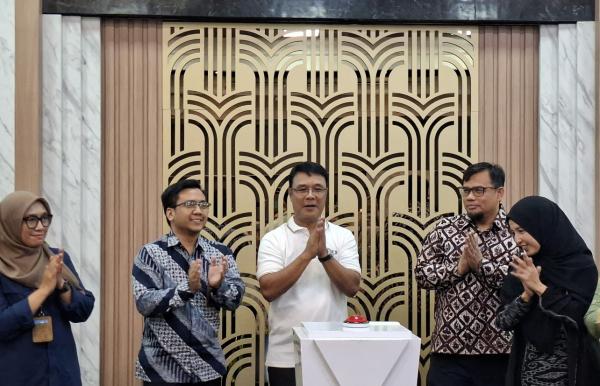
SURABAYA – The city of Surabaya has become one of the national pilot areas for a river program supported by the United Nations Development Programme (UNDP) Indonesia and the Government of the United Arab Emirates (UAE).
This program focuses on reducing waste entering rivers before it reaches the sea, while also strengthening community-based waste management systems.
The program was born out of the need to strengthen river waste management, which remains a major source of marine pollution in Indonesia.
“When we saw that river waste issues were still a big challenge, there was a need for a more structured program. At that time, there were also various challenges related to the division of authority for managing waste in rivers,” said a coordinator from the National Coordination Team for Marine Waste Management and UNDP Indonesia project manager during the program launch in Surabaya.
The program began to be designed in 2023 with the Coordinating Ministry for Maritime Affairs and Investment. Then, in April 2024, the Indonesian and UAE governments signed a funding cooperation agreement, with UNDP appointed as the program implementer in Indonesia.
“This is the first support from the UAE government specifically directed at a waste management program. We see it as a form of international trust in Indonesia’s efforts to address waste issues,” he said.
In its implementation, the government has designated five areas as pilot locations: Surabaya, Sidoarjo, Solo, Bekasi, and Bali, with a total of eight intervention points.
Surabaya was chosen because it is considered to have a strong commitment to environmental management. After studies and discussions with the Surabaya city government, the program was focused on Kali Tebu and Kali Menur rivers.
“Initially we considered Kali Mas as a potential location. But because its condition is already relatively clean, after discussing with the city government we finally chose Kali Tebu and Kali Menur, which still require further treatment,” he said.
The program, which will run until July 2027, partners with several organizations to assist communities, reduce waste, and strengthen environmental management systems in river areas.
The approach used is not only oriented towards cleaning rivers but also building a sustainable system through collaboration with communities and local governments.
“We are not only focused on cleaning rivers but also building a sustainable system. There is collaboration with communities, local governments, and various stakeholders so that after the program ends, the waste management system continues to run,” he said.
Meanwhile, the Acting Head of the Surabaya City Environment Agency stated that this collaborative program aligns with the city government’s efforts to reduce plastic waste pollution in rivers.
He explained that waste collected from rivers is not immediately discarded but is sorted and reused, providing economic value for the surrounding community.
“Waste that is taken is sorted, then sorted again, packaged, and sold. From this activity, residents gain economic benefits because they are involved in the management process,” he said.
To reduce waste generation at its source, the Surabaya city government is also strengthening various community-based waste management programs through the Zero Waste Village and Climate Village Program.
Currently, waste production in Surabaya reaches around 1,800 tons per day. Of that amount, about 200 tons have economic value and can be managed through waste processing facilities or the informal sector. Meanwhile, about 1,000 tons of waste have been used as raw material for energy processing through gasification facilities.
“There are still about 600 tons that go to the landfill. Therefore, we support the construction of waste-to-energy processing facilities so that the volume of waste dumped in landfills can be further reduced,” he explained.
He added that monitoring results at Kali Tebu show the volume of waste captured is currently around one ton per day. However, this figure is starting to decline as public awareness increases.
“On average about one ton per day. But now it is starting to decrease because residents have seen the river condition becoming cleaner, raising awareness to no longer throw waste carelessly,” he concluded.