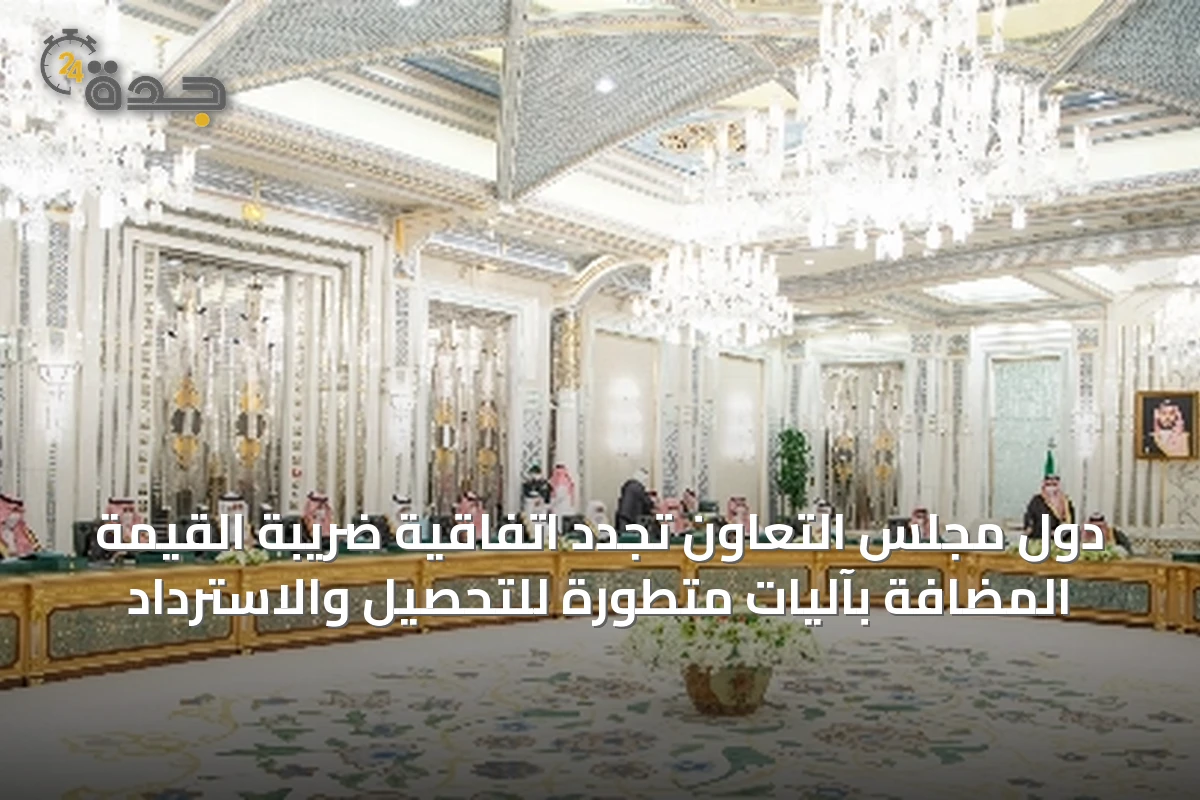
The Council of Ministers, chaired by the Custodian of the Two Holy Mosques King Salman bin Abdulaziz, approved an amendment to the unified Value Added Tax agreement for the Gulf Cooperation Council states. This approval came as part of member states’ efforts to develop tax application methods and enhance tax and customs integration among them, based on Royal Decree No. M/51 issued on May 3, 2017.
Procedural steps leading to adoption
A comprehensive study was previously conducted by the Ministry of Finance on the matter, and the results were presented to the Council of Experts at the Council of Ministers. Recommendations from the Council of Economic and Development Affairs, the Shura Council decision, and the recommendation of the General Committee of the Council of Ministers were also taken into account before approving the amendments.
Amendment of transport and delivery clause between member states
Clause 4 of Article 12 was amended to clarify that the state where transport or dispatch concludes has the right to settle or refund the tax from the state where the process began, through the direct automatic transfer mechanism used in customs. The ministerial committee was also granted authority to adopt additional arrangements to regulate settlement or refund processes, including the possibility of imposing tax at entry points to the receiving state for goods, with a refund or settlement of the previously paid tax to the customer.
Rewording of Article 13 for inter-supplies to non-tax-registered persons
The text was amended to enable any member state to claim tax paid in another state if the supply value exceeds 10,000 riyals or its equivalent in GCC currencies, for individuals and non-registered persons. The tax is refunded or settled through the direct automatic transfer mechanism for customs duties. The importing state also has the right to impose tax at ports if proof of payment in the other state is not provided.
Updating tax rates and import procedures
Amendments were introduced to Article 25 to oblige each member state to apply the basic VAT rate according to its local system, provided it is not less than 5% of the supply or import value, while maintaining exemptions and zero rates in cases stipulated in the agreement.
Regarding import tax, the amended Article 64 stipulated that the tax due on imported goods must be paid at the first entry point and deposited into a dedicated tax account, to be later transferred to the final destination state via the automatic transfer mechanism for customs duties within the GCC customs union framework. The amendments also allow alternative arrangements that permit imposing tax in the destination state, with a direct refund or settlement of the tax collected at the first entry point to the importer.
The amendment granted member states the authority to allow taxpayers to defer payment of import tax on goods used in economic activities, provided they are disclosed in the tax return and eligible for deduction according to the agreement’s provisions.
Enhancing tax information exchange
Clause 4 of Article 71 was updated to enable competent tax authorities in member states to access information related to inter-supplies, aiming to improve data exchange between GCC tax administrations and enhance oversight efficiency and verification of cross-border transactions.
These amendments reflect the GCC states’ path in developing the VAT system in line with the growth of inter-trade and goods movement within the region, contributing to facilitating collection and refund processes, reducing double taxation, and enhancing coordination between tax and customs systems in the Gulf states.
Two Holy Mosques
The “Two Holy Mosques” refers to the Masjid al-Haram in Mecca and the Al-Masjid an-Nabawi in Medina, the two holiest sites in Islam. The Grand Mosque in Mecca surrounds the Kaaba, the direction of Muslim prayer, and has been expanded over centuries since the time of Prophet Abraham. The Prophet’s Mosque in Medina, built by Muhammad himself in 622 CE, houses his tomb and has undergone major expansions, particularly by the Saudi dynasty.
Gulf Cooperation Council states
The Gulf Cooperation Council (GCC) states are a political and economic alliance of six Arab countries bordering the Persian Gulf: Saudi Arabia, Kuwait, the United Arab Emirates, Qatar, Bahrain, and Oman. Founded in 1981 in response to shared security concerns and the Iran-Iraq War, the organization aims to foster economic integration, cultural cooperation, and regional stability among its members. Today, the GCC states are known for their vast oil and gas reserves, rapid modernization, and growing influence in global affairs.
Ministry of Finance
The Ministry of Finance is a key government department responsible for managing a nation’s economic policies, public finances, and budget. Historically, it evolved from early treasuries and financial councils, such as the British Treasury established in the 12th century, to oversee taxation and state expenditures. Today, it plays a central role in shaping fiscal policy and ensuring economic stability.
Council of Ministers
The “Council of Ministers” is a key executive body in many parliamentary systems, typically composed of senior government ministers who oversee national policy and administration. Its modern origins trace back to the development of cabinet government in 18th-century Britain, evolving from the Privy Council to become the central decision-making forum under a prime minister. Today, it serves as the collective leadership that implements laws and manages state affairs, with its specific structure varying by country.
Council of Economic and Development Affairs
The Council of Economic and Development Affairs (CEDA) is a key governmental body in Saudi Arabia, established in 2015 by royal decree to oversee the nation’s economic and development policies. It was created as part of a broader restructuring to modernize the economy and implement the ambitious Vision 2030 reform plan, which aims to reduce Saudi Arabia’s dependence on oil and diversify its economic sectors. Chaired by the Crown Prince, CEDA coordinates between various ministries and agencies to drive sustainable growth and enhance the country’s global competitiveness.
Shura Council
The Shura Council is the advisory or legislative body in several Islamic and Arab countries, often serving as an upper house or consultative assembly. Its name derives from the Islamic concept of “shura,” meaning consultation, which has roots in early Islamic governance where leaders sought counsel from community members. Modern Shura Councils, such as those in Egypt or Saudi Arabia, blend traditional principles with contemporary legislative functions, though their powers and composition vary widely by country.
General Committee of the Council of Ministers
The General Committee of the Council of Ministers is a high-level administrative body in Saudi Arabia, responsible for overseeing the implementation of government policies and coordinating the work of various ministries. Established in the mid-20th century as part of the country’s modernization efforts, it plays a key role in shaping national decisions under the leadership of the Council of Ministers. The committee helps streamline government operations and ensure alignment with the kingdom’s strategic goals.
GCC customs union
The Gulf Cooperation Council (GCC) customs union, established in 2003, is a trade bloc comprising six member states: Saudi Arabia, the UAE, Qatar, Kuwait, Oman, and Bahrain. It aims to create a unified customs territory, eliminating internal tariffs and implementing a common external tariff on imports from non-member countries. While the union has bolstered intra-regional trade and economic cooperation, full implementation has faced delays due to political and economic differences among the member states.