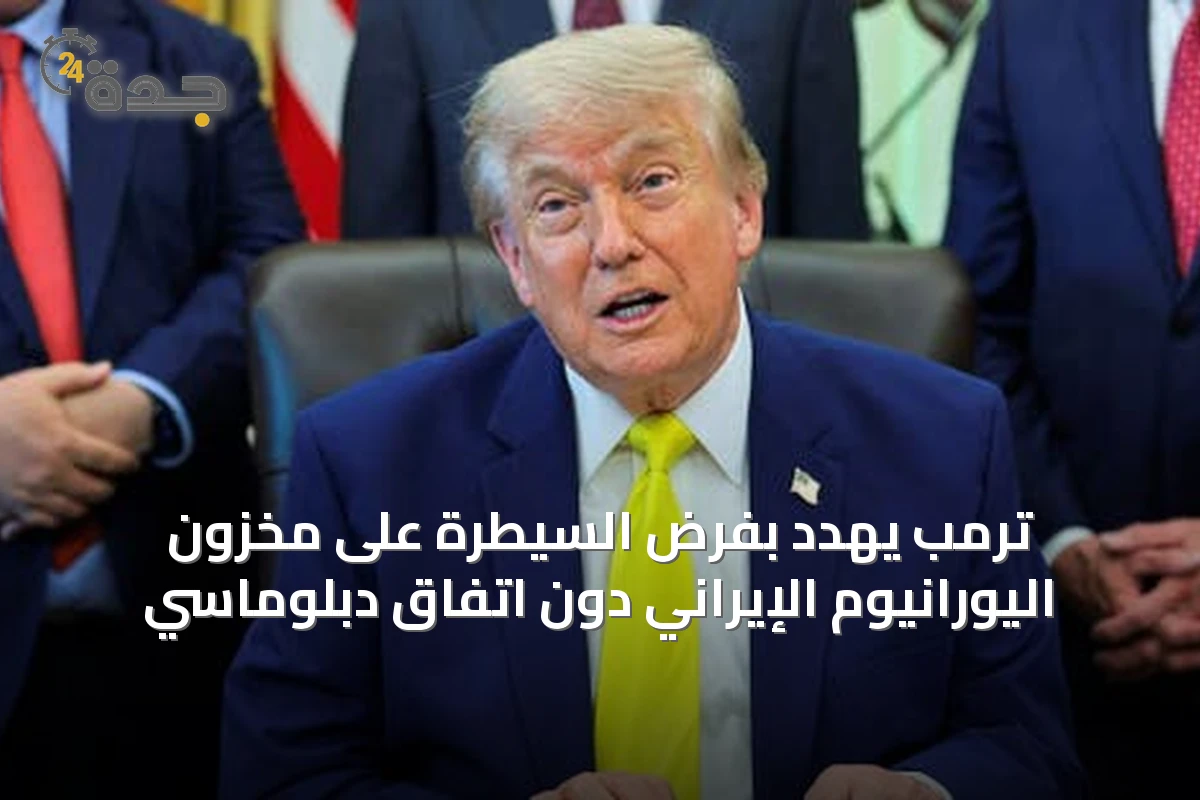
US President Donald Trump has escalated his statements toward Iran, asserting that his country does not need to sign an agreement with Tehran to access its enriched uranium stockpile. These remarks come as diplomatic efforts continue to end the ongoing confrontation and restore stability to the region.
Trump: Military option is possible
During his remarks to reporters at the White House, Trump said Washington can access Iranian uranium if it wishes, considering Iran possessing a nuclear weapon unacceptable. He reiterated his administration’s commitment to preventing Tehran from developing military nuclear capabilities under any circumstances.
The US President clarified that ongoing negotiations with Iran address a range of core issues, noting that one of the most important outcomes of any potential agreement is ensuring the reopening of the Strait of Hormuz and securing international navigation. He stressed that his country will achieve its goals either through a political agreement or via military options if necessary.
US optimism regarding Lebanon
Regarding regional relations, Trump expressed optimism about the possibility of progress on the Lebanese file, affirming that Lebanon deserves peace and stability. He mentioned contacts he made with Israeli Prime Minister Benjamin Netanyahu as part of efforts to calm tensions and prevent the region from sliding into a wider confrontation.
Pakistani mediation between Washington and Tehran
Trump’s statements coincided with intensive diplomatic moves led by Pakistan between Washington and Tehran, as Pakistani Interior Minister Mohsin Naqvi returned to the Iranian capital for meetings with Iranian officials as part of mediation efforts to advance negotiations between the two sides. Informed sources reported that Naqvi met with his Iranian counterpart Eskandar Momeni to discuss ways to bridge differences and overcome obstacles still hindering an agreement.
In a sign of the fragility of the current calm, US reports revealed that Trump informed his aides he might reconsider the ceasefire if American soldiers come under attack from Iran or its allies. Despite the halt in airstrikes for weeks, limited clashes and mutual attacks in the region have raised questions about the durability of this calm over the long term.
US Secretary of State describes escalation as
White House
The White House is the official residence and workplace of the President of the United States, located in Washington, D.C. Construction began in 1792, and John Adams became the first president to live there in 1800. It has since served as a symbol of American leadership and has undergone several renovations, including rebuilding after being burned by British forces in 1814.
Strait of Hormuz
The Strait of Hormuz is a narrow, strategically vital waterway connecting the Persian Gulf to the Gulf of Oman, serving as a passage for about 20% of the world’s oil trade. Historically, it has been a key maritime route for centuries, controlled by various empires from the Portuguese in the 16th century to the British and Iran today. Its geopolitical importance has made it a focal point for regional tensions and international military presence.
Lebanon
Lebanon is a country in the Middle East with a rich history dating back thousands of years, home to ancient Phoenician city-states like Byblos, Tyre, and Sidon. It was later part of the Roman and Ottoman Empires before becoming a French mandate and gaining independence in 1943. Despite a devastating civil war from 1975 to 1990, Lebanon remains known for its vibrant culture, diverse religious communities, and landmarks such as the Jeita Grotto and the ruins of Baalbek.
Washington
Washington, D.C., the capital of the United States, was established as a federal district in 1790 following the Residence Act, with its design largely credited to French engineer Pierre Charles L’Enfant. The city is home to iconic landmarks such as the White House, the U.S. Capitol, and the Washington Monument, which reflect the nation’s political and historical heritage. As a center of government and culture, Washington has witnessed key events in American history, including the War of 1812’s burning of the city and the 1963 March on Washington.
Tehran
Tehran, the capital of Iran, is a sprawling metropolis with a history that dates back to ancient times but rose to prominence in the late 18th century when it became the capital of the Qajar dynasty. The city blends modern skyscrapers with historic landmarks such as the Golestan Palace and the Grand Bazaar, reflecting its evolution from a small village to a major political and cultural hub. Today, Tehran is known for its vibrant arts scene, museums, and as the center of Iran’s economic and administrative life.
Iran
Iran, historically known as Persia, is a country in West Asia with a rich cultural heritage spanning over 2,500 years. It was home to ancient empires like the Achaemenid, Parthian, and Sassanid dynasties, and later became a center of Islamic civilization after the 7th century. Today, Iran is known for its stunning architecture, poetry, and sites such as Persepolis and Isfahan’s Naqsh-e Jahan Square.
Pakistan
Pakistan is a South Asian country with a rich history that includes being part of the ancient Indus Valley Civilization and later a crossroads for various empires, such as the Mughal and British. It was created in 1947 as a homeland for Muslims in the Indian subcontinent, following the partition of British India. Today, Pakistan is known for its diverse cultures, languages, and landmarks like the ancient city of Mohenjo-Daro and the mountainous region of the Karakoram.
Israeli
Israel is a country in the Middle East with a rich and complex history, established in 1948 as a homeland for the Jewish people following centuries of diaspora and the Holocaust. Its cultural sites include the ancient city of Jerusalem, which holds profound religious significance for Judaism, Christianity, and Islam, as well as landmarks like the Western Wall and the Dead Sea. The region’s history spans thousands of years, from biblical times through various empires to modern statehood, making it a focal point of cultural and historical heritage.