In the depths of Wuling, embroidering “Miao flowers,” fingertips tempered with resilience await the deep spring.
“No matter how hard it is, we must make them bloom all over the mountains.”
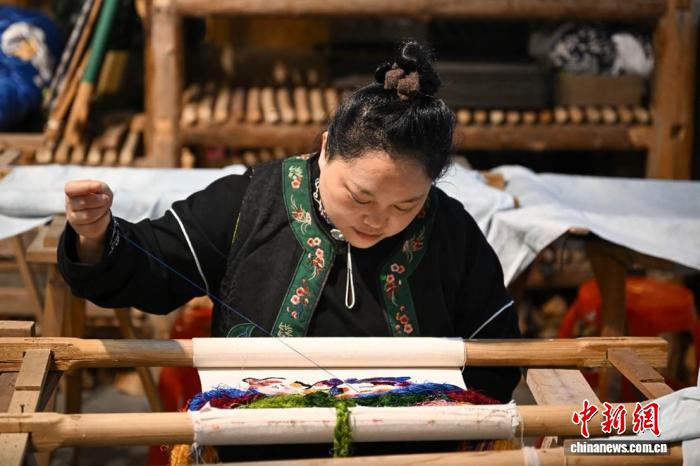
Summer rain, old house, embroidery needles, countless threads stretched between beams. Yang Xiuyan, a representative inheritor of Chongqing’s intangible cultural heritage for Xiushan Jinzhu Miao embroidery, sits by her frame, her fingertips lightly twisting colorful threads. One by one, “Miao flowers” slowly spread across the plain white fabric, following the stitches.
Having spent so long with Miao embroidery, Yang Xiuyan increasingly feels that these painstakingly crafted stitches resemble the wild irises blooming in the Wuling mountain area in late spring and early summer—the stronger the wind, the sturdier they stand; the poorer the soil, the more vibrant they become, until the barren slopes are covered in a sea of purple.
Miao embroidery is a traditional embroidery skill passed down through generations of the Miao people. Its style is ancient, its composition beautiful, its stitching delicate, and its colors bright. Because it encompasses Miao art, culture, history, and customs, it is also known as a “wordless history book” worn on the body.
“No silver, no flowers, no girl; if you have clothes without silver, it’s not a grand outfit.” This old saying captures the essential role of Miao embroidery in the hearts of Miao women.
Tian Maoyuan, a Guizhou provincial-level inheritor of Songtao Miao embroidery, picked up an embroidery needle at the age of seven and began selling her handmade embroideries on the street at fifteen. In those days, when every household in the Miao village had its own embroiderer, the skill was passed down orally from mother to daughter. But in the past, the tradition often clung to old methods, with most elders dedicating their lifelong efforts to a single stitching technique.
As times changed, this “fingertip memory” once faced a lack of successors.
“All the young people left, only the old, weak, women, and children remained.” In 2012, Yang Xiuyan, who had also learned embroidery from her mother, returned to visit her family in Minzu Village, Meijiang Town, Xiushan Tujia and Miao Autonomous County. She witnessed the village’s growing desolation: “There was no rice in the pot, no firewood in the stove, and everyone’s hearts were scattered.”
Encouraged and hopeful from her mother, she took the lead in gathering 56 embroiderers from the village to pick up their needles again, aiming to “make a living and get rich through their craft.” But recalling these years of perseverance, Yang Xiuyan admits it was “a difficult step every step of the way.”
The difficulty lay in the fading scenery, with groups of embroiderers now a thing of the past; in the lack of successors, with few deeply studying the stitching techniques; in the hard-to-compensate value, as every stitch took time and effort but yielded little return; and most of all, in balancing tradition with innovation, finding a middle ground between the old and the new.
Even though the path ahead is rough, the charm of traditional craftsmanship has never diminished.
In October 2018, the local government brought several intangible cultural heritage representative items, including Jinzhu Miao embroidery, to the Louvre in France. “The folk charm of the Wuling mountain area once again captured the world’s attention.”
1.58 million yuan—the final auction price of Yang Xiuyan’s team’s Miao embroidery masterpiece “Crouching Tiger” in Hong Kong—once again confirmed the market value and future potential of traditional folk crafts. Yang Xiuyan explains that during the hardest times, many embroiderers wavered, but this money made everyone understand that “tradition is not a burden, but a treasure.”
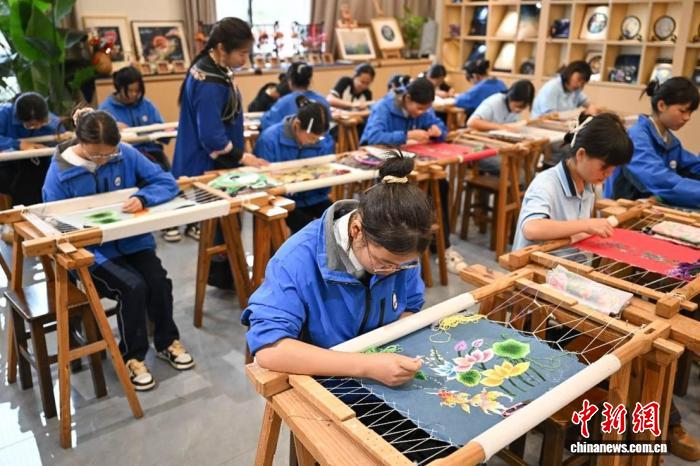
Entering the Xiushan Intangible Cultural Heritage Experience Hall’s Jinzhu Miao Embroidery Workshop, one is dazzled by the array of embroidered pieces. Once used to adorn everyday objects