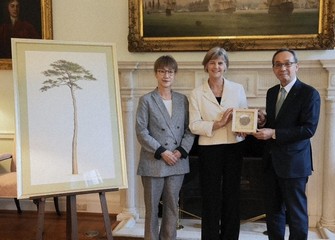
Seeds from a cloned pine tree that survived the 2011 Japan tsunami will be stored in the UK.
Officials from the United Kingdom and Japan pose for a commemorative photo at the British Embassy in Japan with seeds from the cloned successor of the “Miracle Pine,” which are set to be stored in Britain. (Photo courtesy of Sumitomo Forestry Co.)
TOKYO — Seeds from a cloned successor of a single pine tree that initially survived a massive tsunami following the 2011 Great East Japan Earthquake and became a symbol of recovery from the disaster will soon be stored at one of the world’s largest seed banks in Britain.
The tree in the city of Rikuzentakata, Iwate Prefecture, is known as the “Kiseki no Ipponmatsu,” or “miracle pine.” The seeds from the clone are expected to promote international goodwill as a symbol of the strength of people who persevere through hardship, according to the British Embassy in Japan.
Sumitomo Forestry Co. is donating the seeds. Immediately after the disaster, the company began working with the Japan Landscape Contractors Association and others to cultivate successor trees to the miracle pine through grafting and seedlings. The seeds were collected in October 2025 from a 14-year-old cloned successor tree.
Seeds collected from a cloned successor of the “miracle pine,” set to be donated to Britain, are seen. (Photo courtesy of Sumitomo Forestry Co.)
The recipient is the Royal Botanic Gardens, Kew, in southwest London. Since its establishment in 1759, it has cultivated more than 25,000 plant species. The facility was designated a World Heritage Site in 2003. It also operates the Millennium Seed Bank, a facility for preserving plant seeds.
As for the miracle pine, the botanic gardens had been hoping to receive seeds since 2012, shortly after the disaster. The British Ambassador to Japan said that the facility plays a major role from the standpoint of protecting the natural environment and advancing scientific research.
After going through quarantine procedures and other steps, the seeds are expected to arrive in Britain sometime this summer or later. The chairperson of Sumitomo Forestry said, “The road to this donation was not smooth (due to the death of the seedlings and other setbacks). I hope the donation becomes a symbol of Japan-U.K. friendship and the spirit of recovery.”
As part of the project to save the miracle pine, Sumitomo Forestry and others succeeded in cultivating three grafted saplings in December 2011 and nine seedling-grown saplings in June 2013. Successor trees have since been planted in Rikuzentakata and the city of Nagoya.
Miracle Pine
The Miracle Pine is a famous symbol of resilience located in Rikuzentakata, Japan. It is a single pine tree that survived the devastating 2011 Tōhoku earthquake and tsunami, which destroyed over 70,000 other trees in the area. Although the tree later died due to saltwater damage, it was preserved through a restoration project and now stands as a memorial to the disaster and a symbol of hope.
British Embassy in Japan
The British Embassy in Tokyo, located in the Chiyoda district, stands as a symbol of the long-standing diplomatic relationship between the United Kingdom and Japan, which began with the Anglo-Japanese Treaty of Amity in 1854. The current embassy building, designed by British architect Sir Basil Spence, was completed in 1974 and replaced an earlier structure destroyed during World War II. The site also includes the historic British Embassy Residence, one of the few Western-style buildings in Tokyo to survive the 1923 Great Kanto Earthquake.
Royal Botanic Gardens, Kew
The Royal Botanic Gardens, Kew, located in southwest London, is a UNESCO World Heritage site renowned for its vast collection of plants and scientific research. Founded in 1759, it originated from a small exotic garden at Kew Palace and expanded significantly in the 19th century under the direction of prominent botanists like Sir William Hooker. Today, it serves as a global center for botany, conservation, and education, featuring iconic glasshouses like the Palm House and the Temperate House.
World Heritage Site
A World Heritage Site is a landmark or area designated by UNESCO for its outstanding cultural, historical, or natural significance to humanity. The concept originated with the 1972 UNESCO World Heritage Convention, which sought to protect and preserve sites of universal value for future generations. Today, over 1,100 sites worldwide, from the Great Wall of China to the Great Barrier Reef, are recognized under this program.
Millennium Seed Bank
The Millennium Seed Bank, located at Wakehurst in West Sussex, England, is a global conservation project led by the Royal Botanic Gardens, Kew. Established in 2000, its primary mission is to collect and store seeds from wild plants worldwide, safeguarding them against extinction due to climate change, habitat loss, and other threats. It currently holds over 2.4 billion seeds from more than 40,000 species, making it the largest wild seed bank in the world.
Rikuzentakata
Rikuzentakata is a coastal city in Iwate Prefecture, Japan, known for its tragic history during the 2011 Great East Japan Earthquake and tsunami, which destroyed much of the city and killed over 1,600 residents. The city is famous for the “Miracle Pine,” a single pine tree that survived the disaster and now stands as a symbol of resilience, preserved and reinforced near the restored Takata Matsubara beach. In the years since, Rikuzentakata has undergone extensive reconstruction, including the creation of a memorial park and a raised seawall, honoring its past while rebuilding for the future.
Iwate Prefecture
Iwate Prefecture, located in the Tohoku region of Japan’s Honshu island, is known for its rugged natural landscapes, including the iconic Mount Iwate and the scenic coastline of the Sanriku Coast. Historically, it was part of the ancient Mutsu Province and was ruled by the powerful Fujiwara clan during the Heian period, leaving cultural treasures like the Chuson-ji Temple in Hiraizumi, a UNESCO World Heritage site. Today, Iwate blends its rich samurai-era history with modern attractions, such as the folk crafts of Morioka and the tragic memorials of the 2011 tsunami.
Nagoya
Nagoya is a major industrial and cultural hub in Japan, historically known as the home of the powerful Oda and Tokugawa clans during the feudal era. Its most famous landmark, Nagoya Castle, was built in 1612 by the Tokugawa shogunate and later reconstructed after World War II. Today, the city blends its samurai heritage with modern attractions, including the Nagoya City Science Museum and the Toyota Commemorative Museum of Industry and Technology.