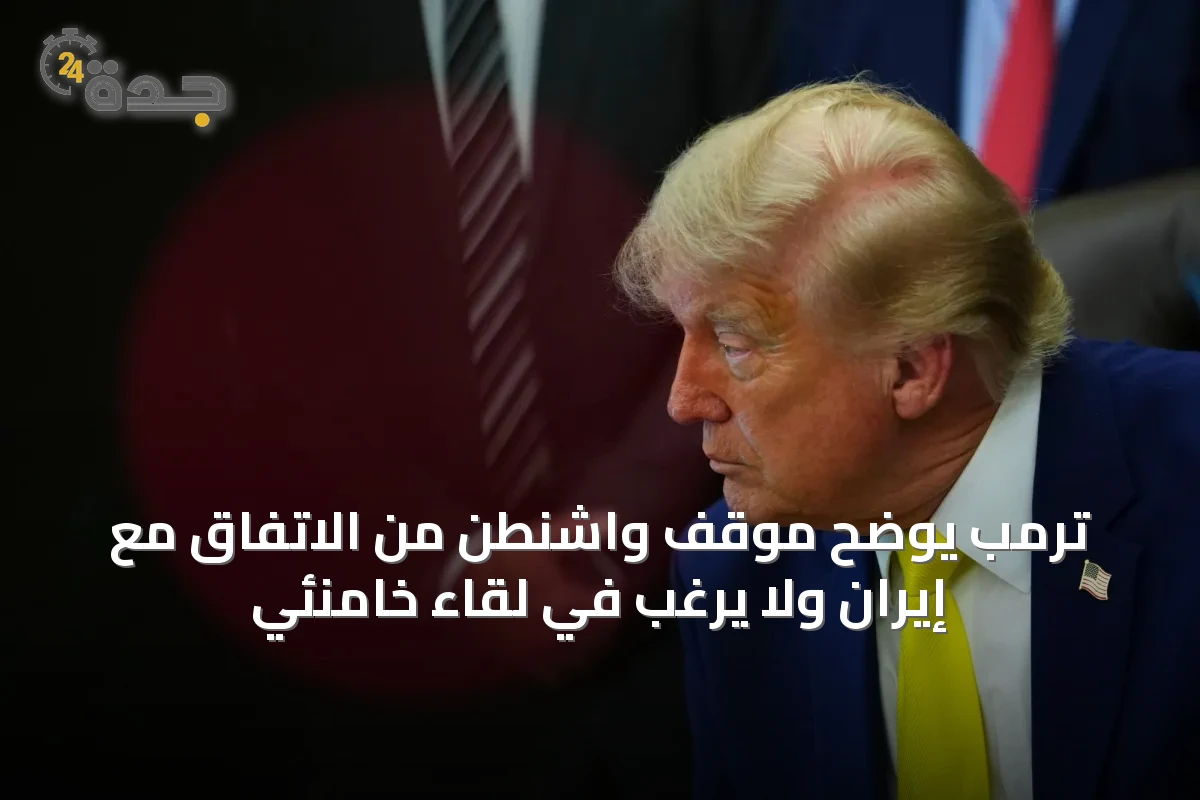
Former US President Donald Trump stated in press remarks to a group of journalists in the Oval Office that the United States does not need to sign any agreement with Tehran to obtain enriched uranium.
Ability to obtain uranium without an agreement
He explained that the United States can extract the required uranium at present, emphasizing that Tehran does not have the ability to prevent this if they wish, adding that there is enough buried stockpile to meet the need.
Trump’s unwillingness to meet Iran’s Supreme Leader
Trump expressed his unwillingness to meet Iran’s Supreme Leader Mojtaba Khamenei, stressing that he sees no justification for it.
However, he stated that if Washington and Tehran reach an understanding leading to an agreement, a meeting might become possible, emphasizing that he would handle any such meeting with respect.
American options between force and agreement
He affirmed that the United States will achieve victory either through military force or by reaching an agreement, noting that one of the most important terms of any potential agreement is the immediate opening of the Strait of Hormuz.
Developments in Lebanon and Israel
He expressed his belief that tangible progress has occurred between Israel and Lebanon, adding that Lebanon deserves to live in safety and peace.
He mentioned that he had a conversation with Israeli Prime Minister Benjamin Netanyahu on this matter, clarifying that he had communicated with Hezbollah regarding the issue, and that progress has been ongoing for a long time.
Oval Office
The Oval Office is the formal working office of the President of the United States, located in the West Wing of the White House. It was constructed in 1909 under President William Howard Taft, who designed its distinctive oval shape to mirror the Blue Room’s form and to create a more formal, dignified space. Since then, it has served as the symbolic center of American presidential power, where many historic decisions and addresses have taken place.
Iran
Iran, historically known as Persia, is a country in Western Asia with a rich cultural heritage spanning over 2,500 years. It was the center of the powerful Achaemenid Empire and later the Safavid dynasty, which shaped its distinct Persian identity and Shia Muslim majority. Today, Iran is known for its ancient sites like Persepolis, intricate Persian gardens, and contributions to art, literature, and science.
Tehran
Tehran, the capital of Iran, is a sprawling metropolis that became the country’s capital in the late 18th century under the Qajar dynasty, replacing the historic city of Isfahan. Its history includes rapid modernization during the 20th century, particularly under the Pahlavi dynasty, and it was the epicenter of the 1979 Islamic Revolution. Today, Tehran blends ancient Persian heritage with contemporary urban life, featuring landmarks like the Golestan Palace and the Azadi Tower.
Strait of Hormuz
The Strait of Hormuz is a narrow, strategically vital waterway connecting the Persian Gulf to the Gulf of Oman and the Arabian Sea. Historically, it has been a crucial trade route for centuries, linking Middle Eastern oil producers to global markets, and it is estimated that about 20% of the world’s petroleum passes through it. Due to its geopolitical significance, the strait has often been a focal point of tensions between Iran, Oman, and other regional powers.
Lebanon
Lebanon is a small but historically rich country on the eastern Mediterranean coast, known for its diverse cultural heritage shaped by Phoenician, Roman, Ottoman, and French influences. Its capital, Beirut, was once called the “Paris of the Middle East” before being devastated by a 15-year civil war (1975–1990). Despite modern challenges, Lebanon remains famous for its ancient ruins, such as the temples of Baalbek and the city of Byblos, one of the oldest continuously inhabited cities in the world.
Israel
Israel is a country in the Middle East with profound historical and religious significance, serving as the birthplace of Judaism, Christianity, and a key site for Islam. Its modern statehood was established in 1948, shaped by centuries of Jewish diaspora, Ottoman rule, and the British Mandate. The land is home to sacred sites like Jerusalem’s Western Wall and the Dome of the Rock, reflecting a complex tapestry of ancient and contemporary history.
Hezbollah
Hezbollah is a Lebanese Shia Islamist political party and militant group, founded in 1982 with Iranian support during the Lebanese Civil War. Initially formed to resist the Israeli invasion of Lebanon, it has evolved into a major political and military force, wielding significant influence in the country’s government and engaging in conflicts with Israel. The group is designated as a terrorist organization by many countries, including the United States and the European Union, due to its armed activities and attacks.
United States
The United States is a large, diverse nation in North America, founded on July 4, 1776, when the thirteen original colonies declared independence from Great Britain. Its history includes westward expansion, the Civil War over slavery, and its rise as a global superpower through industrialization and immigration. Today, it is known for its cultural influence, democratic institutions, and iconic landmarks like the Statue of Liberty and the Grand Canyon.