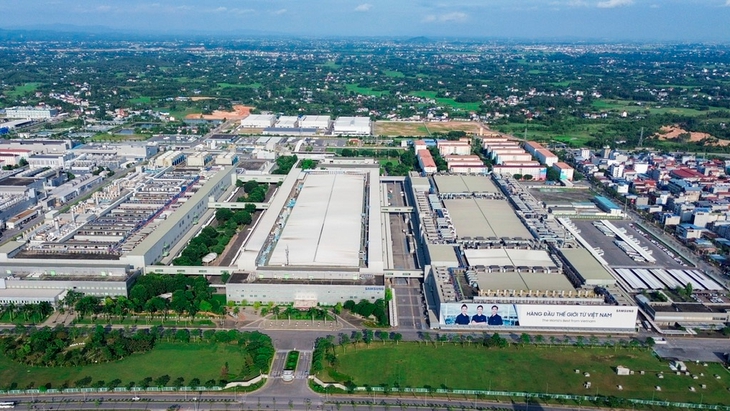
Clean electricity transactions spanning 1,800 km are operational for the first time, creating a turning point for the competitive electricity market and emission reduction goals.
For the first time, a manufacturing enterprise purchased electricity directly from a supplier nearly 1,800 km away. The first direct power purchase agreement is expected to open many opportunities for businesses to buy clean electricity without going through the Vietnam Electricity Group.
In an exchange, Nguyen Quoc Trung – Deputy General Director of the National Power System and Electricity Market Operation Company Limited (NSMO) – stated that Samsung Thai Nguyen signing a direct power purchase agreement (DPPA) with the TTC Duc Hue 2 Solar Power Plant in Tay Ninh is very significant.
Trung said: This is not only the first DPPA transaction to be put into actual operation through the national grid, but also shows that the direct power purchase mechanism has moved from the policy building phase to the actual commercial implementation phase.
Strict requirements for participating in DPPA
* Sir, why has the DPPA mechanism been issued for a long time but only now has the first contract been signed?
– DPPA is a new mechanism, complex because it simultaneously involves legal issues, contracts, power system operation, electricity market, metering, payment, invoices – taxes, and price risk management. With this mechanism, parties can buy and sell electricity directly through a private connection grid or the national grid.
Therefore, to have an operational DPPA transaction, parties not only need to sign a bilateral commercial contract but also must meet many conditions. For example, the power plant needs to meet the conditions to participate in the electricity market. The electricity metering system, supervisory control and data acquisition (SCADA) system, operational data, and payment system need to be ready.
The electricity user is a large customer. Both the seller and buyer also need to agree on pricing mechanisms, output, handling discrepancies, market price fluctuation risks, and payment obligations. The biggest difficulty is that DPPA via the national grid is not a “physical electricity transmission” model from the plant to the customer, but a market transaction model combining financial/forward contracts between the buyer and seller.
Therefore, parties need a clear understanding of the market as well as regulations on invoices, taxes, and green electricity certificates. This is why the preparation process takes a long time.
* So, to meet these conditions, how does NSMO evaluate and verify to ensure technical and system safety?
– NSMO will check the technical conditions for participating in the electricity market and DPPA based on documents, records, and data provided by the unit. At the same time, it will announce the official operational date of the DPPA mechanism when the required conditions are met.
For example, in the case of TTC Duc Hue 2 – Samsung Thai Nguyen, published information shows that NSMO inspected and verified the documents and conditions for participating in the electricity market/DPPA before announcing the plant’s official participation in the electricity market and DPPA operation from June 1st.
I note that the technical requirements are not a “special priority” for DPPA, but full compliance with regulations on electricity market operation. Such as metering, SCADA, forecasting, availability, information disclosure, dispatching, and