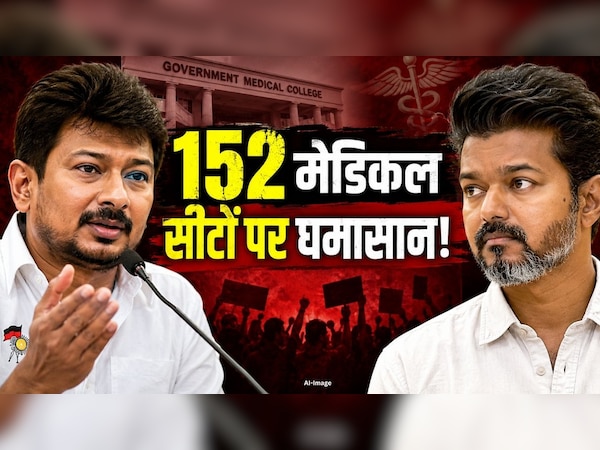
After taking power in Tamil Nadu, Chief Minister C. Joseph Vijay has swung into action mode, approving major decisions one after another. Meanwhile, Leader of the Opposition in the Legislative Assembly, Udhayanidhi Stalin, has written to Chief Minister Vijay demanding that the state’s 152 vacant super-specialty medical seats be prevented from being sent to the All India Quota.
On Thursday (June 4), Leader of the Opposition Udhayanidhi Stalin said in his letter to CM Vijay that following the Supreme Court order on May 29, there is a situation where 152 vacant medical quota seats could be transferred to the All India Quota. He alleges that during the court hearing, the state government did not effectively present its side, leading to this decision. The case was related to a petition by a candidate named Tamilvani.
152 seats remained vacant even after counseling
Stalin mentioned the counseling process, stating that based on the 2025 NEET exam, an admission process was conducted for a total of 430 super-specialty seats in Tamil Nadu. Of these, 215 seats were reserved for doctors working in government service. However, only 63 seats were filled through counseling, and even after the completion of the second phase, 152 seats remained vacant.
Why is there a dispute over these 152 medical seats?
In the letter, he also reminded CM Vijay that during the hearings on April 8, 10, and 16, the then DMK government presented arguments before the court that prevented these seats from going to the All India Quota. Stalin stated in the letter that the lawyer representing the central government told the court that a decision on reducing the qualifying percentile would be made later. He said that if the eligibility criteria are relaxed later and these seats are filled based on the All India merit list, it will directly affect government doctors in Tamil Nadu.
Reminded of Karunanidhi’s reservation system
According to Stalin, this is not just a matter of doctors’ interests but is also linked to the state’s public health system. This could affect the quality of treatment for heart disease, cancer, neurological disorders, and other complex diseases in government hospitals. Stalin also said in his letter that in the year 2000, during the tenure of the late former Chief Minister M. Karunanidhi, a reservation system for super-specialty courses was introduced for doctors working in government service.
If the state government had strongly presented its case…
Later, in 2022, the DMK government strengthened this system again. This policy allowed a large number of government doctors to pursue higher medical education and deliver advanced healthcare services to rural areas. He expressed concern that this system, achieved through years of struggle and effort, is now under threat. Stalin said that if the state government had strongly presented its case in the Supreme Court, this situation might not have arisen.