The first online departure tax refund store in China has officially launched in Beijing, and the first batch of hotel-based centralized departure tax refund points have also been activated.
The online departure tax refund store was developed by the Beijing Municipal Tax Service, the Beijing Municipal Commerce Bureau, and other departments in collaboration with JD.com through the JD app. International travelers can browse products marked with a “Departure Tax Refund” label on the JD app. When placing an order, they enter their ID number and date of entry online, and the system automatically generates an electronic tax refund application. This model removes geographical, scenario, and time constraints on tax refund shopping, allowing international travelers to purchase eligible items anytime via their mobile phones while in China. Tax refund documents are generated automatically online, greatly simplifying the process and significantly improving the shopping experience.
A representative from JD.com’s departure tax refund business noted that the online store currently offers over 300 types of tax-refundable products across six major categories, including mobile phones, digital products, computer office equipment, and home appliances. These cover well-known international brands and popular domestic products, meeting diverse shopping needs. On the JD app, all tax-refundable items are clearly marked with a “Departure Tax Refund” label, making it easy for international travelers to identify and order them.
“Going forward, the platform will continue to expand its tax-refund product range, focusing on adding high-quality domestic goods such as time-honored Chinese brands, Chinese-made tech products, and intangible cultural heritage creative items. Leveraging the traffic advantages of e-commerce, we aim to let international travelers ‘shop for all of China’s great products’ online,” the representative said.
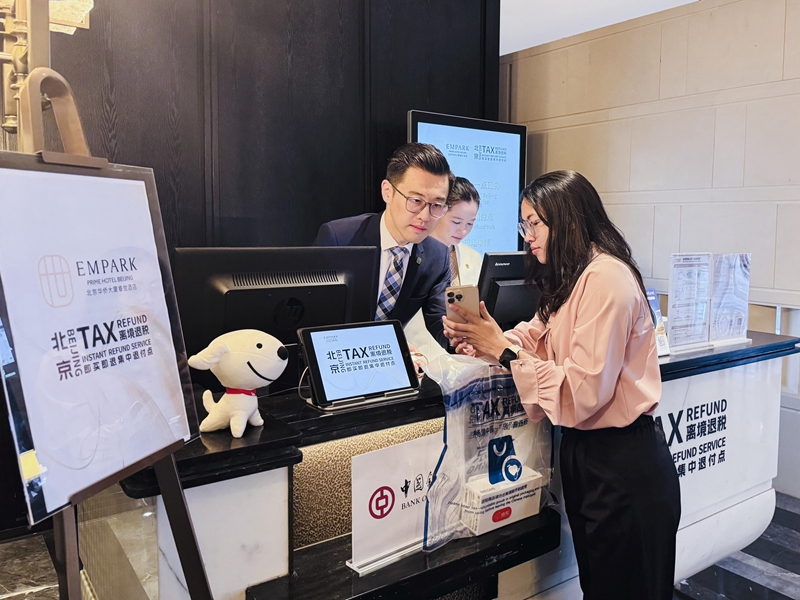
At the same time, Beijing’s first batch of hotel-based centralized departure tax refund points has been launched. The Beijing Prime Hotel and JW Marriott Hotel Beijing are among the first hotels to offer this service, as they are frequent choices for international travelers. After shopping at any tax-refund store in the city, travelers can present their “Departure Tax Refund Application Form” at the hotel’s centralized refund point to receive their tax refund on the spot, with the refund amount credited in real time.
Currently, Beijing has over 1,800 departure tax refund stores. Since the beginning of this year, more than 43,000 international travelers from 163 countries and regions have used the departure tax refund service. The number of tax refund application forms issued has increased by 569% year-on-year, the sales volume of tax-refundable goods has grown by 45% year-on-year, and the amount of tax refunds processed has risen by 51% year-on-year.
A representative from the Beijing Municipal Commerce Bureau explained that Beijing is currently working to promote the construction of an international consumption environment. The bureau has issued a notice on applying for international consumption environment construction projects. This includes supporting shopping districts, streets, malls, scenic spots, sports venues, and transportation hubs to improve services such as departure tax refunds, multilingual signage, and foreign card payments, with a maximum reward of 3 million yuan. Tax-refund enterprises that expand their sales of tax-refundable goods can receive up to 1 million yuan per quarter, with an annual maximum of 4 million yuan. Additionally, subsidies of up to 50% of the investment amount are available for intelligent equipment like self-service tax refund application and verification machines.
“Going forward, the Beijing Municipal Commerce Bureau will leverage policy funds and work with tax authorities to extend departure tax refund stores from key shopping districts to diverse locations such as specialty streets, cultural venues, and parks. By the end of 2027, the city aims to double the number of departure tax refund stores, have over 100 ‘buy and refund immediately’ stores, and establish over 30 centralized refund points,” the bureau representative said.