
“Metro+” Creates Vibrant Urban Micro-Centers
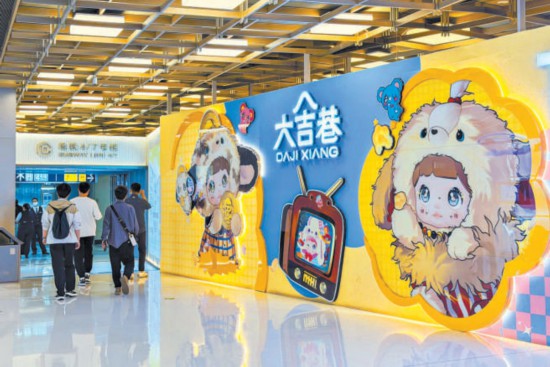
The Daji Alley and Caishikou metro station connection entrance.
Taking Metro Line 4 or Line 7 to Caishikou station, passengers can go through an underground passage without exiting to the surface and directly enter the newly popular commercial area—Zhonghai Daji Alley. At Life Science Park station on the Changping Line, a “sky corridor” has been built to connect with the Changping Super He Sheng Hui shopping center, reducing detours for residents and alleviating road traffic congestion.
In recent years, Beijing has adhered to the concept of “station-city integration” and followed the principle of “connecting wherever possible,” vigorously promoting interconnection between rail transit and surrounding properties. According to the Municipal Transportation Commission, as of now, Beijing’s urban rail transit has achieved 173 interconnections between 27 metro lines, 98 rail transit stations, and 127 surrounding property projects, covering various property types such as shopping centers, office buildings, and residential communities.
Metro stations are no longer just places where passengers pass through quickly; they are becoming vibrant urban micro-centers.
Direct Metro Connections Activate Commercial Vitality
At Caishikou station’s Exit C, where there used to be a “wall,” there is now an underground passage leading to the basement level of the Daji Alley commercial area.
“The station had reserved conditions for connection with the commercial area, with a reserved interface 4 meters wide and 3.2 meters high. During the renovation, we built a 7-meter-long passage to connect the metro station with the commercial reserved space,” introduced Shao Guoxin, the project leader from Beijing Urban Construction Design and Development Group. To handle sudden large passenger flows, a buffer zone was designed during the renovation, a space similar to a foyer that can be temporarily used for crowd management.
“Since the Daji Alley project opened, the dual metro underground connection has become the primary passenger entrance,” said Fu Xiang, deputy general manager of Zhonghai Daji Alley. Leveraging the seamless connection with the metro, the project has activated the morning business vitality of street-front and underground shops, boosting commercial popularity and operational efficiency.
More and more direct metro connections are gathering popularity for commercial areas.
Exiting Life Science Park station’s Exit A on the Changping Line, passengers can walk through a 130-meter-long, 18-meter-wide sky corridor to directly enter the Super He Sheng Hui shopping mall from this elevated station.
“In the past, exiting Exit A led to the Beiqing Road service road. To reach Super He Sheng Hui, you had to cross green spaces and parking lots, taking a detour through city roads to the mall, which took at least 5 to 10 minutes. With this sky corridor, you can enter the mall in just two minutes,” explained Li Xin, the project development leader for Super He Sheng Hui. This corridor directly connects to the commercial complex’s transportation transfer area—the Four Seasons Hall—allowing customers to quickly access the central dome landscape area, the western section of He Sheng Hui, and the adjacent office buildings.
“Since Super He Sheng Hui opened, the weekend average daily passenger flow at Life Science Park station has exceeded that of weekdays, reaching over 50,000 passengers, an increase of more than 20,000 compared to before the opening. The corridor connecting to the mall sees over 20,000 users daily,” reported Cao Yu, deputy station chief of the Xi’erqi station area on the Beijing Metro Changping Line.
Forming an “Metro-Residential-Office” Underground Closed Loop
Metro stations are not only connecting underground spaces but also increasingly linking residential buildings and office towers.
At Exit A of Cuigezhuang station on Line 15, taking the escalator up leads to a small sunken plaza. Through a passage here, passengers can directly enter the underground of the Wangjing International Talent Apartment and the west side of Alibaba’s Beijing headquarters building. From exiting the ticket gate to entering the building’s underground area takes about three minutes.
“The underground connection passage is about 20 meters long and 7.7 meters wide, forming an ‘metro-residential-office’ underground