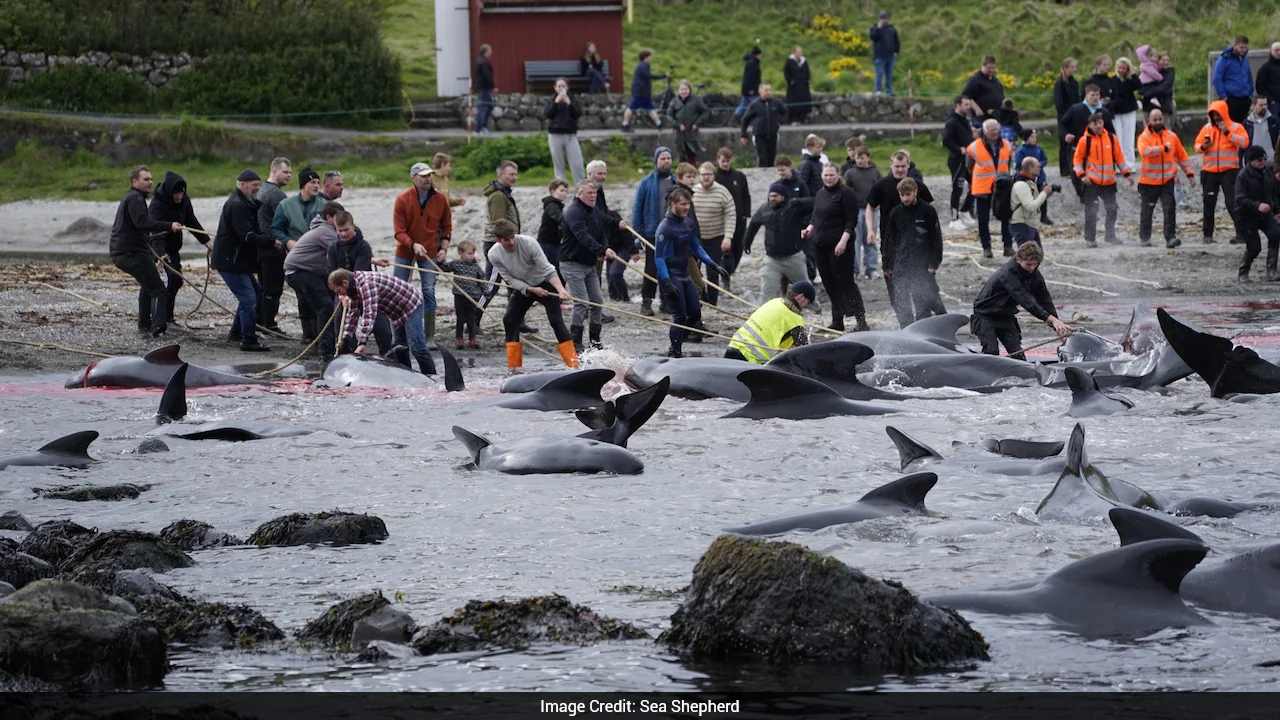
Over 700 whales and dolphins were slaughtered in a barbaric Viking-era hunt on the Faroe Islands.
Over 700 whales and dolphins were slaughtered in the Faroe Islands’ annual grindadrap tradition.
More than 700 whales and dolphins were killed near the Faroe Islands during the annual tradition called the grindadrap or grind, turning the sea crimson red. The locals used hooks and knives to herd and beach the Atlantic white-sided dolphins and long-finned pilot whales into shallow bays. Spectators, including children, watched from the shoreline as the animals were horrifically slaughtered and their bodies slashed open. Afterwards, the carcasses were piled together, hauled off, and carved up for distribution.
According to a global environmental activist NGO, the killings took place across three hunts on Wednesday (May 27), just 200 miles north of Scotland. 402 pilot whales and four bottlenose dolphins were killed in Torshavn, 168 white-sided dolphins were killed in Skalabotnur, and 132 white-sided dolphins were killed in Hvalvik, taking the total to 706.
Reports indicate that it took hunters a long time to kill the animals, which extended the period during which the stranded animals suffered in pain and distress.
“The scale of the killings is without precedent, surpassing two-thirds of all marine mammals killed on the islands in the entire previous year,” the NGO stated.
“The hunts descended into chaos as whalers admitted there was a shortage of spinal lances, which are mandatory for killing dolphins. Multiple marine mammals were instead killed using knives, only leaving the animals stressed for an extended period before bleeding to death.”
Valentina Crast, campaign director for the Faroe Islands at Sea Shepherd, said ‘nobody can ever justify’ the level of intense suffering that was inflicted on the innocent animals. She urged governments across Europe to ban the annual massacre.
“Dolphins were killed without the mandatory equipment. Animals were crushed against rocks and struck by boat propellers. And when a third, secret grind began, one deliberately hidden from public channels, marine conservationists were arrested for documenting it,” said Crast.
Viking-Era Tradition
Framed by supporters as a 1,000-year-old Viking-era tradition, the mass slaughter of whales has sparked fierce backlash from animal rights activists, who consider it a barbaric and outdated practice unnecessary for modern survival. However, the Faroese state, an autonomous territory of Denmark, defends the tradition, stating it is a vital cultural practice that provides food for the community.
According to reports, a day before the mass killings, the Faroese Parliament on May 26 chose to rewrite the Animal Welfare Act to exclude hunted dolphins from its protection.
“Removing an activity from the protection of the law does not make it humane,” said Mark Simmonds, Director of Science for OceanCare. “What the Faroese Parliament has done is not a defense of tradition, it is a deliberate choice to place these animals outside the reach of legal protection, hours before a very large hunt takes place in the capital of the islands.”
Faroe Islands
The Faroe Islands are a self-governing archipelago within the Kingdom of Denmark, located in the North Atlantic Ocean. Settled by Norse Vikings in the 9th century, they have a rich history of Norse and Celtic influence, with a distinct language and culture. Today, they are known for their dramatic landscapes, traditional grass-roofed houses, and a strong fishing economy.
Torshavn
Tórshavn is the capital and largest city of the Faroe Islands, located on the island of Streymoy. Founded in the 10th century as a Viking settlement, it has served as the nation’s political and commercial hub for over a thousand years, with its historic old town featuring grass-roofed houses and a 13th-century cathedral. Today, it blends traditional Faroese culture with modern amenities, making it a unique gateway to the North Atlantic archipelago.
Skalabotnur
Skalabotnur is a small village located on the island of Streymoy in the Faroe Islands, known for its picturesque setting at the head of a fjord. Historically, it served as a key trading post during the 19th century, playing a role in the region’s economic development through its harbor and connections to Danish merchants. Today, it remains a quiet settlement, valued for its natural beauty and traditional Faroese architecture.
Hvalvik
Hvalvík is a small village located on the island of Streymoy in the Faroe Islands, known for its picturesque setting along a bay. Historically, it has been a settlement for centuries, with its name deriving from the Faroese words for “whale” and “bay,” reflecting the area’s traditional connection to whaling. Today, it is a quiet community with a beautiful church and a popular turf-roofed bridge, attracting visitors interested in Faroese culture and nature.
Scotland
Scotland is a country that forms part of the United Kingdom, known for its rich history, rugged highlands, and cultural traditions like bagpipes and kilts. Its history includes ancient Celtic roots, the Wars of Scottish Independence led by figures like William Wallace, and the 1707 union with England. Today, Scotland is celebrated for its historic cities like Edinburgh and Glasgow, as well as its iconic landmarks such as Edinburgh Castle and Loch Ness.
Denmark
Denmark is a Scandinavian country with a rich Viking history, having been unified as a kingdom around the 10th century. It is known for its medieval castles, such as Kronborg, and its modern cultural contributions, including the design principles of hygge and the legacy of fairy-tale author Hans Christian Andersen. Today, Denmark is a constitutional monarchy with a strong welfare state and a capital, Copenhagen, that blends historic architecture with contemporary innovation.
Faroese Parliament
The Faroese Parliament, known as the Løgting, is one of the world’s oldest surviving parliaments, with roots tracing back to the Viking Age around the 9th or 10th century. Originally an assembly of free men that met at Tinganes in Tórshavn, it evolved into a legislative body under Norwegian and later Danish rule. After a period of dissolution, the Løgting was reestablished in 1852 and now serves as the modern parliament of the Faroe Islands, an autonomous territory of Denmark.
Viking
The term “Viking” refers to Norse seafarers from Scandinavia who, between the late 8th and early 11th centuries, raided, traded, and settled across Europe, the North Atlantic, and beyond. This period, known as the Viking Age, began with the infamous raid on the monastery at Lindisfarne in 793 AD and saw the establishment of key settlements in places like Iceland, Greenland, and parts of England and Ireland. Today, Vikings are remembered for their shipbuilding, exploration, and cultural impact, with sites like the Viking Ship Museum in Oslo and the Lofotr Viking Museum in Norway preserving their history.