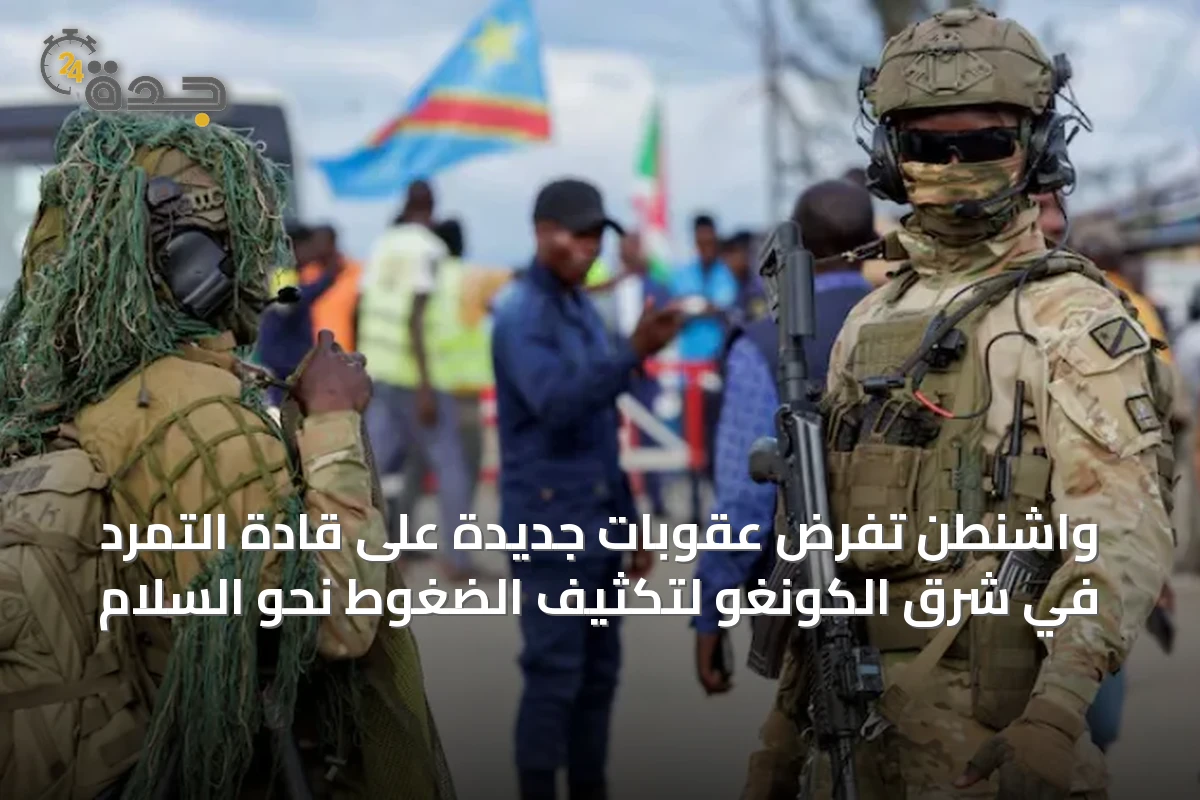
The United States announced new sanctions targeting leaders of rebel groups in eastern Democratic Republic of Congo, a move coinciding with a decline in the Washington-backed peace process over the past year, a worsening Ebola outbreak, and escalating fighting.
Sanctions goal and expert assessment
An expert on African affairs described these sanctions as aimed at “containing the ongoing threats from the March 23 Movement and the Rwandan Liberation Forces, which are at the heart of the conflict in Congo.” He explained that sanctions alone would not be sufficient to achieve understanding but would form part of a set of pressure tools that must continue to seek a lasting peaceful solution.
Military context in eastern Congo
The Democratic Republic of Congo has experienced violent armed rebellion for years, with the national army facing a coalition consisting of the March 23 Movement and the Alliance of Democratic Forces. The March 23 Movement seeks to expand its influence and control over governance, controlling areas adjacent to the Rwandan border, and is alleged to have ties to Kigali’s support. Meanwhile, the Alliance of Democratic Forces operates near the Congo-Uganda border and is linked to the Islamic State group.
Targeted individuals and measures taken
The U.S. State Department on Tuesday evening imposed sanctions on Gustave Kobwayo, an intelligence leader in the Democratic Forces for the Liberation of Rwanda, and John Imani Nzize, the head of intelligence for the Rwandan-backed March 23 Movement. This came in a statement accusing them of committing acts of violence, killings, gross human rights violations, and attacks targeting civilians in eastern Congo and Rwanda.
On April 30, the U.S. Treasury Department announced sanctions targeting former Congolese President Joseph Kabila for his involvement in supporting the March 23 Movement.
Peace process developments and international efforts
The peace process failed to achieve a comprehensive agreement despite negotiation rounds in 2025. U.S. President Donald Trump, Rwandan President Paul Kagame, and Congolese President Felix Tshisekedi signed an agreement in Washington at the end of last year to enhance peace opportunities and economic cooperation.
This was followed by a series of understandings reached in June 2025, in addition to the Doha framework for a comprehensive peace agreement, signed by Kinshasa and the March 23 Movement on November 15 in Qatar, completing an agreement signed on July 19 of the same year. Talks in 2026, the latest in April in Switzerland, did not yield tangible progress.
Analysis of political and economic impact of sanctions
Chadian political analyst Saleh Ishaq Issa indicated that sanctions represent an important political and economic pressure tool, targeting leaders accused of fueling or supporting the conflict, and sending a message that the international community monitors violations and holds those responsible directly accountable.
According to Issa, these measures may help restrict the movement of some armed actors, limit their funding sources, and raise the cost of continuing fighting. However, the effectiveness of sanctions in ending the conflict remains limited if not accompanied by a comprehensive political and security path. He explained that the conflict in eastern Congo is linked to complex ethnic, security, and regional entanglements, along with competition over natural resources, weak state institutions, and the spread of armed groups. Therefore, sanctions may push parties toward negotiation or reduce the pace of escalation, but they alone are not enough to establish lasting peace.
Health developments and airport reopening
Concurrent with ongoing clashes, Congo faces a severe health crisis due to the Ebola outbreak in the eastern Ituri province. The Congolese government announced on Tuesday the reopening of the main airport in the province after a ten-day closure for public safety reasons.
Stalled peace efforts and reactions
Peace attempts have not recorded any notable progress in recent weeks, despite the Congolese army and a rebel official announcing the withdrawal of the March 23 coalition from several key positions in South Kivu province toward areas adjacent to the Rwandan border, according to reports on May 13.
Regarding the rebels’ reaction to the sanctions, the African expert stated there are three possible scenarios: escalation of violence, showing indifference to the sanctions, or demonstrating political flexibility if they sense the sanctions are part of integrated international and regional pressure. Reality may combine these scenarios, with ongoing tensions and limited clashes while negotiation channels remain open.
The expert concluded that sanctions will not lead to immediate calm, and a limited wave of escalation in the coming months cannot