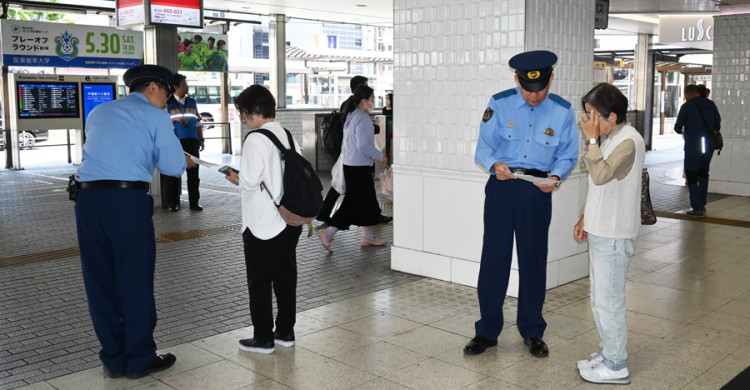
In the city of Hiratsuka, 16 years have passed since the robbery and murder of a taxi driver, whose cash proceeds were stolen. On the 20th, in front of JR Hiratsuka Station, officers from the special investigation headquarters set up at the Hiratsuka Police Station distributed about 500 flyers, calling for information to help solve the case.
The incident occurred on May 20, 2010. Under the Tōkaidō Shinkansen viaduct in Yokouchi, Hiratsuka, a taxi with its driver’s seat area burned was found, and the driver’s body, a man aged 62 at the time, was discovered in the trunk.
JR Hiratsuka Station
JR Hiratsuka Station, located in Kanagawa Prefecture, Japan, opened in 1887 as a stop on the Tokaido Main Line. It has since developed into a major commuter hub, serving the city of Hiratsuka and connecting it to Tokyo and other urban centers. The station’s surrounding area combines historic elements, such as its proximity to the ancient Tokaido road, with modern commercial facilities.
Tōkaidō Shinkansen viaduct
The Tōkaidō Shinkansen viaduct is a key elevated structure supporting Japan’s first high-speed rail line, the Tōkaidō Shinkansen, which began operations in 1964. This viaduct carries bullet trains between Tokyo and Osaka, significantly reducing travel time and revolutionizing Japanese transportation. Its construction was a major engineering achievement, reflecting Japan’s post-war economic growth and technological innovation.
JR Hiratsuka Station
JR Hiratsuka Station is a railway station on the Tokaido Main Line in Hiratsuka, Kanagawa Prefecture, Japan. It opened in 1887, initially serving as a stop on the newly built railway connecting Tokyo and Yokohama, and played a key role in the area’s development as a commuter hub. Today, it remains a vital transportation center, offering access to local attractions like the Tanabata Festival and nearby beaches.
Tōkaidō Shinkansen viaduct
The Tōkaidō Shinkansen viaduct is a key infrastructure component of Japan’s first high-speed rail line, the Tōkaidō Shinkansen, which began operations in 1964. This elevated structure carries the famous « bullet train » between Tokyo and Osaka along the historic Tōkaidō route, a major travel corridor since the Edo period. Its construction marked a revolutionary shift in Japanese transportation, enabling rapid transit over long distances while preserving valuable land below for other uses.
Tokaido Main Line
The Tokaido Main Line is a historic railway line in Japan connecting Tokyo and Kobe, first opened in 1889. It played a crucial role in Japan’s modernization, linking the capital with major cities like Yokohama, Nagoya, Kyoto, and Osaka. Today, it remains a vital transportation artery, with parts of its route paralleled by the famous Shinkansen high-speed rail.
ancient Tokaido road
The ancient Tokaido road was a major coastal route in Japan during the Edo period (1603–1868), connecting Edo (modern Tokyo) to Kyoto. It spanned approximately 500 kilometers and featured 53 post stations where travelers could rest, trade, and exchange horses. This historic road played a crucial role in Japan’s cultural and economic development, and its legacy is preserved today in sites like the Tokaido Hiroshige Museum.
Hiratsuka Police Station
The Hiratsuka Police Station is a local law enforcement facility located in Hiratsuka, Kanagawa Prefecture, Japan. Its history is tied to the development of the city, which grew as a post town on the old Tokaido road during the Edo period. Today, it serves as a key public safety hub for the community, overseeing crime prevention and emergency response in the area.