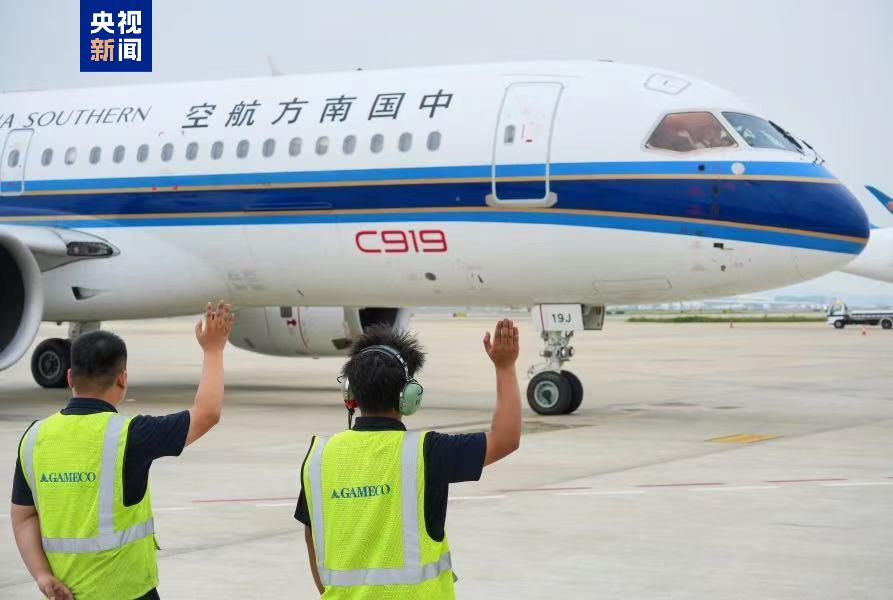
The C919 aircraft operated by China Southern Airlines completed its first major maintenance check and has since officially resumed commercial service.
China Southern Airlines announced that on May 29, its first domestically produced C919 large aircraft successfully completed its first deep scheduled maintenance (referred to as “C-check”) and was officially put into operation on its first commercial flight, taking off from Guangzhou Baiyun International Airport as flight CZ3237.
This was the first C-check for China Southern’s C919 since it entered service, serving as a major assessment of the aircraft’s long-term operational condition. The C-check involved nearly 6,000 man-hours, with up to 60 maintenance personnel working simultaneously. During the inspection, the C919 completed nearly 700 work cards and 28 engineering modification instructions. All aircraft parameters met standards, and the aircraft was put into operation in optimal condition.
Since its maiden flight in September 2024, China Southern’s C919 fleet has grown to 10 aircraft, operating over 10,700 flights and carrying a total of 1.455 million passengers. The aircraft currently operates regular commercial routes from Guangzhou to Nanjing, Ningbo, Wenzhou, Hefei, Wuhan, Beijing Daxing, Xi’an, and other destinations.
Guangzhou Baiyun International Airport
Guangzhou Baiyun International Airport, located in Baiyun District, Guangzhou, is one of China’s busiest aviation hubs. Originally opened in 2004, it replaced the old Baiyun Airport, which had served the city since 1932. The airport is named after the nearby Baiyun Mountain and plays a key role in connecting southern China to domestic and international destinations.
Nanjing
Nanjing, the capital of China’s Jiangsu province, is a historic city that served as the imperial capital for several dynasties, including the Ming Dynasty’s early years. It is renowned for its rich cultural heritage, featuring landmarks like the Ming Xiaoling Mausoleum and the Sun Yat-sen Mausoleum, as well as its poignant role as the site of the Nanjing Massacre during the Second Sino-Japanese War. Today, Nanjing blends ancient history with modern development.
</
Guangzhou Baiyun International Airport
Guangzhou Baiyun International Airport, located in Guangzhou, China, is one of the busiest aviation hubs in the world. Originally opened in 2004 to replace the old Baiyun Airport, it was built to accommodate the rapid growth of the Pearl River Delta region. The airport’s name, meaning “White Cloud,” reflects its scenic location and its role as a key gateway for both domestic and international travel.
Nanjing
Nanjing, located on the Yangtze River in eastern China, served as the capital of several Chinese dynasties, including the Ming Dynasty, and was the capital of the Republic of China. The city is renowned for its rich cultural heritage, featuring landmarks such as the Ming Xiaoling Mausoleum, the Confucius Temple, and the Nanjing City Wall. It also holds a poignant place in modern history as the site of the Nanjing Massacre during the Second Sino-Japanese War.
Ming Xiaoling Mausoleum
The Ming Xiaoling Mausoleum is the burial site of the Hongwu Emperor, the founder of the Ming Dynasty, and is located at the southern foot of Purple Mountain in Nanjing, China. Construction began in 1381 and was completed in 1405, showcasing grand imperial architecture and a sacred path lined with stone statues. It is a UNESCO World Heritage site and serves as a key example of Ming Dynasty funerary architecture.
Sun Yat-sen Mausoleum
The Sun Yat-sen Mausoleum, located in the eastern suburbs of Nanjing, China, is the monumental resting place of Dr. Sun Yat-sen, a pivotal revolutionary leader often called the “Father of Modern China.” Construction began in 1926 and was completed in 1929, with his remains being interred there following a grand state funeral. The site’s design blends traditional Chinese imperial architecture with modern elements, featuring a long, tree-lined walkway and a blue-tiled memorial hall set atop a hill.
Baiyun Mountain
Baiyun Mountain, also known as White Cloud Mountain, is a famous scenic area located in Guangzhou, China. Its name derives from the frequent white clouds that shroud its peaks, and it has been a revered site for Taoist hermits and poets since the Qin and Han dynasties. Today, it is a popular urban park offering hiking trails, temples, and panoramic views of the city.