Eastern Visayas and two Bicol provinces brace for rain as a storm moves over the Philippine Sea.
Filtered by: Weather
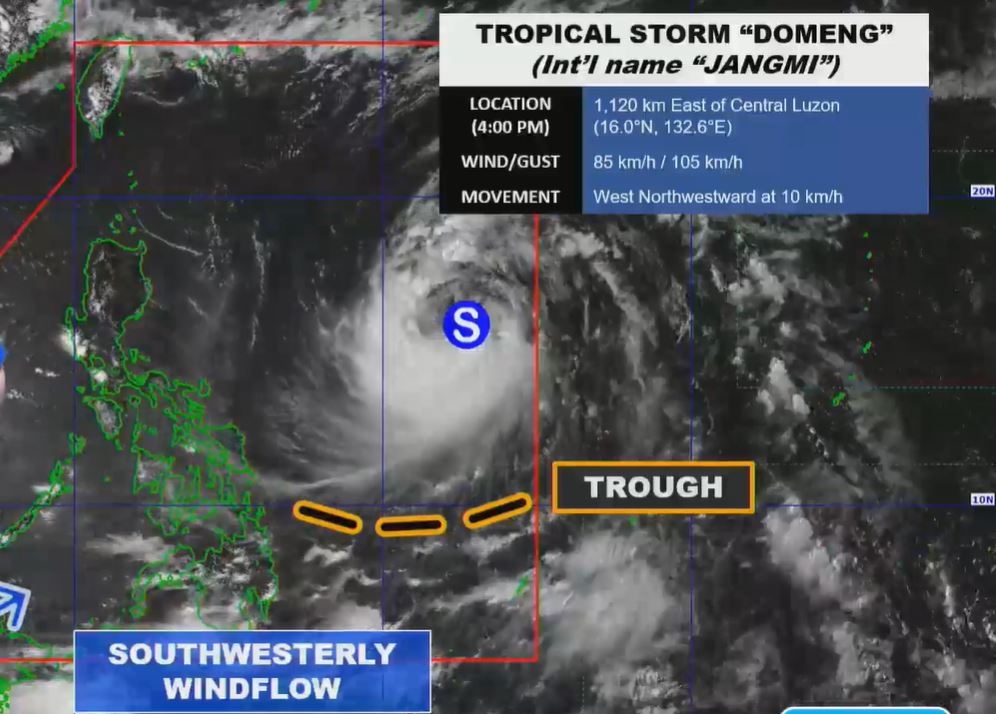
Residents in Eastern Visayas and parts of the Bicol Region may experience scattered rains and thunderstorms due to the trough of Tropical Storm Domeng, while several areas in Western Visayas, Mindanao, and Palawan remain under the influence of the southwest monsoon, the weather bureau said Friday.
In its 4 p.m. weather bulletin, the state weather bureau said Eastern Visayas, Sorsogon, and Masbate will have cloudy skies with scattered rains and thunderstorms caused by the trough of Tropical Storm Domeng (international name: Jangmi).
The weather bureau warned that moderate to at times heavy rains in these areas could trigger flash floods or landslides.
As of 3 p.m., the center of Domeng was estimated at 1,130 kilometers east of Central Luzon, packing maximum sustained winds of 85 kilometers per hour near the center and gusts of up to 105 kph. The storm was moving west northwestward at 10 kph.
Meanwhile, Western Visayas, the Negros Island Region, Zamboanga Peninsula, SOCCSKSARGEN, the Bangsamoro Autonomous Region in Muslim Mindanao (BARMM), Palawan, Occidental Mindoro, and Lanao del Norte will also experience cloudy skies with scattered rains and thunderstorms due to the southwesterly windflow.
The weather bureau likewise warned residents in these areas of possible flash floods or landslides during periods of moderate to heavy rainfall.
Metro Manila and the rest of the country, meanwhile, will have partly cloudy to cloudy skies with isolated rain showers or thunderstorms due to localized thunderstorms.
The weather bureau said severe thunderstorms could still bring flash floods or landslides in vulnerable areas.
For coastal waters, moderate seas with waves ranging from 1.2 to 2.5 meters are expected over the eastern section of Visayas. Slight to moderate seas, with wave heights of 0.6 to 1.8 meters, will prevail over the rest of the country.
The weather bureau advised the public, especially those in areas prone to flooding and landslides, to continue monitoring weather updates as Tropical Storm Domeng moves across the Philippine Sea.
Eastern Visayas
Eastern Visayas is a region in the Philippines composed of the islands of Leyte, Samar, and Biliran, known for its rich history and natural beauty. It played a pivotal role in World War II as the site of the historic Battle of Leyte Gulf in 1944, one of the largest naval battles in history, and General Douglas MacArthur’s famous return to the Philippines. Today, the region is celebrated for its stunning beaches, eco-tourism spots, and cultural heritage, including the San Juanico Bridge and the annual Pintados Festival.
Sorsogon
Sorsogon is a province in the Bicol Region of the Philippines, known for its stunning natural attractions like the whale shark interaction in Donsol and the majestic Bulusan Volcano. Historically, it was a key site for early Spanish colonization in the 16th century and later developed as a center for trade and agriculture. Today, it is celebrated for its eco-tourism, vibrant festivals, and the unique cultural blend of indigenous and colonial influences.
<div class="
Eastern Visayas
Eastern Visayas is a region in the Philippines composed of three main islands—Leyte, Samar, and Biliran—known for its rich history and natural beauty. It is famously the site of the 1944 Battle of Leyte Gulf, a pivotal World War II naval engagement, and General Douglas MacArthur’s historic return to the Philippines. The region also features cultural landmarks like the San Juanico Bridge and the centuries-old Santo Niño Church, reflecting its blend of colonial and indigenous heritage.
Bicol Region
The Bicol Region in the Philippines is known for its active volcanoes, particularly Mayon Volcano, and its rich cultural heritage. Historically, it was a key area for trade and Spanish colonization, with the city of Naga serving as an early missionary center. Today, it is famous for its spicy cuisine, unique festivals like the Penafrancia Fluvial Procession, and the resilient spirit of its people.
Western Visayas
Western Visayas is a region in the Philippines known for its rich cultural heritage and historical significance. It was a center of early Philippine civilization, with the island of Panay playing a key role in the arrival of Malay settlers and later serving as a stronghold for Filipino revolutionaries against Spanish colonial rule. Today, the region is famous for its vibrant festivals, such as the Ati-Atihan in Kalibo, and historic sites like the Miag-ao Church, a UNESCO World Heritage Site.
Negros Island Region
Negros Island Region is a newly established administrative region in the Philippines, created in 2024 by dividing the Western Visayas region. It comprises the island of Negros and its surrounding smaller islands, encompassing the provinces of Negros Occidental, Negros Oriental, and the highly urbanized city of Bacolod. Historically, the island was a major center for sugar production during the Spanish and American colonial periods, which shaped its economy, culture, and political identity.
Zamboanga Peninsula
The Zamboanga Peninsula is a region in the southwestern part of Mindanao, Philippines, known for its rich cultural blend of indigenous, Muslim, and Spanish influences. Historically, it served as a key trading hub and was heavily influenced by the Spanish colonial era, with the city of Zamboanga being fortified to protect against pirate raids. Today, the peninsula is famous for its vibrant Chavacano language, a Spanish-based creole, and its diverse attractions like pristine beaches and the historic Fort Pilar.
Palawan
Palawan, a province in the Philippines, is renowned for its stunning natural landscapes, including the Puerto Princesa Subterranean River National Park, a UNESCO World Heritage site. Historically, the region was inhabited by indigenous groups like the Tagbanwa and later became a key area for trade and settlement during the Spanish colonial era. Today, Palawan is celebrated for its biodiversity, pristine beaches, and role as an eco-tourism destination.
Occidental Mindoro
Occidental Mindoro is a province in the Philippines located on the western half of Mindoro Island, known for its diverse ecosystems and indigenous Mangyan heritage. Historically, it was part of the larger Mindoro province until it was split into two in 1950, and it played a significant role in early Spanish colonial trade routes. Today, it is celebrated for its natural attractions like the Apo Reef Natural Park and the beaches of Puerto Galera.
Lanao del Norte
Lanao del Norte is a province in the Northern Mindanao region of the Philippines, historically part of the larger Lanao region before its division in 1959. It is known for its rich cultural heritage, blending Islamic and indigenous traditions, and is home to the Maranao people. Key attractions include the stunning Maria Cristina Falls and the serene Lake Lanao, which hold both natural and historical significance.