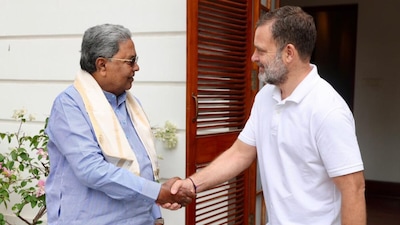
Congress leaders are aware that an abrupt sidelining of Siddaramaiah could alienate sections of OBC voters and destabilise Karnataka’s carefully assembled caste coalition
Even as the Congress prepares for a change, the party’s real challenge may lie elsewhere—how to retain a leader as a national political asset, while making space for DK Shivakumar in Bengaluru.
That balancing act appears to have been at the center of Rahul Gandhi’s recent closed-door meeting with Siddaramaiah in Delhi in a conversation that went far beyond a simple transition.
Sources said Gandhi’s message was blunt: Siddaramaiah should “look beyond Karnataka”. The Congress leadership sees the veteran leader not merely as a regional figure being eased out, but as one of the party’s most significant OBC faces ahead of the 2028 Karnataka assembly election and the 2029 Lok Sabha battle.
The pitch reportedly came with multiple assurances.
Gandhi is learned to have told Siddaramaiah that he would remain the Congress’s “tallest leader” from the backward classes and would be expected to champion the party’s OBC outreach nationally—an issue that has become central to Congress’s political strategy after the caste census debate gained traction.
The conversation also reportedly included hints of a larger role in Delhi, including renewed discussion around a possible Rajya Sabha route in the future. Such an arrangement would allow Congress to simultaneously execute a generational and factional reset in Karnataka while retaining Siddaramaiah’s political heft at the national level.
For now, Siddaramaiah has publicly indicated reluctance to immediately move to Delhi, with reports suggesting he wants to continue as an MLA and remain active in Karnataka politics.
WHY CONGRESS NEEDS SIDDARAMAIAH BEYOND BENGALURU
For Rahul Gandhi, the Karnataka transition is not simply about replacing one chief minister with another. It is about preventing the Congress from repeating mistakes that have hurt regional transitions in the past.
Siddaramaiah remains one of the few Congress leaders with an independent backward-class mass base, administrative credibility, and cross-regional appeal. His AHINDA social coalition—minorities, backward classes and Dalits—helped power Congress’s sweeping Karnataka victory in 2023 and remains politically relevant far beyond the state.
That becomes especially important as Rahul Gandhi increasingly frames national politics around caste representation, social justice, and OBC empowerment. The Congress’s aggressive push for caste census politics over the last two years has already reshaped opposition discourse nationally.
Within that framework, Siddaramaiah offers Congress something it lacks in many states: a proven OBC leader with governance credentials who can communicate social justice politics without appearing purely ideological.
Sources say Rahul Gandhi also conveyed that Siddaramaiah would continue to play a major role in Karnataka’s 2028 assembly election strategy even if he moved away from day-to-day state administration. The idea appears to be to separate electoral influence from administrative office; allowing Shivakumar to run the government while Siddaramaiah remains central to the party’s social coalition.
Congress leaders are aware that an abrupt sidelining of Siddaramaiah could alienate sections of OBC voters and destabilise Karnataka’s carefully assembled caste coalition. So, the solution appears to be a dual-track formula: Shivakumar in Karnataka, Siddaramaiah for the larger national social justice project.
Delhi
Karnataka
Bengaluru
Delhi
Rajya Sabha
Related news
May 28, 2026 News Flash
President’s address in Parliament, Sonia called it pitiable

Amidst the Tata Trust crisis, an important meeting – Noel Tata and N. Chandrasekaran met with Amit Shah.