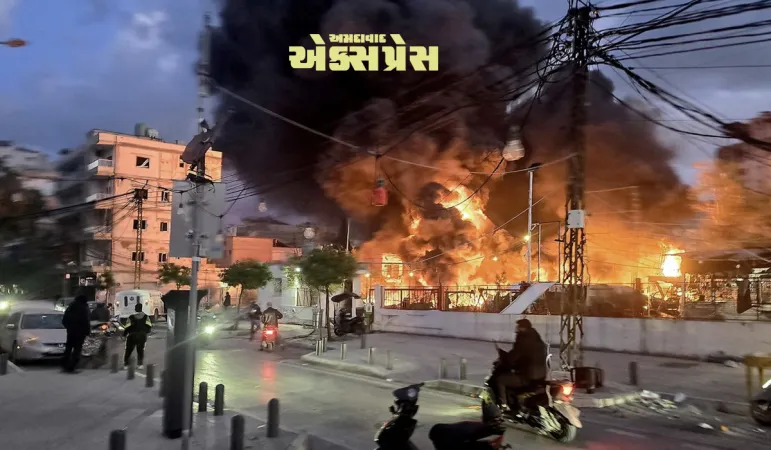
The Israeli army launched a major attack on 135 Hezbollah positions in Lebanon, destroying command centers and launch pads.
The Israeli army destroyed Hezbollah command centers and launch pads in Lebanon.
Israeli Army Launches Major Attack on 135 Hezbollah Positions in Lebanon
The Israeli army has launched a major attack on 135 Hezbollah positions in Lebanon. The air force carried out intense bombing over the past 24 hours amid rising tensions along the border. The military operation completely destroyed the terrorist group’s rocket launch pads and training centers. Israeli fighter jets are continuously carrying out deadly missions in border areas of the neighboring country. The administration has declared a high alert along the border to ensure civilian safety and intensified military activities.
Military Operations Intensify in Southern Lebanon and the Bekaa Valley
According to an official report, the Israel Defense Forces (IDF) issued an important statement on Telegram. According to this military report, the air force conducted large-scale operations in Tyre, the Bekaa Valley, and throughout southern Lebanon. The Israeli army launched a major attack on 135 Hezbollah positions in Lebanon, breaking the organization’s economic and military backbone. It was learned that approximately 10 launch stations that fired rockets at Israeli soldiers in the Bekaa area were destroyed in missile strikes. According to reports, a large training camp of militants located in the Brital area was also targeted. According to government sources, a militant cell was also eliminated in an operation carried out at midnight. The administration has described this operation as the most successful air strike campaign so far.
This incident comes at a time when important negotiations are underway to extend the ceasefire agreement between the two countries. Earlier, on May 15, the U.S. State Department officially announced extending the ceasefire for an additional 45 days. However, ongoing sabotage and attacks from across the border have put peace talks at risk. According to sources, violence on the border has not stopped even after the peace meeting held in Washington.
Ceasefire Violations and Heavy Bombing on the International Border
This intense air strike has had a widespread impact across Middle Eastern countries and at the global diplomatic level. The Israeli army launched a major attack on 135 Hezbollah positions in Lebanon, and the Foreign Ministry released statistics on the social media platform ‘X’. It is noteworthy that since the ceasefire agreement, 12 Israeli civilians and soldiers have been killed in Hezbollah attacks. Additionally, over 8,700 rockets and projectiles have been fired from across the border so far. The administration has made it clear that the Lebanese government has completely failed to stop terrorist activities. In particular, Israel has explicitly denied any territorial claims in the neighboring country, stating that these strong measures were taken solely for self-defense.
Security Talks at the Pentagon and Upcoming Military Strategy
In the coming days, diplomatic efforts will be intensified internationally to reduce this global tension. Although the Israeli army launched a major attack on 135 Hezbollah positions in Lebanon, a special ‘security track’ meeting is set to begin at the Pentagon starting May 29. The administration stated that high-level political negotiations between officials of both countries will continue on June 2 and 3.
The Israeli army launched a major attack on 135 Hezbollah positions in Lebanon and doubled military pressure on the border amid the U.S.-mediated ceasefire agreement. Will the high-level security meeting at the Pentagon in the coming days succeed in preventing a fierce war in the Middle East and establishing lasting peace?
Lebanon
Lebanon is a country in the Middle East with a rich history dating back thousands of years, home to ancient civilizations like the Phoenicians, who established powerful city-states such as Tyre and Byblos. It later became part of the Roman, Byzantine, and Ottoman empires, and gained independence from France in 1943. Today, Lebanon is known for its diverse cultural heritage, vibrant cities like Beirut, and historic sites such as the Baalbek temples.
Southern Lebanon
<div class="
Lebanon
Lebanon is a country in the Middle East known for its rich history, having been home to ancient civilizations such as the Phoenicians, Romans, and Ottomans. Its capital, Beirut, is a cultural hub with a vibrant mix of religious and ethnic communities, though the nation has faced periods of conflict, including a devastating civil war from 1975 to 1990. Today, Lebanon is celebrated for its archaeological sites like Baalbek and Byblos, as well as its diverse cuisine and resilient spirit.
Southern Lebanon
Southern Lebanon is a historically rich region known for its ancient Phoenician cities like Tyre and Sidon, which were major maritime and trade centers. It has been a crossroads of civilizations, influenced by Romans, Crusaders, and Ottomans, and is renowned for its archaeological sites, such as the Temple of Bacchus in Baalbek. In modern times, the area has been shaped by conflicts, including the Israeli occupation and the presence of Hezbollah, while remaining culturally vibrant with diverse religious communities.
Bekaa Valley
The Bekaa Valley is a fertile region in eastern Lebanon, historically known as a key agricultural hub and a crossroads of ancient civilizations, including the Romans and Phoenicians. It is home to the well-preserved Roman ruins of Baalbek, a UNESCO World Heritage site featuring massive temples dedicated to Jupiter, Bacchus, and Venus. Today, the valley remains important for farming, particularly wine and cannabis, though it has also faced challenges from political and military conflicts in the region.
Tyre
Tyre is an ancient Phoenician city located in modern-day Lebanon, renowned for its historical role as a major maritime and commercial power in the Mediterranean. Founded around 2750 BCE, it was famous for its production of purple dye and its extensive trade networks, and it later came under the rule of various empires, including the Assyrians, Babylonians, and Romans. Today, its archaeological ruins, including a Roman hippodrome and a triumphal arch, are a UNESCO World Heritage site.
Brital
Brital is a small village in the Beqaa Valley of Lebanon, known for its historical significance tied to the ancient city of Baalbek. It is home to the Brital Roman Temple, a well-preserved Roman-era temple dedicated to the god Mercury, which dates back to the 1st or 2nd century AD. The site reflects the region’s rich cultural heritage under Roman influence, though it remains less visited than the nearby UNESCO World Heritage site of Baalbek.
Washington
Washington, D.C., the capital of the United States, was established in 1790 as a compromise between northern and southern states, with the site chosen by George Washington. It is home to iconic landmarks such as the White House, the U.S. Capitol, and the Washington Monument, reflecting the nation’s political history and ideals. The city also hosts numerous museums and memorials, including the Smithsonian Institution, making it a global center for culture and history.
Pentagon
The Pentagon is the headquarters of the United States Department of Defense, located in Arlington, Virginia. Constructed during World War II and completed in 1943, it is one of the world’s largest office buildings by floor area and is renowned for its distinctive five-sided shape. It serves as a symbol of U.S. military power and was the site of the September 11, 2001 terrorist attack when American Airlines Flight 77 was hijacked and crashed into the building.
Middle East
The Middle East is a historically and culturally rich region spanning parts of Western Asia and North Africa, often considered the cradle of civilization. It is the birthplace of major religions including Judaism, Christianity, and Islam, and was home to ancient empires such as Mesopotamia, Persia, and the Ottoman Empire. Today, the region is known for its diverse cultures, significant oil reserves, and ongoing geopolitical complexities.