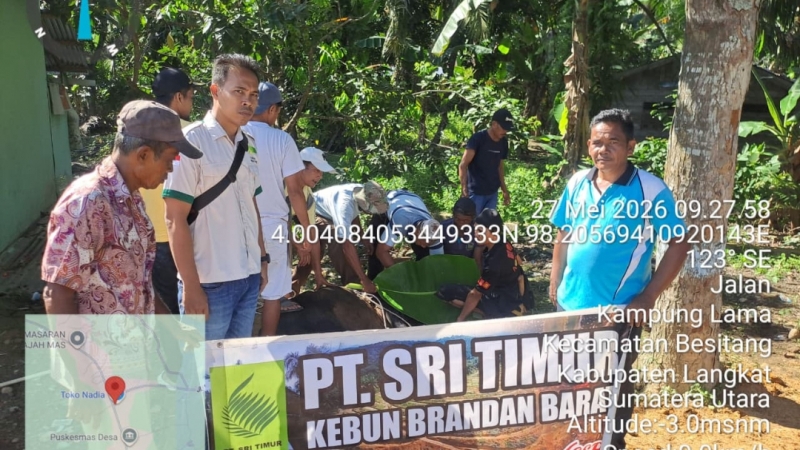
In celebration of Eid al-Adha 1447 H, PT Perusahaan Perkebunan dan Industri Sri Timur, also known as PT Sri Timur, and PT Mirabilis Tunggal Tualang (MTT) distributed a number of sacrificial animals to residents living around the company’s operational area. The handover of these sacrificial animals is part of the company’s corporate social responsibility (CSR) program.
The handover of the sacrificial animals was carried out in Sei Tualang Village, represented by the Estate Manager, Mulyadi Sigalingging. The slaughtering process was carried out cooperatively by the residents after receiving the sacrificial animals.
“The distribution of these sacrificial animals is a routine company activity during every Eid al-Adha. May these sacrificial animals provide benefits to the residents,” said Mulyadi Sigalingging.
Mulyadi added that the CSR program is an obligation of the company to be distributed to the community in accordance with existing regulations. PT Sri Timur and PT MTT themselves ensure their commitment to always fulfill this obligation. In addition to Sei Tualang Village, the distribution of sacrificial animals was also carried out in Lingkungan II, Kampung Lama, Besitang District, Langkat Regency.
“There are a total of around 270 beneficiary families for the sacrificial animals in the places where we distributed them. This is a manifestation of our presence to help meet the needs of the community,” he said.
Apart from the Eid al-Adha moment, the palm oil company also routinely carries out CSR distribution. These CSR aids include infrastructure development to support the economic mobility of residents.
Sei Tualang Village
Sei Tualang Village is a historic settlement in North Sumatra, Indonesia, known for its traditional Malay architecture and culture. The village is famous for its Rumah Adat Karo (traditional Karo houses) and the remnants of the Sultanate of Serdang’s influence, which dates back to the 17th century. Today, it serves as a cultural heritage site, preserving the area’s history and attracting visitors interested in its wooden stilt houses and local crafts.
Lingkungan II
Lingkungan II is a neighborhood or hamlet (dusun) within a village administrative system in Indonesia, commonly found in regions like North Sumatra. Its history often ties to local migration patterns, agricultural settlement, or the expansion of nearby towns. The area typically reflects a mix of traditional Batak or other indigenous cultural influences, with community life centered around family and local customs.
Kampung Lama
Kampung Lama, meaning “Old Village” in Indonesian and Malay, is a term often used to refer to historic, traditional settlements that predate modern urban development, particularly in cities like Jakarta. These areas typically feature narrow alleys, wooden houses on stilts, and a strong sense of community, reflecting the architecture and lifestyle of the colonial and pre-colonial eras. While many have been demolished for modernization, some surviving Kampung Lama serve as cultural heritage sites, preserving the history of early urban life and local traditions.
Besitang District
Besitang District is an administrative area located in Langkat Regency, North Sumatra, Indonesia, known for its strategic position near the border with Aceh. Historically, it developed as a
Sei Tualang Village
Sei Tualang Village, located in North Sumatra, Indonesia, is renowned as the center of the traditional songket weaving industry. Its history dates back to the 19th century when local weavers began producing intricate handwoven fabrics, which became a significant cultural symbol of the Malay community. Today, the village preserves this heritage, attracting visitors to witness the weaving process and purchase authentic songket textiles.
Rumah Adat Karo
Rumah Adat Karo is a traditional longhouse of the Karo people from North Sumatra, Indonesia, characterized by its distinctive elongated roof and elevated structure on stilts. Historically, these houses were built without nails, using wooden pegs and notches, and served as communal dwellings for multiple families under one roof, reflecting the region’s strong kinship and cultural values. Today, they are preserved as cultural heritage sites, offering insight into Karo architecture and social traditions.
Sultanate of Serdang
The Sultanate of Serdang was a Malay kingdom located in present-day North Sumatra, Indonesia, established in the 17th century after breaking away from the Sultanate of Deli. It played a significant role in regional trade and politics until its integration into the Dutch colonial administration in the late 19th century. The sultanate’s cultural legacy remains evident today through traditional ceremonies and the preservation of its royal heritage.
Lingkungan II
“Lingkungan II” refers to a neighborhood or community administrative unit (often called a *dusun* or hamlet) in Indonesia. Its specific history varies by location, as it is a common designation for the second sub-district within a village. Generally, such areas developed from traditional agrarian settlements and now serve as local hubs for community activities and governance under the broader *desa* (village) system.
Kampung Lama
Kampung Lama, which translates to “Old Village” in Indonesian and Malay, typically refers to historic, traditional settlements that predate modern urban development, often found in cities like Jakarta or Kuala Lumpur. These areas are characterized by their dense, community-oriented layouts, wooden stilt houses, and a strong sense of cultural heritage, with histories dating back to colonial eras or earlier. Despite facing pressures from modernization and redevelopment, Kampung Lama sites remain important cultural landmarks, preserving the traditional architecture, social structures, and local customs of their original inhabitants.
Besitang District
Besitang District is a region located in Langkat Regency, North Sumatra, Indonesia, historically known as a key transit point for travelers heading to and from the province of Aceh. Its development was significantly influenced by its role as a railway hub during the Dutch colonial era, connecting the area to major cities like Medan and Banda Aceh. Today, Besitang is recognized for its diverse cultural heritage and as a gateway to the nearby Gunung Leuser National Park.
Langkat Regency
Langkat Regency is a region in North Sumatra, Indonesia, known for its historical significance as a center of the Deli Sultanate’s influence and its rich oil palm and rubber plantations during the Dutch colonial era. The area is home to cultural landmarks such as the Istana Darul Aman (the Sultan’s palace) and the Bukit Lawang ecotourism site, which serves as a gateway to the Gunung Leuser National Park. Its history blends Malay royal heritage, colonial economic development, and natural conservation efforts.