Escalation of raids in southern Lebanon
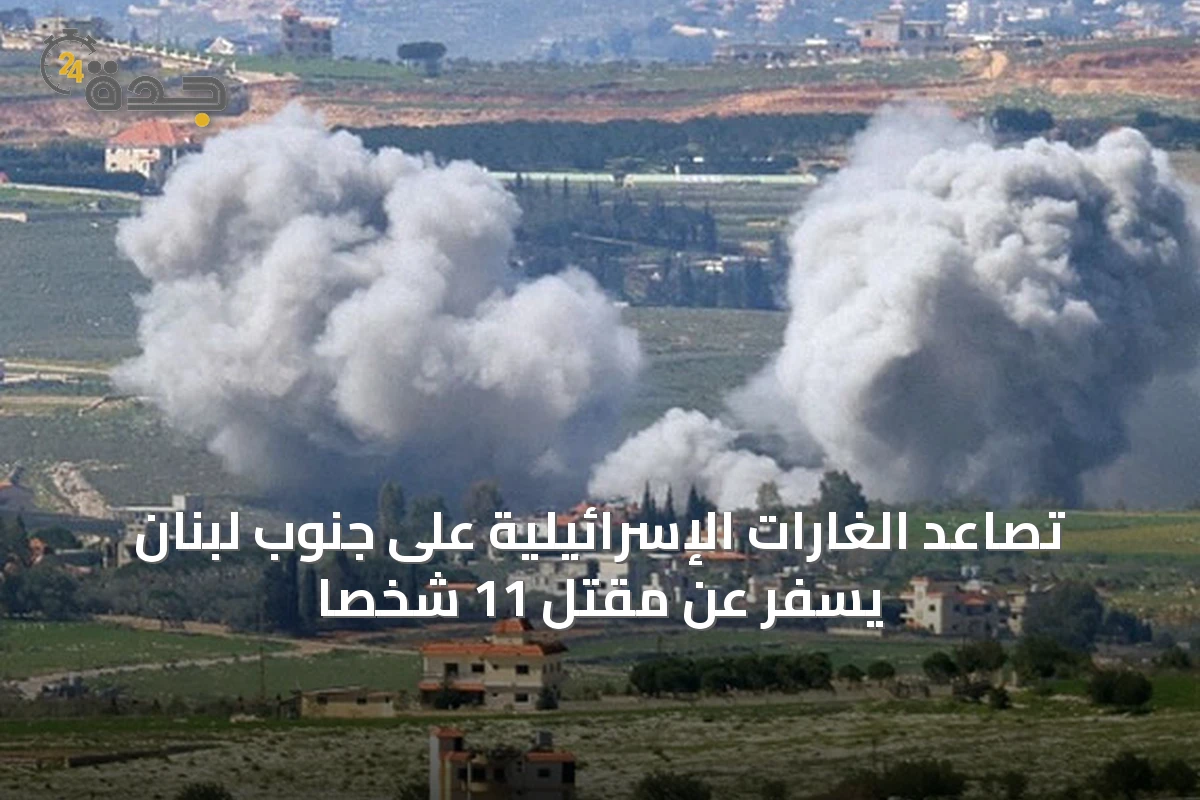
Southern Lebanon witnessed a new military escalation, following a series of Israeli raids that resulted in the deaths of 11 people and injuries to five others, while the death toll of the Lebanese army rose to three within 24 hours, amid growing fears of the collapse of the fragile ceasefire between Israel and Hezbollah.
Targeting civilian areas and displaced persons
Lebanese media reported that the Israeli raids targeted several areas in the south, including Sidon, Tyre, and Adloun, while ambulance and civil defense teams worked to retrieve victims from under the rubble and transport the wounded to hospitals.
The National News Agency reported that an Israeli raid targeted a residential apartment in the Qayaa area of Sidon, resulting in the deaths of three people and injuries to several others, including civilians from a displaced family from the south.
It also noted the deaths of six people, including children, following an attack on a car carrying a civilian family as it attempted to flee from threatened villages to a safer area on the Adloun highway in the Nabi Sari area.
In the city of Tyre, a drone strike targeting a motorcycle in the popular housing area resulted in two deaths, while Israeli raids continued on various areas in southern Lebanon.
Losses of the Lebanese army
In a notable development, the Lebanese army announced the death of one of its soldiers from an Israeli raid that targeted the Zafta – Deir al-Zahrani road, while media reports confirmed that the death toll of the Lebanese army rose to three within one day, indicating an expansion of the scope of targeting.
Raid on the southern suburb of Beirut
Simultaneously with the raids in the south, the Israeli military carried out a raid targeting a residential apartment in the Chouifat area south of Beirut, marking the second direct targeting of the southern suburb and its surroundings since the ceasefire was announced in April.
Israeli media reported that the raid targeted Ali al-Husseini, whom it described as the commander of Hezbollah’s missile unit, while circulated footage showed smoke rising from the targeted building following the attack.
A spokesperson for the Israeli military had previously announced the execution of a “precision strike” in the Beirut area, without providing additional details about the operation or its results.
Positions of the parties and extension of the truce
Israel says its operations aim to prevent Hezbollah from rebuilding its military capabilities and deploying its missile systems near the border, while the party asserts that the Israeli raids represent a clear violation of the truce and an attempt to impose new realities on the ground.
The recent rounds of fighting between the two sides have resulted in the deaths of more than three thousand people, in addition to large waves of displacement and significant destruction in areas of southern Lebanon, while the truce was extended for an additional 45 days days ago in an attempt to contain the escalation.
Sidon
Sidon, one of the oldest Phoenician cities in present-day Lebanon, has a history spanning over 6,000 years. It was a major maritime and commercial power in the ancient Mediterranean, known for its glassmaking and purple dye production. Today, the city features historic landmarks such as the Sea Castle, built by Crusaders in the 13th century, and remnants of its Phoenician and Roman past.
Tyre
Tyre is an ancient Phoenician city located in present-day Lebanon, renowned for its historical role as a major maritime and trading power in the Mediterranean. Founded around 2750 BCE, it was famous for its production of Tyrian purple dye and withstood sieges by Assyrian, Babylonian, and later Alexander the Great, who conquered it
<h3
Sidon
Sidon, one of the oldest Phoenician cities in modern-day Lebanon, has a rich history dating back over 6,000 years. It was a major maritime and commercial hub in the ancient world, known for its purple dye and glass manufacturing, and it later came under the rule of various empires, including the Assyrians, Persians, Romans, and Arabs. Today, Sidon is a vibrant city featuring historic landmarks such as the Sea Castle, built by the Crusaders, and its bustling old souk.
Tyre
Tyre is an ancient Phoenician city located in modern-day Lebanon, renowned for its historical significance as a major maritime and trade power. Founded around 2750 BCE, it was famous for producing Tyrian purple dye and withstanding sieges by Alexander the Great. Today, its archaeological ruins, including a Roman hippodrome and a triumphal arch, are a UNESCO World Heritage site.
Adloun
Adloun is a coastal village in southern Lebanon, known for its significant archaeological site featuring caves and rock shelters that contain evidence of prehistoric human habitation dating back to the Paleolithic period. The caves, such as the Abri Zumoffen, have yielded important artifacts and fossils, providing insights into early human life in the Levant. Today, Adloun is also recognized for its natural beauty, including sandy beaches and a nature reserve.
Nabi Sari
Nabi Sari is a historical and sacred site located in the village of Sari, near the city of Gorgan in northern Iran. According to local tradition and Islamic lore, it is believed to be the burial place of the biblical prophet Daniel, also known as Nabi Sari (Prophet Daniel). The site features a distinctive domed shrine and has long been a place of pilgrimage for both Muslims and Jews, reflecting its deep religious and cultural significance.
Deir al-Zahrani
Deir al-Zahrani is a historic village in southern Lebanon, known for its ancient olive groves and the Zahrani River. The site is notable for its old stone houses and a traditional monastery, reflecting a long history of Christian and Muslim coexistence in the region. Its name, meaning “Monastery of the Zahrani,” hints at its religious past, though much of its early history remains unrecorded.
Chouifat
Chouifat is a residential suburb located south of Beirut, Lebanon, known for its mixed Christian and Druze population. Historically, it was a village that grew into a suburban area during the 20th century, particularly after the Lebanese Civil War, as people moved from Beirut. Today, it is recognized for its quiet, family-oriented environment and its proximity to the Beirut–Rafic Hariri International Airport.
Beirut
Beirut is the capital and largest city of Lebanon, with a history dating back over 5,000 years, making it one of the oldest continuously inhabited cities in the world. It was a major cultural and economic hub in the ancient Phoenician, Roman, and Ottoman eras, earning the nickname “Paris of the Middle East” in the mid-20th century for its vibrant cosmopolitan atmosphere. Despite suffering extensive damage during the Lebanese Civil War (1975–1990) and a devastating port explosion in 2020, Beirut remains a resilient center of art, cuisine, and commerce.