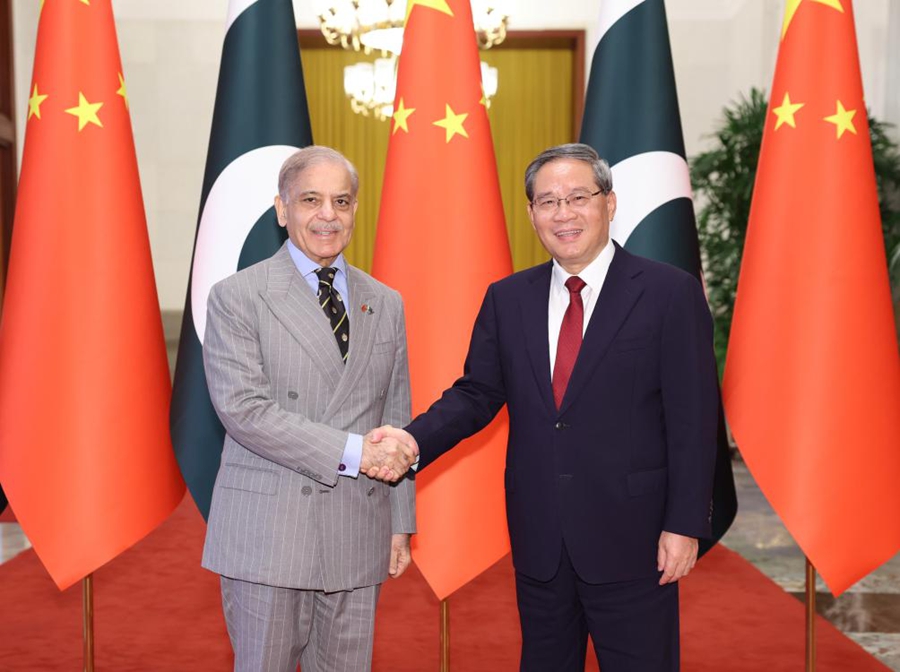
On the morning of May 25, Chinese Premier Li Qiang held talks with Pakistani Prime Minister Shehbaz Sharif, who was on an official visit to China, at the Great Hall of the People in Beijing.
Li Qiang stated that this year marks the 75th anniversary of the establishment of diplomatic relations between China and Pakistan. Over the past 75 years, no matter how the international situation has changed, China and Pakistan have always stood together through thick and thin, forging an unbreakable and profound friendship. Currently, the international situation is intertwined with changes and turmoil. China and Pakistan maintain close communication and coordination to safeguard their common interests and inject positive energy into regional peace. This afternoon, President Xi Jinping will meet with the Prime Minister to provide strategic guidance for further deepening bilateral relations. China always prioritizes its relations and cooperation with Pakistan in its neighborhood diplomacy and is willing to stand more closely united with Pakistan, carry forward traditional friendship, firmly support each other, continuously expand practical cooperation, and promote more fruitful results in building a China-Pakistan community with a shared future.
Li Qiang pointed out that China is willing to work with Pakistan to deeply advance the construction of the China-Pakistan Economic Corridor, continue to focus on major connectivity projects between the two countries, and strengthen cooperation in areas such as industry, mining, agriculture, people’s livelihood, and finance. China is willing to import more high-quality products from Pakistan, actively work with Pakistan to create an upgraded version of the bilateral free trade agreement, and promote continuous expansion and quality improvement of bilateral trade. The two sides can also explore cooperation in fields such as artificial intelligence, digital economy, and green energy, jointly cultivating new drivers of development. China is also willing to deepen human resources development cooperation with Pakistan and welcomes more young Pakistani students to study and further their education in China. It is hoped that Pakistan will continue to take necessary measures to protect the safety of Chinese personnel, projects, and institutions in Pakistan, creating a secure and stable environment for cooperation.
Shehbaz Sharif stated that under the wise leadership of President Xi Jinping, China’s development has achieved remarkable accomplishments that have attracted worldwide attention. Developing relations with China is the cornerstone of Pakistan’s foreign policy. Pakistan adheres to the One-China principle and always firmly supports China’s just stance on core interests such as Taiwan, Xinjiang, Tibet, and maritime issues. Pakistan is willing to learn from China’s experience in economic and social development, further strengthen high-level exchanges with China, accelerate the construction of the “2.0 upgraded version” of the China-Pakistan Economic Corridor, expand cooperation in trade, agriculture, finance, artificial intelligence, science and technology, and continuously advance the Pakistan-China community with a shared future. Pakistan welcomes Chinese enterprises to invest and do business there, and will continue to take strong measures to provide a safer and better business environment. Pakistan actively supports the four major global initiatives proposed by President Xi Jinping and is willing to closely engage in multilateral communication and coordination with China to contribute to the peace, stability, and development of the world and the region.
Before the talks, Li Qiang held a welcome ceremony for Shehbaz Sharif in the North Hall of the Great Hall of the People.
After the talks, the two premiers jointly witnessed the signing of multiple cooperation documents in fields such as economy and trade, science and technology, agriculture and food, and human resources.
Wu Zhenglong attended the above activities.
Great Hall of the People
The Great Hall of the People is a significant political building located on the western side of Tiananmen Square in Beijing, China. Constructed in 1959 in just ten months to commemorate the 10th anniversary of the People’s Republic of China, it serves as the meeting place for the National People’s Congress and hosts various state ceremonies and cultural events. The hall is renowned for its massive scale, featuring numerous grand halls and auditoriums, including the iconic 10,000-seat Great Auditorium.
<h3 class="text-lg font-semibold mb-2 text-blue
Great Hall of the People
The Great Hall of the People is a monumental state building located on the western side of Tiananmen Square in Beijing, China. Constructed in just ten months between 1958 and 1959, it was built as one of the “Ten Great Buildings” to celebrate the 10th anniversary of the People’s Republic of China. The hall serves as the primary venue for the National People’s Congress and other major political and cultural events, symbolizing the nation’s unity and political power.
Beijing
Beijing, the capital of China, is a city with over 3,000 years of history, serving as the nation’s political and cultural center for centuries. It was the imperial seat of the Ming and Qing dynasties, home to iconic landmarks like the Forbidden City and the Great Wall. Today, Beijing blends ancient heritage with modern development, hosting major events like the 2008 Summer Olympics and preserving its rich cultural legacy.
China-Pakistan Economic Corridor
The China-Pakistan Economic Corridor (CPEC) is a major infrastructure and economic development project connecting China’s Xinjiang region with Pakistan’s Gwadar Port. Launched in 2013, it is a cornerstone of China’s Belt and Road Initiative, aiming to enhance trade, energy, and transportation links between the two countries. The corridor has spurred significant investment in roads, railways, and energy projects, fostering deeper bilateral cooperation and regional connectivity.
Taiwan
Taiwan is an island in East Asia with a complex history, including periods of indigenous settlement, Dutch and Spanish colonization, and rule by the Ming loyalist Koxinga before becoming part of the Qing dynasty. It was ceded to Japan in 1895 after the First Sino-Japanese War and later became the refuge of the Republic of China (ROC) government in 1949 following the Chinese Civil War. Today, Taiwan is a vibrant democratic society with a distinct cultural identity, known for its advanced technology, bustling night markets, and stunning natural landscapes like Taroko Gorge.
Xinjiang
Xinjiang, located in northwest China, is a vast autonomous region known for its diverse cultures and stunning landscapes, including the Taklamakan Desert and the Tianshan Mountains. Historically, it was a key hub on the ancient Silk Road, facilitating trade and cultural exchange between East and West for centuries. Today, it is home to multiple ethnic groups, including the Uyghur and Han peoples, and remains a region of significant economic and strategic importance.
Tibet
Tibet, often called the “Roof of the World,” is a high-altitude region in Central Asia known for its stunning Himalayan landscapes and deep Buddhist heritage. Historically, it was an independent kingdom with a unique culture and theocratic government centered in Lhasa, before being incorporated into the People’s Republic of China in the 1950s. Today, it remains a culturally significant area, home to iconic sites like the Potala Palace and a focus of ongoing political and cultural discussions.
Tiananmen Square
Tiananmen Square, located in the heart of Beijing, is one of the world’s largest public squares and a symbol of modern China. Originally built in the 15th century as a gate to the imperial city, it was expanded significantly after the founding of the People’s Republic in 1949 to host national celebrations and political events. The square is surrounded by important landmarks, including the Monument to the People’s Heroes, the Great Hall of the People, and the Mausoleum of Mao Zedong.