-
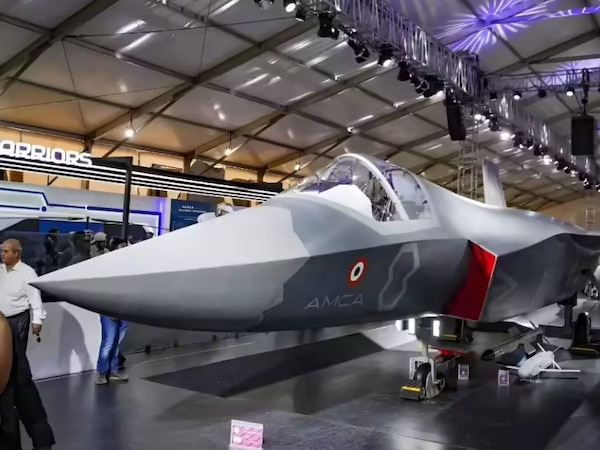
Defence News: India is continuously setting new benchmarks in the defense sector. The central government has taken a significant decision regarding the indigenous fifth-generation stealth fighter jet project, the Advanced Medium Combat Aircraft (AMCA), by approving the entry of the private sector into this field.
The Ministry of Defence has issued a Request for Proposal for the Advanced Medium Combat Aircraft (AMCA) project, giving new heights to the indigenous fifth-generation stealth fighter program.
Companies that received the proposal
According to reports, leading companies in this race include Tata Advanced Systems, the Bharat Ford-BEML-Data Patterns consortium, and the L&T-BEL consortium. Notably, India’s state-owned company Hindustan Aeronautics Limited has not been included in this phase. This decision is seen as a historic shift in the defense production sector.
What is the cost of this project?
The cost of this project is reported to be 15,000 crore rupees, and under this project, the selected company will need to produce five prototypes of the AMCA. It is worth mentioning that plans are underway to build a new greenfield facility on about 650 acres in Puttaparthi, Andhra Pradesh. This project will be fully funded by the government. Meanwhile, technical development will be carried out jointly by DRDO and the Aeronautical Development Agency (ADA).
Indigenous fifth-generation stealth fighter jet
The AMCA will be India’s first indigenous fifth-generation stealth fighter jet. It will feature special technology and is planned to be equipped with an internal weapon bay and advanced sensor systems. Once this aircraft is inducted into the Air Force, the strength of the military will increase manifold.
Also read:
Puttaparthi
Puttaparthi is a town in the Indian state of Andhra Pradesh, best known as the birthplace and lifelong residence of the spiritual leader Sathya Sai Baba. It gained international prominence as the headquarters of the Sri Sathya Sai Central Trust, which oversees a vast ashram, a university, and a super-specialty hospital. The town’s history as a spiritual center began in the mid-20th century, transforming it from a small village into a major pilgrimage destination attracting devotees from around the world.Andhra Pradesh
Andhra Pradesh is a state in southeastern India known for its rich cultural heritage, including classical dance forms like Kuchipudi and the ancient Buddhist site of Amaravati. Historically, it was part of the powerful Vijayanagara Empire and later the Mughal and British colonial territories, with the state being officially formed in 1956 from the merger of Andhra State and the Telugu-speaking areas of Hyderabad. The region is also famous for its iconic Tirumala Venkateswara Temple and the picturesque Araku Valley.Puttaparthi
Puttaparthi is a town in the Indian state of Andhra Pradesh, best known as the birthplace and longtime residence of the spiritual leader Sathya Sai Baba. It gained international prominence in the mid-20th century when Sai Baba established his ashram, Prasanthi Nilayam, which has since become a major pilgrimage center attracting millions of devotees from around the world. The town’s identity is deeply tied to Sai Baba’s teachings and the charitable institutions he founded, including a university and a super-specialty hospital.Andhra Pradesh
Andhra Pradesh is a state in southeastern India known for its rich cultural heritage and historical significance. It was a major center of the ancient Satavahana and Vijayanagara empires, and later became a key region under British rule. Today, it is famous for its classical dance form Kuchipudi, the sacred Tirumala Venkateswara Temple, and the Amaravati Stupa, a Buddhist site dating back to the 3rd century BCE.Amaravati
Amaravati, located in the Indian state of Andhra Pradesh, is a historic city renowned as the capital of the ancient Satavahana dynasty. It is famous for the Amaravati Stupa, a major Buddhist monument built between the 3rd century BCE and the 3rd century CE, which served as a key center for Buddhist art and learning. Today, it is also being developed as the new administrative capital of Andhra Pradesh, blending its rich heritage with modern significance.Vijayanagara Empire
The Vijayanagara Empire was a powerful medieval South Indian kingdom that flourished from 1336 to 1646, with its capital at the magnificent city of Vijayanagara (modern-day Hampi, a UNESCO World Heritage site). Founded by Harihara I and Bukka Raya I of the Sangama dynasty, the empire reached its zenith under rulers like Krishnadevaraya, becoming a major center of art, architecture, and trade. The empire’s legacy is marked by its grand temples, intricate sculptures, and the famous Battle of Talikota in 1565, which led to its decline.Tirumala Venkateswara Temple
The Tirumala Venkateswara Temple, located in the hill town of Tirumala in Andhra Pradesh, India, is a renowned Hindu temple dedicated to Lord Venkateswara, a form of Vishnu. Its origins date back over a thousand years, with the earliest references found in Tamil literature from the 6th-9th centuries, and it has been expanded and patronized by various dynasties, including the Cholas and the Vijayanagara Empire. Today, it is one of the richest and most visited religious sites in the world, drawing millions of pilgrims annually.Araku Valley
Araku Valley is a scenic hill station in the Eastern Ghats of Andhra Pradesh, India, known for its lush coffee plantations, waterfalls, and tribal culture. Historically, the valley was inhabited by indigenous tribes like the Bagata and Kondadora, and it gained prominence during British rule when coffee cultivation was introduced. Today, it is a popular tourist destination, also famous for the Araku Valley Railway on the scenic Kirandul–Kottavalasa line.