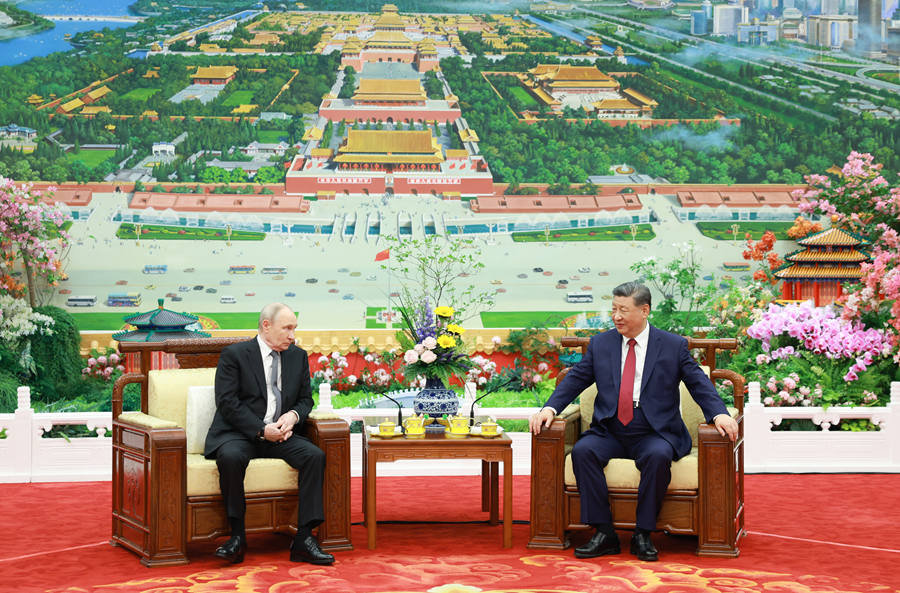
On the evening of May 20, Chinese President Xi Jinping held a tea talk with Russian President Vladimir Putin at the Great Hall of the People in Beijing.
Great Hall of the People
The Great Hall of the People is a massive state building located on the western side of Tiananmen Square in Beijing, China. Constructed in just 10 months and completed in 1959, it was built to serve as the primary venue for the National People’s Congress and other major political and cultural events. The hall symbolizes the political power and architectural ambition of the People’s Republic of China, featuring a grand auditorium and numerous halls named after Chinese provinces and regions.
Great Hall of the People
The Great Hall of the People is a monumental building located on the western side of Tiananmen Square in Beijing, China. Completed in 1959 in just ten months, it was built as one of the “Ten Great Buildings” to commemorate the 10th anniversary of the People’s Republic of China. The hall serves as the primary venue for the National People’s Congress and other major political and cultural events, symbolizing the nation’s legislative authority and architectural ambition.
Tiananmen Square
Tiananmen Square, located in the heart of Beijing, is one of the world’s largest public squares, with a history dating back to the Ming Dynasty when it served as the front gate of the Imperial City. It gained modern prominence as a site for national celebrations and political events, particularly after the founding of the People’s Republic of China in 1949, when Mao Zedong proclaimed the new nation from its rostrum. Today, it remains a symbol of Chinese national pride and a major tourist attraction, surrounded by landmarks like the Forbidden City and the Monument to the People’s Heroes.
Great Hall of the People
The Great Hall of the People is a monumental state building located on the western side of Tiananmen Square in Beijing, China. Constructed in just ten months in 1959 as one of the “Ten Great Buildings” to commemorate the 10th anniversary of the People’s Republic of China, it serves as the primary venue for the National People’s Congress and other major political and cultural events. The hall is renowned for its vast scale, featuring a grand auditorium and numerous meeting halls, each representing a different province or region of China.
Tiananmen Square
Tiananmen Square, located in the heart of Beijing, is one of the world’s largest public squares and a symbol of modern China. Its history dates back to the Ming Dynasty when it served as the front gate of the Imperial City, but it gained its current form in the 20th century, especially after 1949 when it became the site of major national celebrations and political events. Today, it is surrounded by significant landmarks such as the Great Hall of the People, the National Museum of China, and the Mausoleum of Mao Zedong.
Forbidden City
The Forbidden City, located in the heart of Beijing, China, served as the imperial palace for 24 emperors during the Ming and Qing dynasties from 1420 to 1912. Construction began in 1406 under Emperor Yongle, and it functioned as the political and ceremonial center of Chinese government for nearly 500 years. Today, it is a UNESCO World Heritage site and houses the Palace Museum, showcasing a vast collection of ancient Chinese art and artifacts.
Monument to the People’s Heroes
The Monument to the People’s Heroes is a towering obelisk located in the center of Tiananmen Square in Beijing, China. Erected in 1958, it commemorates the martyrs who sacrificed their lives during the Chinese revolutionary struggles from the 19th century through the Chinese Civil War and the establishment of the People’s Republic. The monument features inscriptions by Mao Zedong and Zhou Enlai, along with eight large relief sculptures depicting key revolutionary events.