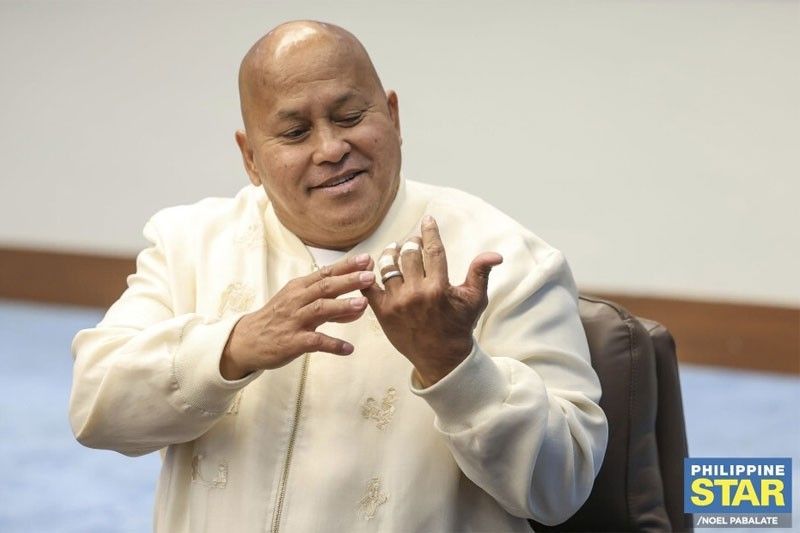
Senator Ronald “Bato” Dela Rosa shows his bandaged fingers to reporters before the Senate plenary session on May 12, 2026, a day after National Bureau of Investigation agents pursued him through the building to serve an arrest warrant.
Appeal from 58 mayors
Manila, Philippines — A coalition of incumbent mayors called Mayors for Good Governance (M4GG) is urging the Senate not to condone what they describe as ‘betrayal’ and ‘neglect’ by Senator Ronald “Bato” dela Rosa.
This is in connection with the senator’s continued absence from work while still receiving a monthly salary of 300,000 pesos.
In a statement signed by 58 mayors nationwide, M4GG emphasized that ordinary Filipinos are subject to a “no work, no pay” policy, so the same should apply to the senator.
They argued that under normal circumstances, Dela Rosa’s actions would result in suspension or termination of contract.
The mayors questioned, “Why does the law seem different when a powerful official is involved?”
“This kind of abandonment and neglect is unacceptable for those of us who are paid by the people, while our citizens daily face poverty, high prices of goods, and an economic crisis,” M4GG added.
They also called Dela Rosa’s actions an insult to the millions of Filipinos who work hard to earn a living for their families.
M4GG further appealed, “We call on our senators: the Senate should not be a haven for absenteeism and cover-ups.”
“An elected official who avoids their responsibilities while continuing to receive a salary from the people should not be protected,” they added.
It is worth recalling that Dela Rosa has not attended Senate proceedings for nearly half a year after it was reported that the International Criminal Court (ICC) had issued an arrest warrant against him.
He entered on May 11 to vote on the change of Senate leadership but later left and never returned.
During his period of absence, it is estimated that Dela Rosa has received about 1.8 million pesos over six months without reporting to work.
Senate
The Senate is a key legislative body in many governments, most famously the United States Senate, which was established in 1789 as part of the bicameral Congress. Its origins trace back to the Roman Senate, an advisory council that evolved into a powerful governing institution in ancient Rome. Today, the U.S. Senate plays a crucial role in lawmaking, confirming presidential appointments, and ratifying treaties.
National Bureau of Investigation
The National Bureau of Investigation (NBI) is the primary criminal investigation agency of the Philippines, established in 1936 as a division of the Department of Justice. It was modeled after the U.S. Federal Bureau of Investigation (FBI) to handle major crimes and provide forensic support to law enforcement. Over the decades, the NBI has evolved to include specialized units for counterterrorism, cybercrime, and anti-organized crime efforts.
Manila
Manila is the capital and largest city of the Philippines, located on the island of Luzon. Its history dates back to the 16th century when it was established as a Spanish colonial city, later becoming a major hub for the Manila-Acapulco galleon trade. The city has endured significant events such as World War II devastation and has since evolved into a vibrant cultural and economic center, blending historic landmarks like Intramuros with modern urban life.
<div class="my-4 p-4 rounded
Senate
The Senate is a key legislative body in many governments, most notably the United States Senate, which was established in 1789 as the upper chamber of Congress. It was designed to provide equal representation for each state, with two senators per state, and has played a central role in passing laws, confirming presidential appointments, and ratifying treaties. The Senate’s history includes landmark debates over issues like slavery, civil rights, and impeachment, shaping the course of American democracy.
National Bureau of Investigation
The National Bureau of Investigation (NBI) is the primary criminal investigation agency in the Philippines, established in 1936 under Commonwealth Act No. 181. Originally modeled after the U.S. Federal Bureau of Investigation (FBI), it was created to handle major crimes and provide forensic support to law enforcement. Over the decades, the NBI has evolved into a key institution for upholding justice, investigating offenses from corruption to cybercrime, and maintaining national security.
Manila
Manila, the capital of the Philippines, is a bustling metropolis with a rich history shaped by Spanish, American, and Asian influences. Founded in 1571 by Spanish conquistadors, it served as a key trading hub in Asia and was heavily damaged during World War II, leading to extensive reconstruction. Today, it is known for its historic districts like Intramuros, vibrant cultural scenes, and significant landmarks such as Rizal Park and the San Agustin Church.
United States Senate
The United States Senate is the upper chamber of the U.S. Congress, established in 1789 under the Constitution. It was designed to provide equal representation for each state, with two senators per state, and has played a key role in shaping national legislation, confirming presidential appointments, and ratifying treaties. Over its history, the Senate has been a forum for major political debates and decisions, from the Civil War era to modern-day policy-making.
Roman Senate
The Roman Senate was a key political institution in ancient Rome, initially established as an advisory council for kings and later evolving into a powerful governing body during the Republic. Comprised of aristocrats and former magistrates, it shaped legislation, foreign policy, and financial administration for centuries. Though its influence waned under the Roman Empire, the Senate remained a symbolic and ceremonial fixture until the fall of the Western Roman Empire.
Intramuros
Intramuros is a historic walled area in Manila, Philippines, built by the Spanish colonial government in the late 16th century. It served as the political, religious, and military center of Spanish rule for over 300 years, housing key institutions like churches, schools, and government buildings. Although heavily damaged during World War II, Intramuros has been restored and remains a popular tourist destination showcasing the country’s colonial heritage.
Manila-Acapulco galleon trade
The Manila-Acapulco galleon trade was a crucial maritime route that connected Spanish colonial Philippines with Mexico from 1565 to 1815. For over 250 years, these massive ships transported Asian luxury goods—such as silk, spices, and porcelain—to the Americas, while carrying silver from Mexico and Peru back to Asia. This trade network profoundly shaped global commerce, facilitated cultural exchange, and established Manila as a major entrepôt in the early modern world.
Luzon
Luzon is the largest and most populous island in the Philippines, serving as the country’s political and economic center. Its history includes early settlement by Austronesian peoples, Spanish colonization beginning in the 16th century, and a key role in the Philippine Revolution and World War II. The island is home to the capital Manila, as well as the famous Banaue Rice Terraces, a UNESCO World Heritage site carved by indigenous Ifugao communities over 2,000 years ago.