Filtered by: Topstories
KYIV – Russia said on Monday that it intended to launch “systematic strikes” on targets in Kyiv linked to the Ukrainian military as well as decision-making centers, and urged foreigners to leave, a day after one of its heaviest bombardments of the city since the start of the war.
But Ukrainian Foreign Minister Andrii Sybiha urged Kyiv’s allies not to give in to “Russian blackmail.” And the head of the EU mission in the city said the 27-nation bloc was “not going anywhere.”
Russian Foreign Minister Sergei Lavrov told US Secretary of State Marco Rubio, according to a Russian Foreign Ministry statement, that the impending strikes were “in response to the continuing terrorist attacks by the Kyiv regime” against civilians in Russia.
The statement said Russia’s armed forces “are starting systematic strikes on facilities located in Kyiv that are used for the needs of the Armed Forces of Ukraine, as well as on centers where the corresponding decisions are being made.”
An earlier Russian Foreign Ministry statement urged foreigners, including diplomats, to leave Kyiv as quickly as possible.
Russia has cited what it describes as a deliberate drone strike last Friday on a student dorm in the Russian-controlled Luhansk region of eastern Ukraine.
Ukraine’s military denied the Russian accusations and said it had struck an elite drone command unit in the area.
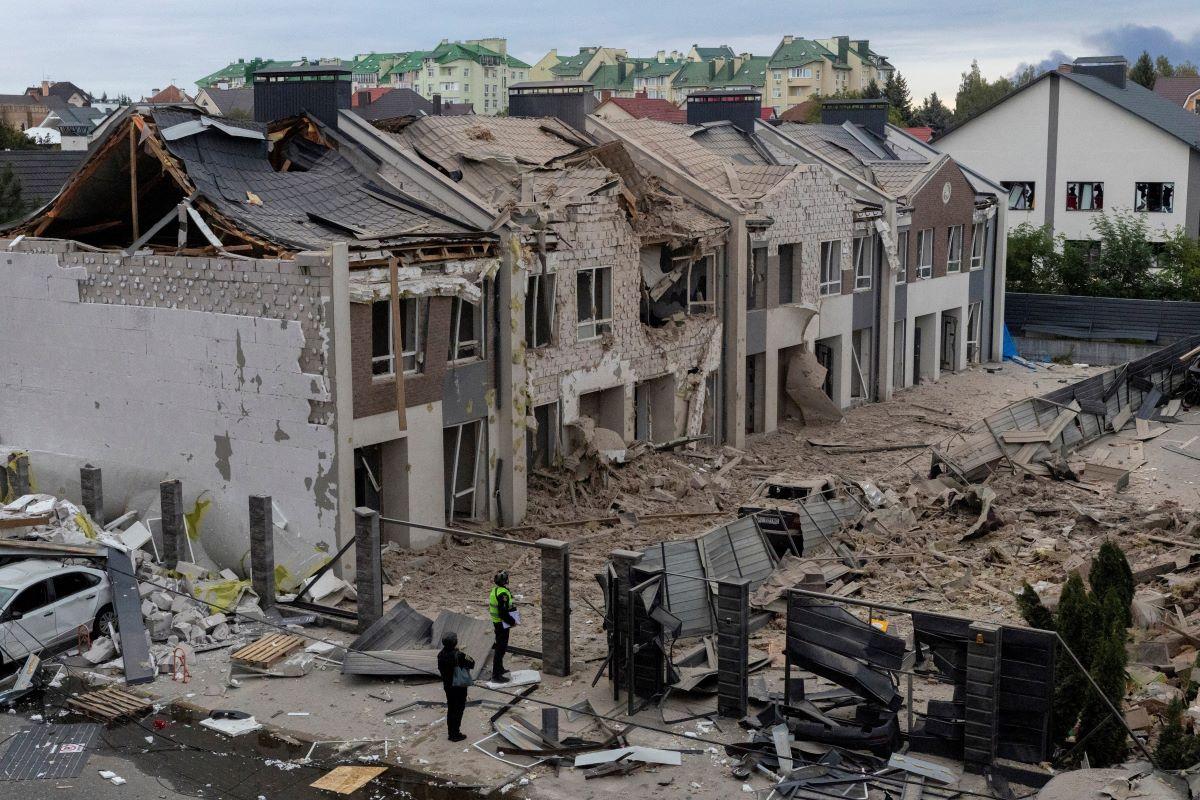
In Kyiv, rescuers tackled the aftermath of Sunday’s strikes, which authorities said had killed two people and injured 91.
Moscow fired an Oreshnik hypersonic missile near Kyiv — its third use of the nuclear-capable weapon in more than four years of war.
Ukrainian Foreign Minister Sybiha wrote on the social media platform X: “We are currently discussing with our partners that there is no need to give in to this Russian blackmail.”
The head of the EU mission in Kyiv, Katarina Mathernova, said the Russian warning sought to sow panic.
“Russia wants fear. Panic. Isolation of Ukraine. It will not work,” she said on social media. “The EU is not going anywhere. We are staying in Kyiv. We are staying with Ukraine.
President Volodymyr Zelenskyy said around 300 sites across Kyiv had been damaged in the weekend strikes, including a newly opened museum devoted to the 1986 Chornobyl nuclear disaster.
More than 70 foreign diplomats paid their respects to the victims of the strikes in Kyiv, visiting the heavily damaged neighborhood of Lukyanivka on Monday.
Attacks in Russia, Ukraine
Meanwhile, Ukraine continued its own attacks against Russian infrastructure and industrial assets.
In Russia’s Belgorod region, one man was killed and another injured in a missile and drone attack that also cut power and water supplies, local authorities said on Telegram.
The Russia-installed head of parts of eastern Ukraine’s Donetsk region, Denis Pushilin, said seven people were killed in Ukrainian attacks, including a family of four whose car was struck in the industrial town of Horlivka.
In Ukrainian-held territory, two people were killed and 16 wounded in Russian attacks over 24 hours in the southern Kherson region, regional governor Oleksandr Prokudin said on Telegram.
In a missile attack on Monday on the town of Derhachi near Kharkiv, Ukraine’s second-biggest city, two people were killed and more than 20 injured, officials said.
In the Black Sea port of Odesa, a frequent Russian target, the city’s top official said one person was killed and three injured in a Russian strike.
A further 14 were wounded in the southeastern Dnipropetrovsk region, officials said. Emergency services said drones attacked a nine-story apartment building in the town of Pavlohrad.
The governor of those parts of Donetsk region held by Ukraine, Vadym Filashkin, said 12 people had been hurt in the frontline city of Kramatorsk.
Reuters could not independently verify the reports. Russia and Ukraine deny deliberately targeting civilians since Russia invaded its neighbor in February 2022.</