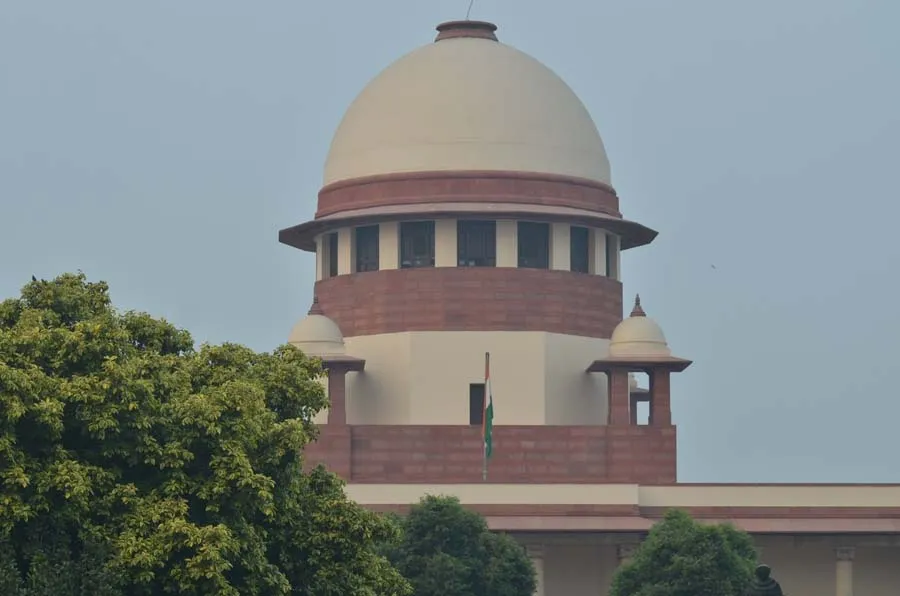
New Delhi, May 23. The Supreme Court will hear next week a petition challenging the Central Board of Secondary Education’s (CBSE) new policy making the study of three languages compulsory for class 9 students. The petition has been filed by parents and teachers from New Delhi, Gurugram, Noida, and Chennai.
Senior advocate Mukul Rohatgi mentioned the matter before a bench comprising Chief Justice Suryakant, Justice Joymalya Bagchi, and Justice Vipul M. Pancholi. He argued that the sudden implementation of this rule would affect students’ preparation for the class 10 board exams and impose an unfair academic burden on them.
Senior advocate Rohatgi argued that students who were previously studying only two languages would now suddenly have to learn an additional language at the class 9 level and take its exam in class 10, creating confusion and academic chaos among students. Taking note of the arguments, the bench said the matter would be listed for hearing next week.
The challenge relates to a circular issued by CBSE on May 15, through which the “study scheme” has been aligned with the National Education Policy (NEP) 2020 and the National Curriculum Framework for School Education (NCF-SE) 2023.
Under the revised framework, from July 1, 2026, students entering class 9 will be required to study three languages, of which at least two must be Indian languages. A foreign language can only be chosen if the remaining two languages are Indian, or it can be taken as an additional fourth subject.
According to the petitioners, this policy is completely different from CBSE’s earlier notification issued on April 9, 2026, which had deferred the mandatory third language at the class 9 level until the academic session 2029-30.
The petition claims that the sudden implementation of this policy will impose an additional academic burden on students who are already preparing for board exams, while schools lack the necessary infrastructure, trained teachers, and adequate study materials.
It alleges that directing class 9 students to rely on class 6 level textbooks for learning an additional language reflects the inadequacy of teaching methods, rather than any meaningful language acquisition. The petition also expresses concern over the policy’s unequal impact on students from non-Hindi speaking states and points to the absence of a clear assessment framework for the newly introduced third language.
Supreme Court
The Supreme Court of the United States is the highest federal court in the country, established by Article III of the Constitution in 1789. Its role includes interpreting the Constitution, reviewing lower court decisions, and ensuring the equal application of laws. The iconic neoclassical building in Washington, D.C., opened in 1935, symbolizing the judiciary’s independence and authority.
Central Board of Secondary Education (CBSE)
The Central Board of Secondary Education (CBSE) is a national-level board of education in India for public and private schools, established in 1962. It evolved from the earlier Uttar Pradesh Board of High School and Intermediate Education and was granted autonomous status to standardize and improve secondary education across the country. Today, CBSE affiliates over 27,000 schools in India and abroad, conducting the crucial Class 10 and Class 12 board examinations.
New Delhi
New Delhi is the capital of India, officially inaugurated in 1931 as the imperial capital of British India, designed by British architects Edwin Lutyens and Herbert Baker. The city was built to the south of the historic old city of Delhi, incorporating wide tree-lined avenues and grand government buildings, most notably the Rashtrapati Bhavan and India Gate. Today, it serves as the seat of India’s government and stands as a vibrant symbol of the nation’s complex history, blending colonial heritage with modern Indian identity.
Gurugram
Gurugram, formerly known as Gurgaon, is a major satellite city and financial hub located southwest of New Delhi, India. Its history dates back to the epic Mahabharata, where it was believed to be the village of Guru Dronacharya, the teacher of the Pandavas, from whom it derives its name. In the late 20th and early 21st centuries, it rapidly transformed from a sleepy agricultural town into a modern metropolis, becoming a center for multinational corporations, information technology, and real estate development.
Noida
Noida, short for the New Okhla Industrial Development Authority, is a planned city in Uttar Pradesh, India, established in 1976 as part of a post-independence initiative to decongest Delhi and promote industrial growth. It was developed as a modern, satellite township with a focus on urban planning, featuring wide roads, residential sectors, and commercial hubs. Over the decades, Noida has evolved into a major center for information technology, manufacturing, and real estate, becoming an integral part of the National Capital Region.
Chennai
Chennai, formerly known as Madras, is a major cultural and economic hub on India’s southeastern coast, with a history dating back to the 17th century when the British East India Company established a trading post there. The city grew around the Fort St. George, built in 1644, and became a key colonial administrative center under British rule. Today, Chennai is renowned for its classical dance, music, and vibrant Tamil culture, blending its colonial past with modern urban life.