Police Commissioner Brajesh Kumar Jha Gives Directives to Appoint Nodal Officers in Educational Institutions, Seizes Narcotics Worth Over 13.65 Lakh Rupees in One Month
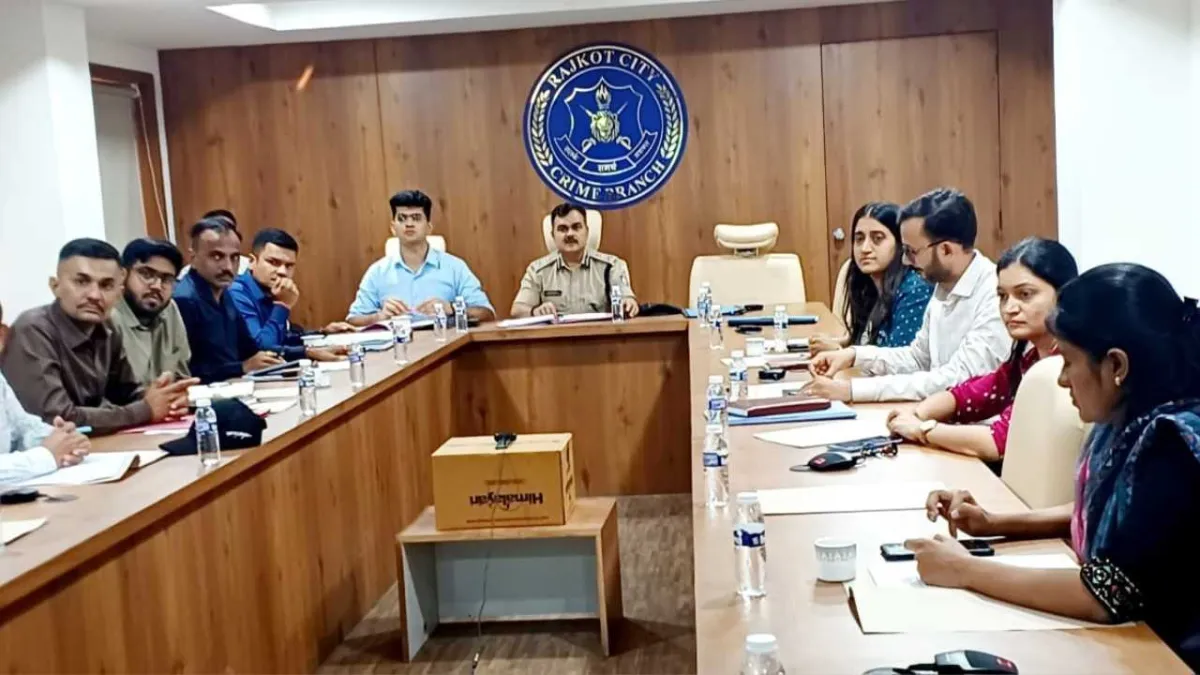
An important meeting of the Narco Coordination Center was held at the Rajkot DCB Police Station under the chairmanship of Police Commissioner Brajesh Kumar Jha. The meeting reviewed the ongoing campaign against narcotic substances in the city and emphasized strengthening coordination between various departments.
During the meeting, Police Commissioner Brajesh Kumar Jha gave directives to appoint nodal officers in colleges, universities, and other educational institutions. He stated that these officers would coordinate with the police department to exchange information related to narcotic substances. Additionally, considering the potential for drug sales near educational institutions, he appealed to citizens and institutions to report suspicious vendors to the police.
DCP of Crime Branch Jagdish Bangarwa informed the meeting that under the anti-drug campaign conducted this month, the police have seized 13.22 kilograms of narcotics such as cannabis, opium, and mephedrone. Their total value is estimated at over 13.65 lakh rupees. In this regard, five cases have been registered and six accused have been arrested.
DCP Bangarwa also stated that despite the ban on tobacco sales within 100 meters of schools, action has been taken against violators under the COPTA Act. The police department collected fines of 23,200 rupees in 116 cases, while the Rajkot Municipal Corporation collected penalties of 3,280 rupees in 117 cases.
During the meeting, information was also shared about the work done by the municipal corporation, the Food and Drug Department, and the Health Department for drug control and awareness. Additionally, discussions were held on anti-drug awareness programs organized by the Special Operations Group (SOG) of the Rajkot city police and the Customs Department of the Government of India.
The meeting was attended by SOG PI N.B. Chaudhary, PSI V.V. Dhrangu, officers from various police stations, representatives from the Agriculture and Forest Department, the Social Welfare Department, Customs, the Food and Drug Department, the Forensic Department, as well as nodal officers from various universities in Rajkot.
Rajkot DCB Police Station
Rajkot DCB Police Station is a law enforcement facility in Rajkot, Gujarat, India, serving as the headquarters for the city’s District Crime Branch (DCB). While specific historical records are limited, it functions as a key unit for investigating serious crimes and maintaining public safety in the region. The station represents the modern policing infrastructure developed to address urban security needs in Rajkot.
Narco Coordination Center
The Narco Coordination Center, also known as the “Narco Museum” or “Museo del Narco,” is a controversial private museum in Mexico City that displays artifacts and exhibits related to the country’s drug cartels and narcotrafficking history. It was founded in 2010 by a private collector, showcasing items such as weapons, vehicles, and personal belongings of infamous drug lords, aiming to document the violent impact of the drug trade. The site has sparked debate over whether it glorifies or educates about the complex social and historical context of drug-related violence in Mexico.
Rajkot Municipal Corporation
The Rajkot Municipal Corporation (RMC) is the civic body responsible for governing the city of Rajkot in the Indian state of Gujarat. Established in 1973, it oversees urban infrastructure, public services, and local development in the city, which has a rich history as a former princely state capital and the birthplace of Mahatma Gandhi. Today, the RMC plays a key role in managing Rajkot’s growth as a major industrial and cultural hub in the Saurashtra region.
Food and Drug Department
The Food and Drug Department, often associated with agencies like the U.S. Food and Drug Administration (FDA), is a government body responsible for protecting public health by regulating food safety, pharmaceuticals, medical devices, and other consumer products. Its history dates back to the early 20th century, notably with the Pure Food and Drug Act of 1906 in the United States, which was a response to unsafe food and drug practices. Over time, the department has evolved to oversee extensive safety standards, approvals, and recalls, playing a critical role in modern public health.
Health Department
The term “Health Department” typically refers to a government agency responsible for protecting public health through disease prevention, sanitation, and health education. Modern health departments emerged in the 19th century in response to industrial urbanization and outbreaks like cholera, with early examples including the New York City Health Department founded in 1866. Today, they operate at local, state, and national levels to enforce health regulations, track diseases, and promote community wellness.
Special Operations Group (SOG)
The Special Operations Group (SOG) was a highly classified, multi-service U.S. military unit that operated during the Vietnam War, conducting covert and unconventional warfare missions behind enemy lines in Laos, Cambodia, and North Vietnam. Established in 1964, SOG specialized in reconnaissance, sabotage, psychological operations, and prisoner rescue, often working with indigenous forces like the Montagnards. Its legacy is marked by extreme secrecy, high casualty rates, and pioneering tactics that influenced modern special operations.
Customs Department of the Government of India
The Customs Department of the Government of India is a key agency under the Ministry of Finance, responsible for enforcing customs laws, collecting duties, and regulating cross-border trade. Its history dates back to the British colonial era, with the establishment of the first customs houses in the 19th century, evolving through major reforms like the Customs Act of 1962. Today, it plays a vital role in facilitating legitimate trade while preventing smuggling and revenue evasion.
Rajkot city police
The Rajkot city police force is the law enforcement agency responsible for maintaining public order and safety in Rajkot, Gujarat, India. Historically, the police system in Rajkot traces its roots to the British colonial era, when it was established to serve the princely state of Rajkot under British influence. Today, it operates under the Gujarat Police and focuses on modern policing challenges, including crime prevention and traffic management in the growing city.