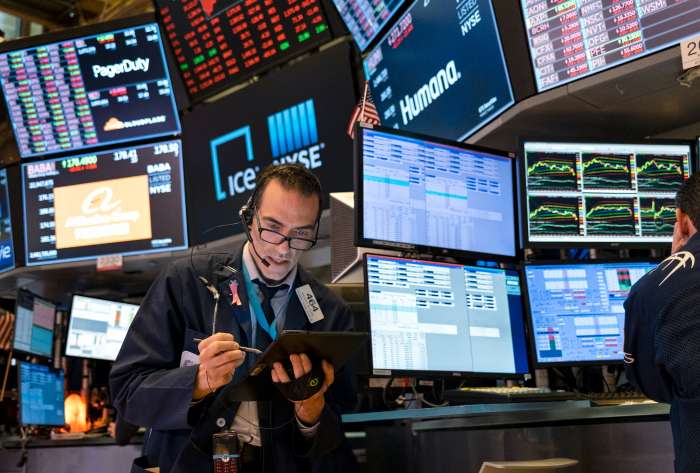
On Wednesday, May 20, Eastern Time, all three major U.S. stock indexes rallied sharply. As international oil prices fell, Treasury yields cooled, and the market renewed its bet on strong AI demand ahead of Nvidia’s earnings report, investor risk appetite clearly rebounded. At the close, the S&P 500 rose 1.08%, the Nasdaq surged 1.5%, and the Dow Jones gained 1.3%. The day before, the bond market had experienced a sell-off amid concerns that persistent inflation might force the Federal Reserve to reconsider its rate hike path. The Fed meeting minutes released on Wednesday further reinforced those worries.
Nvidia Reports Strong Earnings
Just as the market began to worry whether the AI rally had gone too far, Nvidia’s latest earnings report gave Wall Street a fresh boost. The company reported first-quarter revenue of $81.6 billion, up 85% year-over-year, significantly beating market expectations. Adjusted earnings per share came in at $1.87, also above estimates. More critically, the company’s revenue guidance for the next quarter reached $91 billion, far exceeding analysts’ expectations of $87.2 billion. Data center revenue surged 92% year-over-year to $75.2 billion, continuing to show that global AI infrastructure construction remains in a rapid expansion phase.
In the earnings report, Nvidia’s CEO emphasized that AI infrastructure construction is expanding at an unprecedented pace and noted that agentic AI has begun to generate real commercial value. The company also announced a new $80 billion stock buyback plan and increased its quarterly dividend from 1 cent to 25 cents per share. These moves not only strengthened market confidence in Nvidia’s cash flow and profitability but also further cemented its status as a core beneficiary of AI.
Following the earnings report, a well-known tech analyst at Wedbush stated that Nvidia still stands at the pinnacle of the AI revolution. As global AI infrastructure construction accelerates, the market still underestimates the scale of AI demand in the coming years. He predicted that global large tech companies’ AI capital expenditures could exceed $750 billion in 2026, and over the next 12 to 18 months, AI deployment by enterprises, governments, and global markets will continue to accelerate. The analyst even believes that for every dollar invested in Nvidia, the entire tech industry chain could see a multiplier effect of $8 to $10, and expects tech stocks to have 10% to 12% upside by year-end.
Market Enters a New Tug-of-War
However, the market is now trading not just on AI growth but also on macro risks. The latest Fed meeting minutes showed that more officials are growing concerned that if the conflict in the Middle East continues to drive up energy prices and keeps inflation above 2% for an extended period, the Fed may need to raise rates again in the future rather than cut them. Although rates remain unchanged, the Fed saw the most dissenting votes since 1992, with four officials opposing the current stance, and some even objected to retaining language about the possibility of future rate cuts.
Meanwhile, the situation in the Middle East remains highly uncertain. On Wednesday, former President Trump signaled a de-escalation. According to reports, Trump said on the 20th that if the U.S. and Iran could reach an agreement, he would be willing to wait a few more days for Iran’s response. International oil prices then fell sharply, with WTI crude briefly dropping below $100. The market began to bet that if normal traffic through the Strait of Hormuz resumed, energy supply pressures could ease and inflation risks might decline. But the market remains cautious about a true ceasefire, as Trump has made similar optimistic statements multiple times in recent weeks, only for tensions to escalate again. Currently, Iran continues to block the Strait of Hormuz, while the U.S. maintains a blockade on Iranian ports, with both sides effectively at a standoff.
What Wall Street truly fears is the chain reaction from prolonged high oil prices. Citigroup warned that the market underestimates the risk of a long-term disruption in the Strait of Hormuz, and if the situation persists, Brent crude could rise to $120. Consulting firm Wood Mackenzie even suggested that in an extreme scenario, if the strait remains closed until year-end, oil prices could approach $200. This is why the Fed is once again concerned about inflation—because rising energy prices are not just a short-term shock; core inflation is also rebounding simultaneously.
This macroeconomic environment is also beginning to affect sentiment in chip stocks. After the recent pullback in