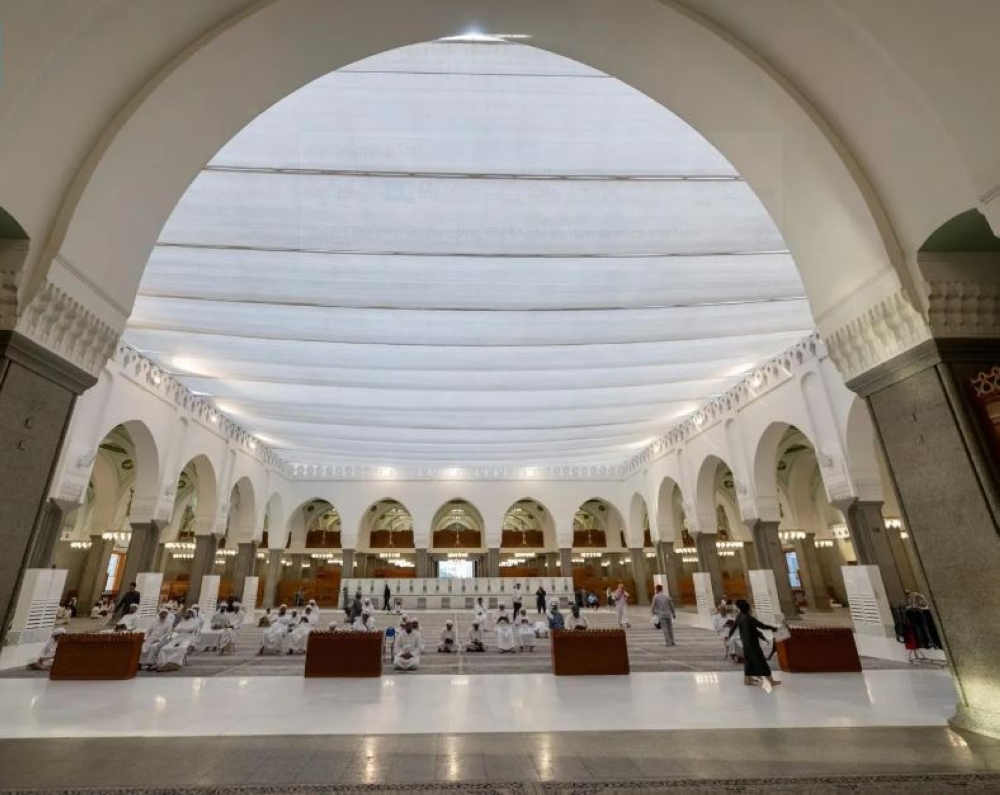
During the ten days of Dhul-Hijjah, Quba Mosque witnesses a large influx of pilgrims and visitors, under an integrated service system that prepares facilities and organizes visitor flow, providing an easy spiritual experience for those heading to the first mosque established in Islam.
The Madinah Region Development Authority oversees the management of the mosque’s operations and services provided to worshippers and visitors through an integrated operational system. This includes organizing entry and exit movements, intensifying cleaning and sterilization efforts, providing guidance and awareness services in multiple languages, and monitoring the readiness of facilities and supporting services around the clock.
Quba Mosque is one of the most prominent destinations for pilgrims during their stay in Madinah, due to its historical and spiritual significance linked to the Prophet’s biography. The Prophet Muhammad, peace be upon him, founded it upon his arrival in Madinah as a migrant, and several prophetic hadiths mention its virtues.
Enhancing Capacity
Development projects and ongoing expansions in and around the mosque contribute to enhancing capacity and improving the visitor experience. This includes developing courtyards, pathways, and operational services, as part of continuous efforts to raise the quality of services provided to the guests of the Most Merciful.
The area surrounding the mosque witnesses active movement of visitors, markets, and commercial services, amid regulatory measures aimed at enhancing smoothness and achieving the highest standards of safety and comfort for pilgrims and worshippers.
These efforts are part of the service system provided by various entities in Madinah during the Hajj season, reflecting the care the Kingdom gives to the Two Holy Mosques, Islamic sites, and their visitors, in line with the goals of Saudi Vision 2030 and the Guests of the Most Merciful program.
Quba Mosque
The Quba Mosque, located on the outskirts of Medina, Saudi Arabia, is one of the oldest mosques in the Islamic world, with its foundation stones laid by the Prophet Muhammad in 622 CE upon his arrival from Mecca. According to Islamic tradition, the Prophet personally participated in its construction, and it is mentioned in the Quran as a mosque “founded on piety.” The mosque has undergone several expansions and renovations over the centuries, most notably a major reconstruction in 1986 that preserved its historic significance while greatly enlarging its capacity.
<h3 class="text-lg font
Quba Mosque
The Quba Mosque, located on the outskirts of Medina, Saudi Arabia, is one of the oldest mosques in Islam, with its foundation laid by the Prophet Muhammad in 622 CE upon his arrival from Mecca. According to Islamic tradition, the Prophet himself participated in its construction, and it is revered as the first mosque built in Islam. The mosque has undergone several expansions over the centuries, with a major renovation in the 20th century that added modern architectural elements while preserving its historic significance.
Madinah
Madinah, also known as Medina, is a city in western Saudi Arabia that is the second holiest city in Islam after Mecca. It holds profound significance as the place where the Prophet Muhammad migrated in 622 CE (the Hijra) and established the first Muslim community. The city is home to Al-Masjid an-Nabawi (the Prophet’s Mosque), which contains Muhammad’s tomb and serves as a major pilgrimage site for millions of Muslims each year.
Two Holy Mosques
The term “Two Holy Mosques” refers to the Masjid al-Haram in Mecca and the Al-Masjid an-Nabawi in Medina, the two holiest sites in Islam. Masjid al-Haram surrounds the Kaaba, the direction of prayer for Muslims worldwide, and has been expanded numerous times since its founding by the Prophet Abraham. Al-Masjid an-Nabawi was originally built by the Prophet Muhammad in 622 CE and contains his tomb, making it a major pilgrimage destination.
Saudi Vision 2030
Saudi Vision 2030 is a strategic framework launched in 2016 to diversify Saudi Arabia’s economy, reduce its dependence on oil, and develop public service sectors such as health, education, and tourism. The initiative aims to transform the kingdom through major projects like NEOM and the Red Sea Project, while also empowering women and expanding entertainment and cultural opportunities. Rooted in Crown Prince Mohammed bin Salman’s reform agenda, it represents a historic shift toward a more modern, sustainable, and globally integrated Saudi society.
Guests of the Most Merciful program
“Guests of the Most Merciful” is a Saudi government initiative that hosts pilgrims from around the world to perform Hajj or Umrah, covering all expenses. Launched in 2008, the program selects participants from diverse backgrounds, often including those affected by conflict or disaster, to promote Islamic unity and humanitarian values. It reflects Saudi Arabia’s role in serving Muslim pilgrims and fostering global goodwill.