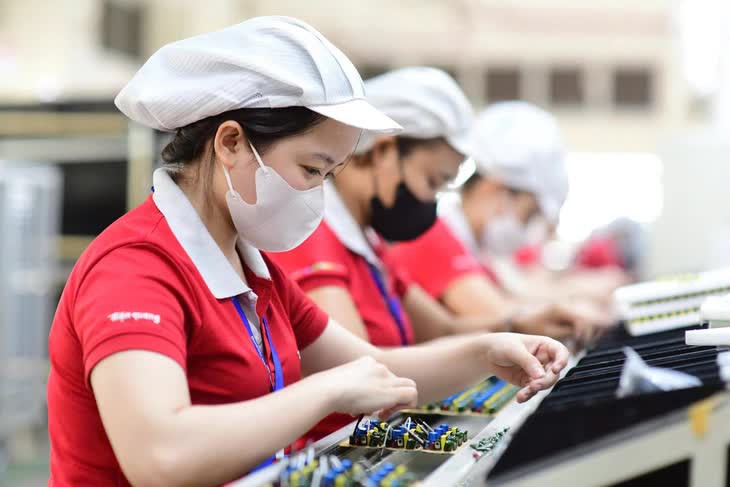
A significant portion of businesses lack a specific bonus mechanism, or if they have one, the bonus amount is modest, mainly serving as moral encouragement without creating real motivation for workers.
Recently, in a speech at the 11th Congress of the Vietnam Fatherland Front, the President of the Vietnam General Confederation of Labor proposed a solution regarding the need to research, propose, and negotiate with a bonus mechanism based on the value of benefits created.
This is an opinion with a solid theoretical and practical basis. Theoretically, when workers have initiatives and innovations that create added value beyond their tasks and labor norms, benefiting the business, they are very deserving of a share of that value.
Need full recognition and specific solutions
In corporate management, rewarding workers from the value of benefits created will promote new initiatives and innovations, helping businesses increase revenue and profits.
However, in practice, a significant portion of businesses lack a specific bonus mechanism, or if they have one, the bonus amount is modest, mainly serving as moral encouragement without creating real motivation for workers to strive, innovate, overcome difficulties, and come up with initiatives and innovations to promote business development.
This reality leads to losses for both businesses and workers, lacking a competitive atmosphere for innovation and creativity throughout society. This is a waste that we need to fully recognize and address with specific solutions.
From experience in many work environments and a concern for improving workers’ lives, the president is very interested in this issue and has asked the professional department of the General Confederation to research, advise, and propose solutions.
First, the Vietnam General Confederation of Labor will recommend to the National Assembly and the Government to focus on building and perfecting legal documents on a mechanism for appropriate rewards for those with initiatives and innovations that benefit businesses.
The issue is that these documents must be complied with by all types of businesses, as this is a specific content of benefit distribution requiring state intervention through law.
Researching legislative history, I see that since 1965, the Government Council issued regulations on rewarding initiatives for technical improvements, production rationalization, and work process improvements (Decree 20-CP dated February 8, 1965), with a general reward level of 25% of the value of benefits created.
Meanwhile, Decree No. 13/2012/ND-CP of the Government on issuing the Charter of Initiatives currently in effect stipulates a minimum remuneration of 7% of the profit amount, with a maximum level for businesses to decide.
Clearly, researching and proposing a higher reward level is a priority for the union in the coming time.
In addition, we will propagate and mobilize the business community and public service units to pay attention and provide appropriate rewards to workers.
Many businesses mainly offer moral encouragement
At grassroots unions, the executive committee must negotiate with employers on this specific clause.
To do this well, union officials must understand the field of initiatives and innovations, labor productivity, and the value of benefits created; they must be bold and assertive in presenting viewpoints, arguments, and reaching consensus on specific provisions in collective labor agreements or labor rules, while also monitoring implementation.
Recently