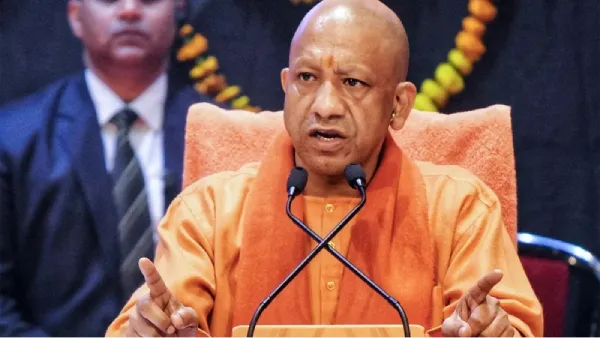
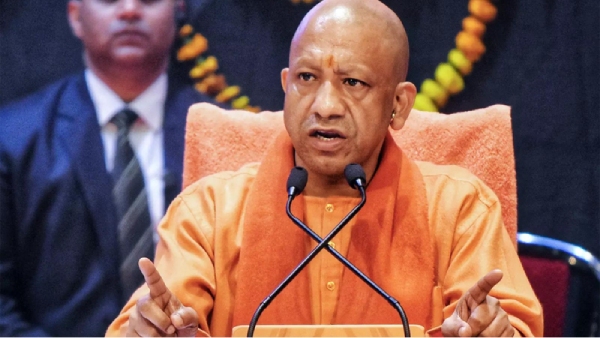
“Won’t allow namaz on UP’s roads; accept it lovingly, or there are other ways too,” CM Yogi’s blunt warning.
UP CM Yogi Adityanath On Namaz Warning: Before Bakrid (Eid-ul-Adha) 2026, the political and administrative atmosphere in Uttar Pradesh has heated up once again. Chief Minister Yogi Adityanath has made a very strict statement regarding offering namaz on roads. During an event in Lucknow, he clearly stated that namaz on roads will not be allowed in UP, and public pathways cannot be used for any religious gatherings.
CM Yogi said that roads are meant for people’s movement. No individual or group can block roads to conduct religious activities. He also said that if people follow the rules willingly, it is good, but if anyone tries to break the law, the government has other methods as well.
The Chief Minister’s statement comes at a time when preparations for Bakrid, i.e., Eid-ul-Adha 2026, have already begun. Every year, large numbers of people offer Eid prayers in many cities, and roads sometimes get jammed in some places. Keeping this in mind, the government wants to send a message of strictness in advance. This statement was made before Bakrid (around May 27, 2026), when large-scale prayer preparations usually take place. The government’s clear message is that road blockages will not be tolerated.
Yogi Government’s Tough Stance: Why and How?
Yogi Adityanath has repeatedly said that roads are not meant for religious events. According to him:
Roads are for traffic.
Every community should show religious discipline.
During events like Mahakumbh, crores of devotees maintained discipline without any disruption; others should learn from this example.
The CM said that if people comply willingly, it is fine; otherwise, action will be taken according to the law. In several districts, the administration has already issued warnings that strict action will be taken against offering namaz on roads.
The Story of Change in UP
In previous years, offering namaz on roads in many cities of UP (Meerut, Saharanpur, Lucknow, etc.) caused traffic jams. Ordinary citizens, school children, office-goers, and emergency services faced difficulties. The Yogi government tightened control upon coming to power:
Namaz only in mosques or designated Eidgahs.
Azaan sound on loudspeakers limited to inside the mosque.
No religious event at public places should disrupt traffic.
On Bakrid, animal sacrifice only at designated places.
The government argues that the law is equal for everyone. During Hindu festivals (Kumbh, Shivratri, Rath Yatra, etc.), road jam complaints also arise, but discipline is maintained.
Allahabad High Court’s Stance
In Uttar Pradesh, this policy is supported not only administratively but also from a judicial perspective. The Allahabad High Court has clearly stated multiple times that there is no right to offer namaz on public roads or parks. Religious freedom does not mean misuse of public facilities.
Preparations for Bakrid 2026
In view of Bakrid 2026 (likely May 27), instructions have been given to DM and SP of all districts:
Adequate arrangements at designated Eidgahs and mosques.
Selection of alternative places for additional prayers.
Traffic police on alert.
Immediate action against any crowd or jam.
Designated slaughterhouses or places for sacrifice.
Situation in Major Cities
In cities like Lucknow, Kanpur, Meerut, Ghaziabad, Aligarh, and Saharanpur, road namaz was common earlier. Now the administration is being strict. Police and local administration are already talking to community leaders.
Yogi’s Broader Message
This statement is not limited to just one festival. It is part of the policy of ‘rule of law’ and ‘public discipline’ in UP. The CM often
Lucknow
Lucknow, the capital of Uttar Pradesh, India, is renowned for its rich cultural heritage, particularly its refined “Ganga-Jamuni” culture blending Hindu and Muslim traditions. It flourished as the seat of the Nawabs of Awadh in the 18th and 19th centuries, who were great patrons of arts, music, and architecture, leaving landmarks like the Bara Imambara and the Rumi Darwaza. Often called the “City of Nawabs,” it is also famous for its distinctive cuisine, embroidery (Chikankari), and etiquette.
Meerut
Meerut is a historic city in the Indian state of Uttar Pradesh, famously known as the birthplace of the 1857 Indian Rebellion against British rule, which began at the local cantonment. The city has a rich history dating back to ancient times, with references in Hindu mythology and later serving as an important center during the Mughal and British colonial periods. Today, Meerut is a bustling industrial and educational hub, known for its sports goods and scissors manufacturing.
Saharanpur
Saharanpur is a historic city in the Indian state of Uttar Pradesh, known for its rich cultural heritage and wood carving industry. It was founded in the 14th century by Sultan Muhammad Shah Tughlaq and later flourished under the Mughal Empire, becoming an important center for arts and crafts. Today, it is famous for its intricate woodwork, particularly the Saharanpur wood carving, which has earned the city a Geographical Indication (GI) tag.
Allahabad High Court
The Allahabad High Court, located in Prayagraj (formerly Allahabad), India, is one of the oldest high courts in the country, established in 1866. Its origins trace back to the British colonial era, when it was created as a court of record following the merger of the Sudder Diwani and Sudder Nizamat Adalats. The court has played a significant role in Indian legal history, including hearing landmark cases such as the Ayodhya dispute.
Kanpur
Kanpur, located in the Indian state of Uttar Pradesh, is a major industrial city known historically as a key center of the British Raj’s textile and leather industries. It played a significant role in the Indian Rebellion of 1857, notably the Siege of Cawnpore, a tragic event where many British and Indian civilians lost their lives. Today, Kanpur is a bustling urban hub, blending its colonial-era architecture with modern industries and cultural landmarks.
Ghaziabad
Ghaziabad is a city in the Indian state of Uttar Pradesh, located near the national capital, New Delhi. Historically, it was founded in 1740 by the Mughal emperor Muhammad Shah’s nobleman, Ghazi-ud-Din, and was originally named Ghaziuddin Nagar after him. Today, it is a rapidly growing industrial and commercial hub, often considered a satellite city of Delhi.
Aligarh
Aligarh is a city in the northern Indian state of Uttar Pradesh, historically significant as the center of the 1857 Indian Rebellion and later for the Aligarh Movement, a socio-religious reform initiative led by Sir Syed Ahmad Khan. It is most famous for Aligarh Muslim University (AMU), founded in 1875 as the Muhammadan Anglo-Oriental College, which played a pivotal role in modern education for South Asian Muslims. The city also houses historical landmarks like Aligarh Fort, built by the Dor Rajputs and later modified by the British.
Mahakumbh
Mahakumbh, also known as the Kumbh Mela, is a major Hindu pilgrimage and festival held in a cycle of approximately 12 years at four rotating locations in India: Prayagraj, Haridwar, Ujjain, and Nashik. Its origins are rooted in Hindu mythology, where it is said to commemorate the battle between gods and demons over a pot (kumbh) of the nectar of immortality, with drops falling at these four sacred sites. The Mahakumbh, specifically the largest gathering at Prayagraj, is recognized as the world’s largest peaceful congregation of people, drawing millions of devotees for ritual bathing in holy rivers.