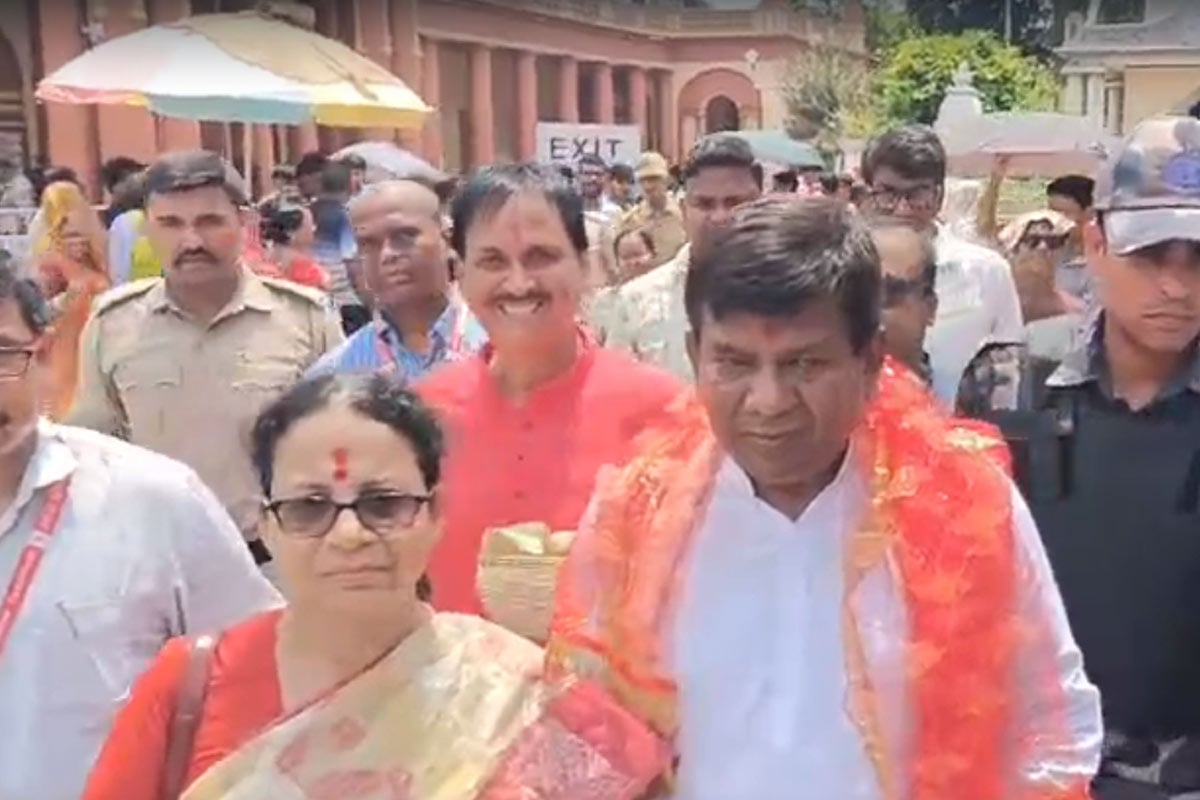
The BJP government believes in democracy. Leaders of the opposition in the Assembly will have the “space to speak.” The Leader of the Opposition will not have to stay out of the Assembly for long. On the day after taking charge as Speaker of the Assembly, Rathindra Bose made this clear. His unambiguous message: “The democratic space that the opposition needs, the time to speak—all of that will be there. This is democracy, and we believe in democracy.” On Saturday, the auspicious occasion of Falharini Amavasya, after offering prayers with his wife, the Speaker described the political change in the state as “the blessing of Mother Kali.”
The day after assuming the role of Speaker of the Assembly, Rathindra Bose visited the temple of Mother Bhabatarini in Dakshineswar. After the prayers, he faced journalists in the temple complex. There, he criticized the previous government regarding the state’s parliamentary democracy and the role of the opposition. He said, “We are not like other governments. Our government is running in 21 states. Nowhere has a situation arisen where the Leader of the Opposition had to stay outside for 11 months.”
He further stated, “We are Sanatani. Mother Kali is our revered deity. It is because of the blessings of Mother Kali that change has occurred in Bengal.” According to him, it is Mother Kali who has protected the Sanatani Hindus in West Bengal. Therefore, on this holy occasion of Falharini Amavasya, bowing at the feet of the Mother, he prayed that “everyone in Bengal live in happiness and peace, and prosper.” After the prayers at Dakshineswar, Rathindra Bose went to the Adyapith in Ariadaha. There, he partook of the offerings to Mother Adya with his wife and received the blessings of Brahmachari Murali Bhai.
Notably, in the recent history of the state, this is the first time a legislator from North Bengal has become the Speaker of the West Bengal Assembly. Rathindra Bose, the BJP legislator from the Cooch Behar South constituency, has been elected as a member of the legislative assembly for the first time. A Chartered Accountant by profession, Rathindra has been associated with the RSS for a long time. He is currently the Vice-President of the state committee of the BJP. In the Assembly elections, he defeated Trinamool Congress candidate Abhijit De Bhowmik in the Cooch Behar South constituency by a margin of over 23,000 votes.
Dakshineswar
Dakshineswar is a famous Hindu temple complex located on the eastern bank of the Hooghly River in Kolkata, India. Built in 1855 by Rani Rashmoni, a wealthy philanthropist, it is dedicated to the goddess Kali and is closely associated with the 19th-century mystic Ramakrishna Paramahamsa, who served as its head priest. The site remains a major pilgrimage destination, drawing devotees to its central temple and the twelve smaller shrines dedicated to Shiva.
temple of Mother Bhabatarini
The Temple of Mother Bhabatarini, located in the Dakshineswar Kali Temple complex near Kolkata, India, is a revered Hindu shrine dedicated to the goddess Kali in her form as Bhabatarini. Built in 1855 by Rani Rashmoni, a philanthropist and devotee, the temple is historically significant as the place where the 19th-century saint Ramakrishna Paramahamsa served as a priest and attained spiritual enlightenment. It remains an important pilgrimage site, attracting thousands of devotees who seek the goddess’s blessings.
Adyapith
Adyapith is a significant cultural and educational institution located in Kolkata, India, established in 1905 by the renowned social reformer and religious leader Swami Vivekananda. It serves as a center for learning, spiritual growth, and the study of Indian philosophy and culture, reflecting Vivekananda’s vision of combining modern education with traditional values. The institution continues to promote intellectual and moral development, honoring its historical roots in the Indian renaissance movement.
Ariadaha
Ariadaha is a neighborhood in the northern part of Kolkata, India, located along the eastern bank of the Hooghly River. Historically, it was a small village that developed into a bustling urban area during the late 19th and early 20th centuries, partly due to the establishment of the Ariadaha rail and road bridges connecting it to the rest of the city. Today, it is known for its residential communities, local markets, and the historic Ariadaha Khal, a canal that once served as a key waterway for trade and transport.
Cooch Behar South
Cooch Behar South refers to the southern part of the Cooch Behar district in West Bengal, India, which was once part of the princely state of Cooch Behar under the Koch dynasty. Historically, this region was influenced by the Kamata Kingdom and later came under British colonial rule, with its cultural identity shaped by Rajbanshi traditions. Today, it is known for its rural landscapes, agricultural economy, and proximity to the larger Cooch Behar town, which features landmarks like the Cooch Behar Palace.