Demands to resume flights to Dubai, Sharjah and Bangkok, detailed discussion on infrastructure expansion of Surat Airport
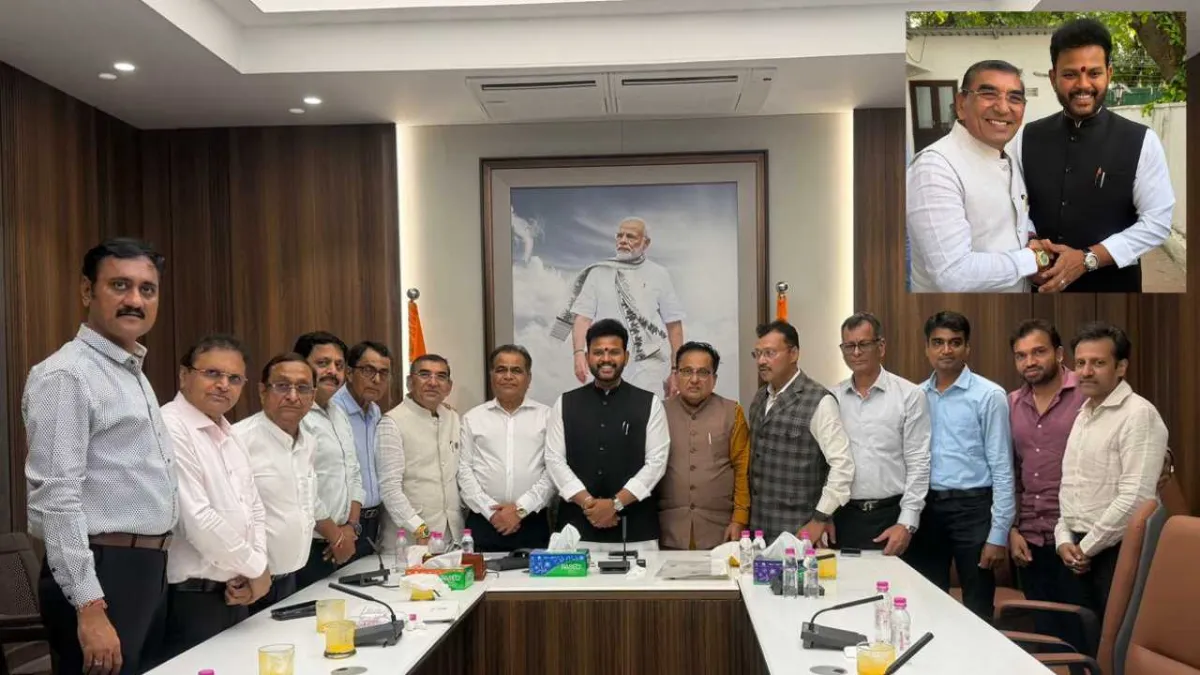
Surat. In New Delhi, a delegation from the Southern Gujarat Chamber of Commerce and Industry (SGCCI) met with Union Civil Aviation Minister Kinjarapu Ram Mohan Naidu and gave a detailed presentation on issues related to air connectivity and infrastructure development at Surat International Airport. The delegation was led by SGCCI President-Designate Ashok Jirawala.
This important meeting was organized at the residence of Union Jal Shakti Minister and Navsari MP C.R. Patil in New Delhi through his special mediation and coordination. The meeting discussed airport development in detail, considering the rapidly growing industrial and commercial needs of South Gujarat.
Demand to make Surat a ‘Point of Call’
In the presentation, SGCCI stated that Surat is a rapidly emerging economic hub of the country, with global influence in the diamond, textile, engineering, chemicals, and MSME sectors. Despite this, even after being declared an international airport, there remains a lack of international flights and modern facilities.
The delegation demanded that Surat be included as a “Point of Call” under the Air Service Agreement (ASA), so that international airlines can be permitted to operate direct flights from Surat.
Additionally, they urged the resumption of previously operated international flights from Surat to Dubai, Sharjah, and Bangkok. The chamber noted that there is huge demand on these routes from business travelers, NRIs, and Gujarati migrants.
Demand for connectivity to new cities including Mumbai and Bhubaneswar
The meeting also proposed increasing the number of daily flights between Surat and Mumbai, and introducing additional frequency on the Delhi sector. Furthermore, a demand was made to start direct flights from Surat to Bhubaneswar, to facilitate workers and industries between Odisha and Gujarat.
The chamber also highlighted the need to start air connectivity to major cities such as Jodhpur, Jaisalmer, Ranchi, Patna, Varanasi, Kochi, Coimbatore, Indore, and Lucknow. A request was also made to approve additional UDAN routes to enhance regional connectivity.
Emphasis on airport infrastructure expansion
The delegation demanded permission for simultaneous operation of domestic and international flights at Surat Airport. They also proposed developing a full-fledged international cargo terminal with customs clearance facilities to reduce exporters’ dependence on Mumbai.
To prevent flight delays during bad weather, they demanded the installation of a CAT-I landing system and an advanced approach lighting system. Additionally, suggestions were made to start duty-free shops at the airport and modernize it under a PPP model.
2047 Master Plan and future preparations
The chamber informed that in 2023, a modern terminal of 25,520 square meters was developed at Surat Airport, with an annual capacity of 5.5 million passengers. Facilities such as 24×7 operations and night parking are also available at the airport.
The meeting also discussed the vision under the Airport Master Plan-2047 to develop capacity to handle 22.5 million passengers annually in the future. A suggestion was also made to allow electric vehicles in airside operations.
Minister gave positive assurance
Union Civil Aviation Minister Kinjarapu Ram Mohan Naidu listened seriously to all the issues raised by the delegation and gave assurance of positive consideration and necessary action.
The meeting was attended by Airport Advisory Committee members Paresh Patel, Suresh Agarwal, Keyur Kheni, Kewal Shah, Pramod Chaudhary, Vinod Agarwal, Kunjvihari Sultania, Subhash Patodia, J.P. Agarwal, Jeetubhai Vakharia, Anand Desai, Nagjibhai Sakaria, Bhuratal Shah, Kailash Hakim, Vishal Budhia, and Bharat Sukhadia, along with several industrialists and representatives of trade organizations from South Gujarat.