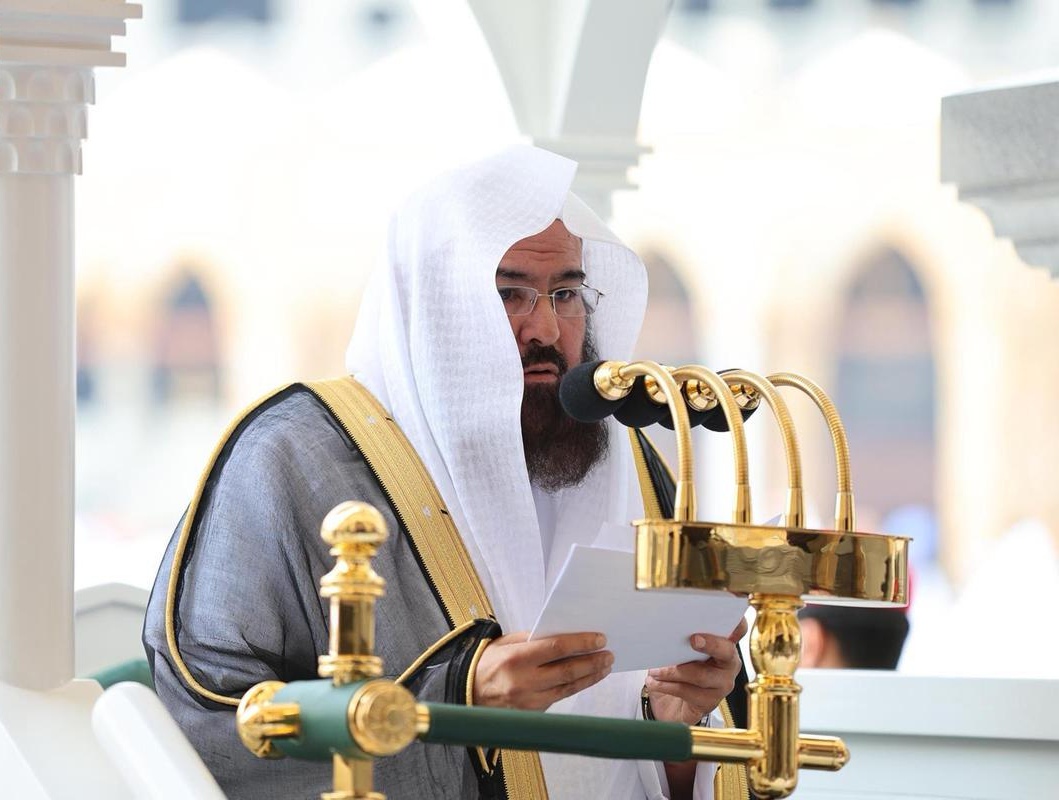
The Imam and Khateeb of the Grand Mosque advised Muslims to fear God Almighty and hasten to seize the seasons of goodness and obedience, emphasizing that the obligation of Hajj is one of the greatest rituals of Islam, where the meanings of guidance and blessings are manifested in the sanctuary of the Sacred House, which God Almighty made: “a blessing and a guidance for the worlds.”
During the Friday sermon delivered at the Grand Mosque, it was explained that God has blessed Mecca with a unique status; it is the place of revelation, the mission of the prophets, and the heart’s desire of Muslims. In it is the first house established for people to worship God, in accordance with His saying: “Indeed, the first House [of worship] established for mankind was that at Bakkah [Mecca] – blessed and a guidance for the worlds.”
It was pointed out that among the greatest characteristics of the Ancient House is the security and tranquility that God has exclusively granted it, citing His saying: “God has made the Kaaba, the Sacred House, a support for the people,” and His saying: “And whoever enters it is safe.” It was affirmed that this security is firmly established by God’s decree until the Day of Resurrection, as stated in the Prophet’s hadith: “Indeed, this city was declared sacred by God on the day He created the heavens and the earth, so it is sacred by God’s sanctity until the Day of Resurrection.”
It was said: “Hajj is a great act of worship based on achieving pure monotheism for God Almighty, in compliance with His saying: ‘And [remember] when We assigned to Abraham the site of the House, [saying], “Do not associate anything with Me,”‘ and following the guidance of the Prophet,” explaining that among its greatest fruits is what is mentioned in the authentic hadith: “Whoever performs Hajj for God and does not engage in sexual relations or commit sin, will return as on the day his mother bore him.”
It emphasized the necessity of revering the sanctity of the place, contemplating its sacredness, and avoiding anything contrary to the objectives of Sharia, affirming that God has surrounded the Sacred House with a fence of awe and veneration, so no aggression, corruption, or terrorizing of the secure is allowed, in compliance with God’s saying: “And whoever intends [to commit] deviation or wrongdoing therein – We will make him taste a painful punishment.”
The importance of the Islamic nation’s awareness of the misleading campaigns and calls for discord it faces was also highlighted, stressing that the current stage requires verification, wisdom, unity of word, and enhancing awareness of the status of the Two Holy Mosques as the qibla of Muslims and the focus of their hearts. Pilgrims to the Sacred House of God were called to thank God Almighty for the blessing of reaching these holy places, to embody good character, and to make that a hallmark of their conduct, while encouraging cooperation, helping the weak, adhering to serenity and gentleness, and avoiding crowding and pushing.
The Imam and Khateeb of the Grand Mosque affirmed the importance of adhering to the regulations and instructions governing Hajj, including performing the obligation with a permit, to achieve the Sharia objectives of preserving lives and organizing crowds. The efforts of the relevant authorities in serving the guests of the Most Merciful and their organizational and security work that facilitates the performance of rituals were praised, asking God Almighty to protect the pilgrims of His Sacred House, to complete their rituals in safety and ease, to perpetuate the blessing of security and stability upon the kingdom, and to guide those in authority to everything that serves Islam and Muslims.
Grand Mosque
The Grand Mosque, also known as the Sheikh Zayed Grand Mosque in Abu Dhabi, is a stunning architectural masterpiece that blends modern and classical Islamic design. Completed in 2007, it was built to honor the late UAE founder, Sheikh Zayed bin Sultan Al Nahyan, and features 82 domes, marble courtyards, and one of the world’s largest hand-knotted carpets. It serves as a major cultural landmark, welcoming visitors of all faiths to experience its serene beauty and Islamic heritage.
<div class="my-4 p-4 rounded-lg
Grand Mosque
The Grand Mosque, also known as the Sheikh Zayed Grand Mosque in Abu Dhabi, is a stunning modern architectural masterpiece that blends Mamluk, Ottoman, and Fatimid design styles. Completed in 2007, it was built to honor the late UAE founder, Sheikh Zayed bin Sultan Al Nahyan, and serves as a place of worship and a major cultural landmark, welcoming visitors from all backgrounds. Its history reflects the UAE’s vision of unity, tolerance, and artistic excellence.
Mecca
Mecca, located in western Saudi Arabia, is the holiest city in Islam and the birthplace of the Prophet Muhammad. Its history dates back to pre-Islamic times as a trading hub, but it became the spiritual center of the Islamic world after Muhammad’s revelations in the 7th century. The city is home to the Masjid al-Haram (the Grand Mosque) and the Kaaba, which Muslims face during daily prayers and is the focal point of the annual Hajj pilgrimage.
Kaaba
The Kaaba is a sacred cube-shaped building located in the center of the Grand Mosque in Mecca, Saudi Arabia, and is the holiest site in Islam. According to Islamic tradition, it was originally built by the Prophet Abraham and his son Ishmael as a house of monotheistic worship, and it has been a focal point for pilgrimage and prayer for centuries. Muslims around the world face the Kaaba during their daily prayers, and it is the destination of the Hajj pilgrimage, which all able Muslims are required to undertake at least once in their lifetime.
Sacred House
The Sacred House, known as the Kaaba in Mecca, Saudi Arabia, is the holiest site in Islam. According to Islamic tradition, it was originally built by the prophet Abraham and his son Ishmael as a house of monotheistic worship, and it was later rededicated by the Prophet Muhammad. Muslims around the world face toward the Sacred House during their daily prayers, and it is the focal point of the Hajj pilgrimage.
Ancient House
The “Ancient House” in Ipswich, England, is a beautifully preserved 15th-century timber-framed building known for its intricate carvings and decorative plasterwork. Originally built as a merchant’s home, it later served as a shop and has become a notable example of Tudor architecture. The site reflects the town’s prosperous medieval trading history and is now a popular visitor attraction.
Bakkah
Bakkah is an ancient name for Mecca, the holiest city in Islam, located in present-day Saudi Arabia. Mentioned in the Quran, it is traditionally considered the site where the Prophet Ibrahim (Abraham) and his son Ismail (Ishmael) built the Kaaba, the sacred structure towards which Muslims pray. The city’s history as a major religious and trade center dates back centuries before the rise of Islam, and it remains the destination of the annual Hajj pilgrimage.
Two Holy Mosques
The “Two Holy Mosques” refers to the Masjid al-Haram in Mecca and the Prophet’s Mosque in Medina, the two holiest sites in Islam. Masjid al-Haram surrounds the Kaaba, which Muslims believe was built by Abraham and Ishmael, while the Prophet’s Mosque was established by the Prophet Muhammad and houses his tomb. These mosques are central to Islamic pilgrimage, with millions of Muslims visiting them annually for Hajj and Umrah.
Sacred House of God
The “Sacred House of God” is most commonly understood as a reference to the Kaaba, the holiest site in Islam, located in Mecca, Saudi Arabia. According to Islamic tradition, it was originally built by the Prophet Abraham and his son Ishmael as a monotheistic house of worship, and it has been a central pilgrimage site for Muslims for over 1,400 years. The Kaaba is the qibla, the direction Muslims face during prayer, and it is draped in a black silk cloth known as the Kiswa.