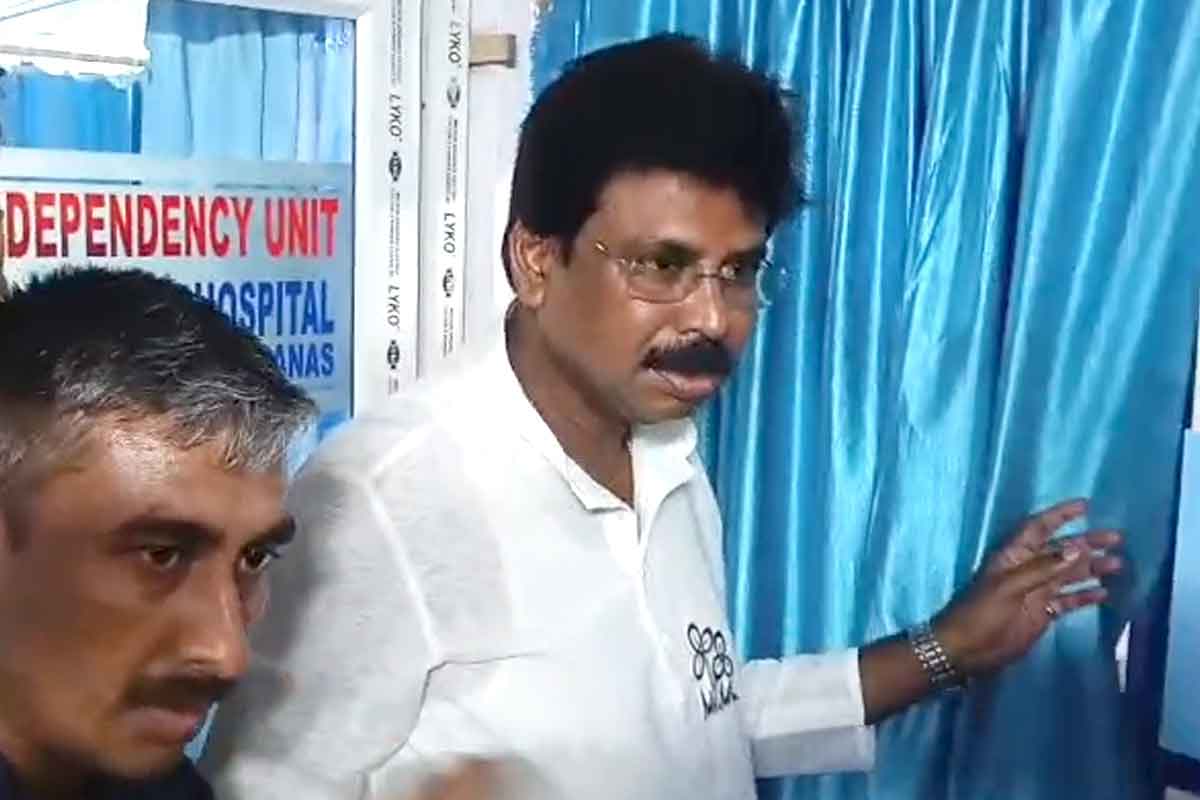
TMC candidate visits hospital to check on ailing BJP rival, setting aside campaign after a photo emerges in Bongaon.
TMC candidate visits hospitalized BJP opponent during campaign.
The second phase of political campaigning is at its peak. All political parties are campaigning in various places. Amidst this, political courtesy was seen in Bongaon. The Trinamool Congress candidate went to the hospital to visit the ailing BJP candidate. This morning, Saturday, such a scene of courtesy was witnessed in Bongaon, North 24 Parganas.
More on this topic
It has been learned that Ashok Kirtania, the BJP candidate from the Bongaon North constituency, has been affected by fever, cold, and cough. Due to his illness, he returned from campaigning last night, Friday, and was admitted to the Bongaon Subdivisional Hospital. Today, Saturday morning, Trinamool Congress candidate Biswajit Das set out for campaigning. During the campaign, Biswajit Das learned that Ashok Kirtania had fallen ill and was hospitalized. Immediately after, leaving his campaign behind, the Trinamool candidate reached the hospital.
It has been learned that the BJP candidate is admitted to the hospital’s High Dependency Unit. The Trinamool candidate went there and met Ashok Kirtania. The two spoke for a while. Trinamool candidate Biswajit Das wished the BJP candidate a speedy recovery. After meeting the BJP candidate and coming out, Biswajit Das said, “This is political courtesy. He is my opponent, but that is on the political battlefield. Chief Minister Mamata Banerjee established the High Dependency Unit at Bongaon Hospital. Many people are admitted there and benefit. Ashok Babu is recovering there. The doctor said he is much better now.”
Bongaon Hospital Superintendent Krishnachandra Barui said, “No matter which party someone does politics for, if they fall ill and come to us, it is our duty to treat them as our patient. Ashok Babu is now much better.” Regarding this, BJP leader Diptendu Bikash Bairagi said, “Biswajit Das has come to show political courtesy, and he may come. But if there is any political motive behind this, it will not yield any benefit. The people of Bongaon have already made their decision.”
Bongaon
Bongaon is a historic town in West Bengal, India, located near the Bangladesh border. It was an important center for the indigo trade during the British colonial period and is known for its association with the 19th-century religious reformer Ramakrishna Paramahamsa, who served as a temple priest here. Today, Bongaon is a significant railway junction and a gateway for cross-border travel.
Bongaon North constituency
Bongaon North is a constituency in the Indian state of West Bengal, located in the North 24 Parganas district. It is part of the Bongaon Lok Sabha constituency and has a history tied to the region’s agricultural and cultural heritage, with the area once serving as a significant trading hub during the British colonial period. Today, it remains a key political and administrative center, reflecting the diverse social fabric of the Bengal delta.
Bongaon Subdivisional Hospital
Bongaon Subdivisional Hospital is a key healthcare facility located in Bongaon, West Bengal, India, serving the surrounding rural and urban communities. Its history is tied to the development of the region’s medical infrastructure, likely established
Bongaon
Bongaon is a historic town in West Bengal, India, known for its rich cultural heritage and proximity to the Bangladesh border. It was a significant trading center during the British colonial period and is famous for the annual “Rash Mela” festival, which celebrates the region’s folk traditions. The town also serves as a gateway to the Sundarbans and is noted for its traditional terracotta temples and handloom weaving.
Bongaon North constituency
The Bongaon North constituency is a legislative assembly seat in West Bengal, India, located in the North 24 Parganas district. It was formed in 2011 following a delimitation process, and its history is tied to the broader political landscape of the region, which has seen significant influence from the Communist Party of India (Marxist) and later the Trinamool Congress. The constituency includes parts of the Bongaon municipality and surrounding rural areas, reflecting a mix of urban and agricultural communities.
Bongaon Subdivisional Hospital
Bongaon Subdivisional Hospital is a government healthcare facility located in Bongaon, West Bengal, India, serving as a key medical center for the surrounding region. Its history is tied to the area’s development, likely established or expanded after India’s independence in 1947 to meet the healthcare needs of the growing population in this border district. Today, it provides essential medical services, including outpatient and inpatient care, to the local community.
North 24 Parganas
North 24 Parganas is a district in the Indian state of West Bengal, located just north of Kolkata. Historically, it was part of the larger 24 Parganas district created during the British colonial era, named after the 24 revenue subdivisions or “parganas” established by the Mughals. Today, it is known for its diverse culture, the Sundarbans mangrove forest in its southern reaches, and its role as a key suburban and industrial hub.
Bongaon Hospital
Bongaon Hospital, located in the Bongaon subdivision of West Bengal, India, is a key healthcare institution serving the local population. Established in the early 20th century during the British colonial period, it has a long history of providing medical services, evolving from a small facility into a larger, modern hospital. Today, it continues to play a vital role in community health, offering a range of treatments and emergency care.
High Dependency Unit
The High Dependency Unit (HDU) is an intermediate-care hospital ward for patients who require more monitoring and observation than a general ward can provide, but less intensive care than an intensive care unit (ICU). Historically, HDUs emerged in the late 20th century as a cost-effective way to bridge the gap between general wards and ICUs, offering specialized nursing and equipment for patients with single-organ failure or those recovering from major surgery. They have since become a standard component of many modern hospitals, improving patient outcomes by preventing unnecessary ICU admissions and facilitating step-down care.