Recently, the STAR Market has continued to recover. Since April 1, the STAR 50 Index has risen by 15.71%. During this period, a total of 47 individual stocks on the STAR Market hit new historical highs.
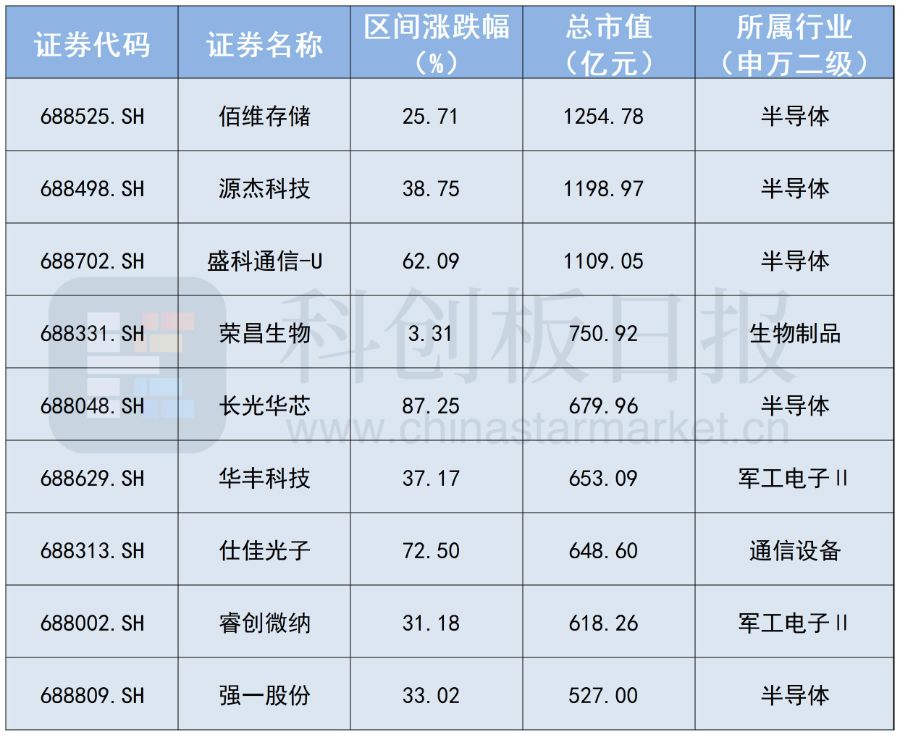
After analyzing 11 companies with a total market capitalization exceeding 50 billion yuan, it was found that the AI computing hardware sector accounts for the vast majority of this list, including companies such as Biwin Storage, Yuanjie Technology, Shengke Communication, Everlight Electronics, Huafeng Technology, Shijia Photonics, and Qiangyi Stock. Among these, except for Biwin Storage and Qiangyi Stock, the remaining stocks belong to the optical communication sector.
In terms of interval gains, the optical communication sector also holds a relatively leading position. Among them, Everlight Electronics and Shijia Photonics are particularly notable, with cumulative gains of 87.25% and 72.50%, respectively.
The computing hardware track, centered on optical communication, was the main line with the highest consensus among funds in early April. Moreover, the profit-making effect is no longer limited to the CPO concept, but has spread across the entire industry chain, including sub-sectors such as OCS, PCB, optical fiber, and optical chips. Additionally, there is a trend of rotation from high to low within computing hardware, with stocks like Changxin Bochuang, Guangxun Technology, and Shijia Photonics, which were previously at relatively low positions or had fully adjusted, showing sharper gains.
The concentrated influx of funds into the “optical” sector is not coincidental. As of press time, some of the aforementioned optical communication concept stocks have disclosed their first-quarter reports for 2026, with many showing excellent performance. For example, Everlight Electronics achieved operating revenue of 130 million yuan, a year-on-year increase of 37.81%; net profit attributable to shareholders of the listed company was 4.4796 million yuan, turning losses into profits year-on-year.
This performance growth may stem from the explosion in demand for optical communication. In its first-quarter report, Shijia Photonics mentioned that the market demand related to artificial intelligence has increased, the company’s production and operation capabilities have improved, and product sales orders have increased. Everlight Electronics stated that it adheres to a horizontal expansion strategy, and the revenue growth in the first quarter mainly came from the growth of previously deployed optical communication businesses.
Outside the STAR Market, the optical communication leader Zhongji Innolight exceeded expectations in its first-quarter report. The company achieved a net profit attributable to the parent company of 5.7 billion yuan, a year-on-year and quarter-on-quarter increase of 262% and 56%, respectively. The performance change is mainly due to the strong investment by end customers in computing infrastructure, leading to continued growth in product shipments. In its latest report, it was stated that as data center architecture evolves from horizontal to vertical, it brings higher bandwidth and more connection needs, significantly driving the expansion of the overall serviceable market.
From the perspective of overseas mapping, Lumentum’s demand for optical components from U.S. hyperscale data center customers is accelerating, and orders are already fully booked through 2028. Meanwhile, Applied Optoelectronics stated in a conference call that it aims to achieve monthly production capacity of over 500,000 units of 800G and 1.6T by the end of 2026, while also planning to more than triple its optical chip production capacity in Texas, reflecting the urgent and continuously overflowing “additional order” demands from downstream customers.
In a research report on April 22, it was indicated that as the market gradually becomes desensitized to the turbulence in the Middle East, optical communication has become the track with the highest certainty of benefiting from this round of AI investment explosion and has vast long-term space, potentially showing significant excess returns over the broader market. In addition to leading optical module stocks that are consistently delivering performance, funds are expected to spill over more to “small optical” targets from individual stock position considerations.
Commercial Aerospace and Innovative Drugs Emerge
From the above list, it can be seen that besides companies “standing in the light,” some commercial aerospace and innovative drug concept stocks are also favored by funds. For example, Raytron Technology has laid out both satellite payloads and ground terminals. The company stated that it will actively explore more application areas and strive to continue growing by riding the wave of commercial aerospace.
It is worth noting that the commercial