Perfect timing, it’s on fire! Yuexiushan Stadium celebrates its 100th birthday tonight with a match to watch.
In April 1926, on a dirt football field at the foot of Yuexiu Mountain, the first city-wide school sports meet of Guangzhou was held here.
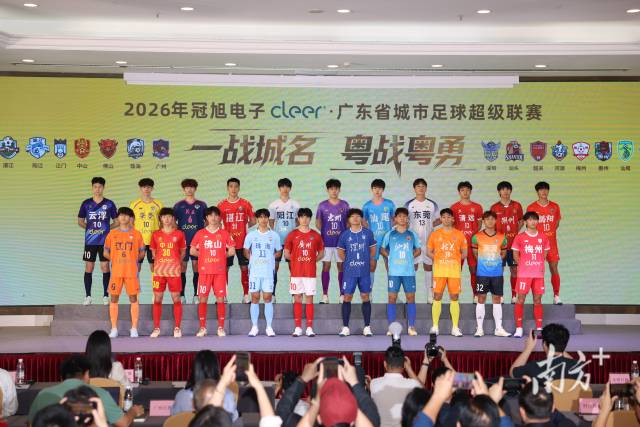
A hundred years later, in the same April, the lights of Yuexiushan Stadium lit up as the opening match of the Guangdong Super League was about to begin. The phrase “Conquer the city with fame, fight with courage in Guangdong” opened a new chapter for this mountain.
The field has been upgraded with new turf, and the stands now have seats. The whistle is about to blow, and the whole mountain holds its breath.
The Golden Age, Hidden in a String of Shining Names
Going to watch a match at Yuexiushan Stadium is called “going up the mountain to watch the ball” by locals.
The stadium is actually located in a valley of Yuexiushan. This natural bowl-shaped field, built according to the terrain, is the “treasure bowl” of Guangdong football.
Since the 1950s, generations of players have emerged from here, and countless battles have been fought here.
The cheers in the valley have never stopped. Some names are repeated so often that they become legends.
Su Yongshun, a coach from Guangzhou. He designed a short-pass training drill for the Guangdong team involving three players crossing positions within 15 meters, allowing players to develop默契 through quick passing.
In 1975, the Guangdong team won the National Games championship for the first time. The “fast, accurate, clever” style of Southern Chinese football was shaped under his guidance.
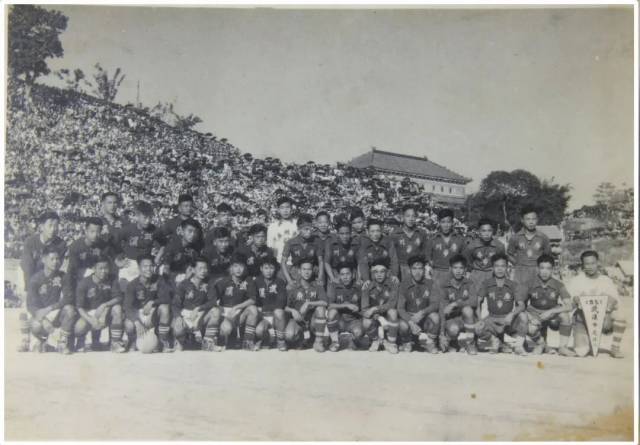
In 1951, the Central-South China football final was held at Yuexiushan, where the Guangzhou team defeated Wuhan 2-0 to win the title. Su Yongshun (front row, fourth from right), then 17, was the youngest member of the Guangzhou team.
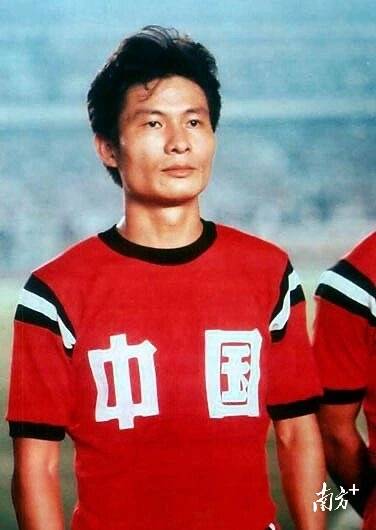
During the same period, fans in the stands of Yuexiushan began to repeatedly chant another name—Rong Zhixing.
Originally from Taishan, Jiangmen, he practiced football at Baogang Stadium as a youth. In his 18-year career, he never received a single yellow or red card.
During one match, he dribbled into the penalty area, and two opposing defenders collided and fell. Facing an open goal, he stopped, reached out, and helped them up. The crowd paused for a moment, then burst into applause.
In 1978, the Sports Daily first used the term “Zhixing Style” to summarize his sportsmanship and character. Pelé gifted him a number 10 jersey and called him “world-class.”
At the 2025 National Games, at age 77, he once again climbed Yuexiushan as a torchbearer.
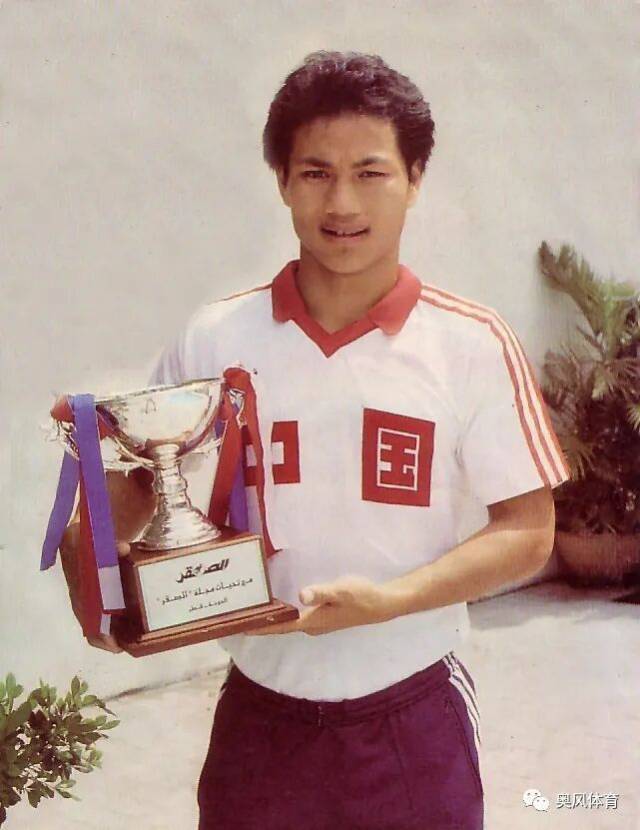
Around the same time as Rong Zhixing, there was another person. Standing only 1.62 meters tall, he almost didn’t make it onto the team. Coach Luo Rongman slammed the table and said, “Keep him.”
In 1984, Zhao Dayu won the top scorer award at the Asian Cup qualifiers held in Guangzhou.
In 1984, he came off the bench and scored the winning goal against the Argentine team. From then on, the name “Short-legged Tiger” Zhao Dayu resounded throughout Yuexiushan.
After retiring, Zhao Dayu founded the Yida Football School, passing the torch of Southern Chinese football to the next generation.
Fast forward to 1994, the first year of the Jia-A League. Peng Weiguo won the Golden Ball, and Hu Zhijun won the Golden Boot. In the stands of Yue
Yuexiu Mountain
Yuexiu Mountain, located in Guangzhou, China, is a historic cultural site that houses the iconic Five Rams Statue and the Zhenhai Tower. The mountain has served as a significant landmark for over 2,000 years, dating back to the Qin and Han dynasties, and was a key military stronghold during the Ming dynasty. Today, it is part of Yuexiu Park, offering visitors a blend of natural scenery and ancient heritage.
Yuexiushan Stadium
Yuexiushan Stadium, located in Guangzhou, China, is a historic multi-purpose sports venue originally built in 1950. It has served as a major site for football matches and cultural events, including hosting matches during the 1991 FIFA Women’s World Cup. The stadium’s name, meaning “beautiful mountain,” reflects its scenic setting near Yuexiu Park.
Baogang Stadium
Baogang Stadium is a multi-purpose stadium located in Baotou, Inner Mongolia, China, primarily used for football matches and athletic events. It was constructed in the 1950s as part of the development of the Baotou Steel industrial complex (Baogang Group), reflecting the area’s industrial growth during China’s early socialist period. Over the decades, it has served as a key venue for local sports competitions and community gatherings, symbolizing the city’s industrial heritage.
Guangdong Super League
The Guangdong Super League is a prominent regional football (soccer) competition in Guangdong Province, China, serving as a key platform for local clubs to compete and develop talent. Established in the early 2000s, it has grown to feature numerous teams from cities across the province, reflecting the region’s strong passion for the sport. The league plays a vital role in grassroots football development and has helped produce players for higher-tier national competitions.
National Games
The National Games is a major multi-sport event in China, first held in 1910 during the late Qing Dynasty, making it one of the oldest modern sporting competitions in the country. After a period of disruption, it was revived in 1959 under the People’s Republic of China to promote national fitness and athletic excellence. The event showcases top Chinese athletes across numerous sports, serving as a key platform for Olympic talent development and national pride.
Asian Cup
The Asian Cup is the premier international men’s football tournament in Asia, organized by the Asian Football Confederation (AFC). First held in 1956, it has grown to feature 24 teams and takes place every four years, with notable winners including Japan, Saudi Arabia, and Iran. The tournament serves as a major platform for showcasing Asian football talent and has a rich history of memorable matches and emerging rivalries.
Jia-A League
The Jia-A League was the top professional football division in China from 1987 to 2003, serving as the precursor to the Chinese Super League. It marked a significant era in Chinese football, with clubs like Dalian Wanda and Shanghai Shenhua dominating the competition. The league was replaced in 2004 to improve organization and competitiveness, paving the way for modern Chinese football.
Yida Football School
Yida Football School is a well-known youth football training institution in China, recognized for developing talented young players. Founded in 2000 in Guangzhou by philanthropist and football enthusiast Yida, the school combines rigorous academic education with professional football training. It has produced several players who have gone on to represent Chinese national teams at various levels.