A robotic hand gives a “thumbs up,” humanoid robots interact with guests, while bipedal and quadrupedal robots busily work. Although the robots come in different forms, after being implanted with the “smartest brain”—the world’s first deep reasoning + multimodal large model, Zidong Taichu 4.0—they can all work and think.
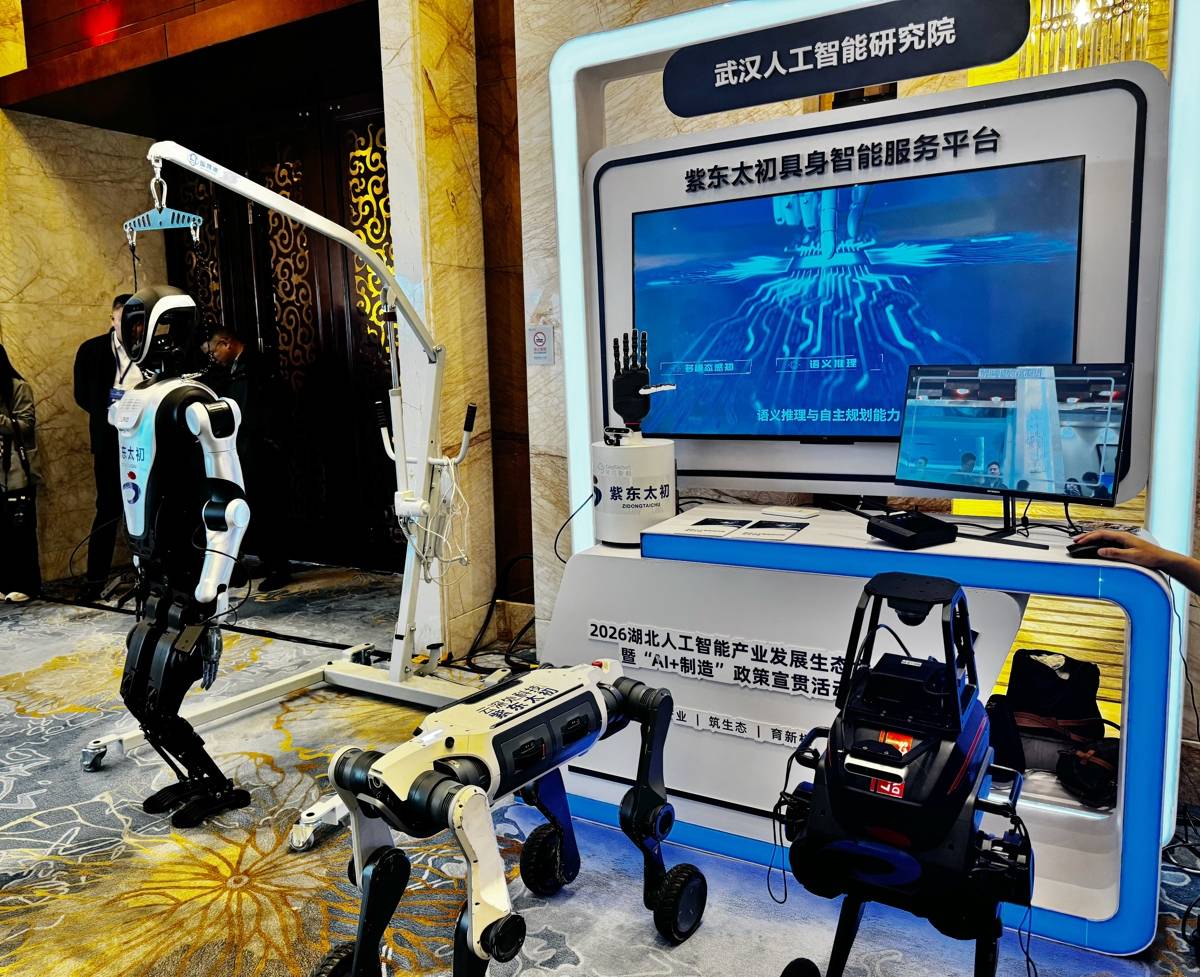
On April 16, at the 2026 Hubei Artificial Intelligence Industry Development Ecosystem Conference, the Zidong Taichu Embodied Intelligent Service Platform, developed by the Wuhan Institute of Artificial Intelligence, a new type of research institution in Hubei Province, was officially launched. After robots of different forms are implanted with the “smartest brain” Zidong Taichu 4.0 via this platform, they can not only understand common sense like “handle fragile objects gently,” but also reflect on and adjust strategies when tasks encounter obstacles, efficiently and flexibly serving industries such as intelligent manufacturing, healthcare, and education.
With Eastern aesthetics as its soul and cutting-edge technology as its backbone, “Zidong Taichu” symbolizes auspiciousness and the dawn of creation. The Zidong Taichu large model is vividly designed as a digital human named “Xiaochu” wearing traditional Hanfu, representing the full-stack domestic production of Zidong Taichu from algorithms to hardware and computing power, with the entire chain “Made in China.” With continuous iterative upgrades, “Xiaochu” has evolved from the initial image of a little girl into a young woman.
The Zidong Taichu large model digital human “Xiaochu”
“It can now think independently, equivalent to the level of a college student, and will continue to iterate in the future, reaching the level of a doctoral student or expert,” said Wang Jinqiao, Deputy Chief Engineer of the Institute of Automation, Chinese Academy of Sciences, and President of the Wuhan Institute of Artificial Intelligence.
The Zidong Taichu Embodied Intelligent Service Platform launched this time is a national-level full-stack infrastructure for embodied intelligence. With the Zidong Taichu 4.0 multimodal large model as the “smartest brain” and a fully independent Chinese foundation, it breaks the boundary between the digital and physical worlds, achieving perfect coordination between the “brain (complex task understanding and dynamic decomposition)” and the “cerebellum (high-precision motion control and perception execution).”
Embodied intelligence is a data-hungry technology. Without data, the large model is like water without a source. This platform has aggregated over 10 million high-quality real-world data entries and more than 3,000 real-world scene data points. There has always been a gap between robot bodies and real industrial scenarios. This platform now supports over 50 categories of robot bodies, has trained over 300 embodied atomic skills, which help robots decompose complex industrial processes into atomic actions such as “moving, mapping, grasping, and placing.” It has built high-fidelity robot training grounds in Beijing, Wuhan, Foshan, Qingdao, Changchun, Guiyang, and other locations, broadly empowering scenarios like intelligent manufacturing, drone inspection, surgical and rehabilitation robots, modern services, and vocational education.
“Please help me pick up a package, it’s a red box.” “Okay, program starting.” In the Zidong Taichu training ground, a humanoid robot receiving the command walks steadily to the container, searches through it, precisely locates the target, flexibly bends and extends its robotic arm joints, steadily picks up the red package with its fingertips, turns, steps forward, and hands it over—the entire set of actions is smooth and natural.
In the kitchen simulation area, a service humanoid robot follows a trainer’s VR control, repeatedly practicing opening a rice cooker lid and precisely placing a water cup in the center of a placemat.
In the factory simulation area, a robot precisely grasps red and blue blocks.
In the factory simulation area, red and blue blocks are stacked without any pattern. A dual-arm robot, like an experienced craftsman, precisely grasps and sorts them into