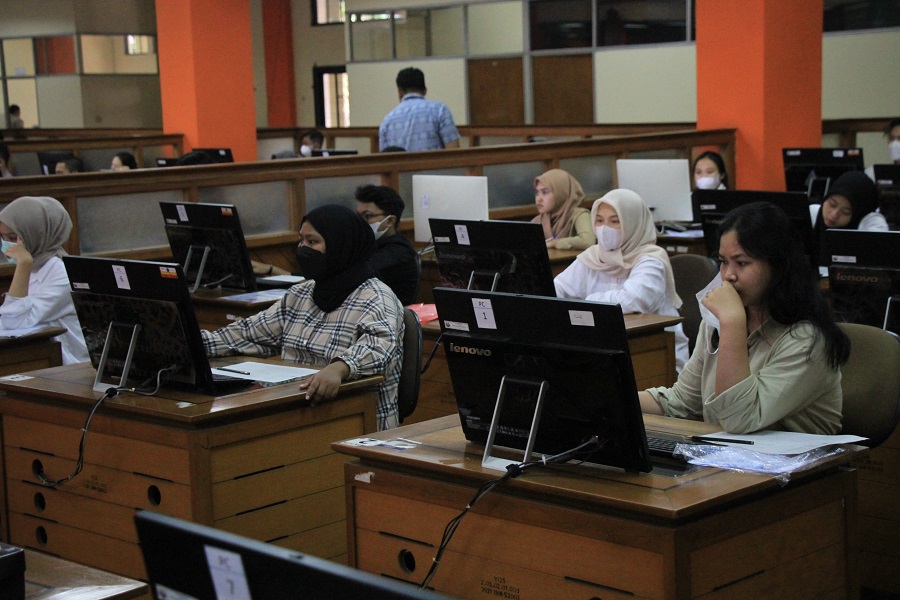
The National Selection Committee for New Student Admissions (SNPMB) found several cheating practices committed by participants in the Computer-Based Writing Test – National Test-Based Selection (SNBT) on the first day of implementation, Tuesday (April 21, 2026).
These violations were disclosed directly by the 2026 SNPMB committee. The committee discovered cheating ranging from the use of advanced technology to the practice of using proxies. Additionally, the Monitoring and Evaluation Team (Monev) of the SNPMB Central Committee revealed that from the beginning, they had mapped 2,940 anomalous participant data points.
“This morning until 09:00 WIB, we received information about various types of cheating that participants attempted at several UTBK centers,” said Prof. Dr. Ir. Eduart Wolok, ST, MT, General Chair of the 2026 National Selection Committee for New Student Admissions (SNPMB).
The first cheating case was found at the UPN Veteran East Java UTBK center. At that location, a participant was found trying to modify their registration photo to hide their true identity.
“The photo was slightly modified, but it was still tracked or detected by the facial recognition system used by the committee,” Eduart said.
Then, quite surprising cheating was found at Diponegoro University, Semarang. One UTBK participant was known to be using a hearing aid implanted inside their ear.
“The next cheating case was at the UTBK center at Diponegoro University (Undip) Semarang, involving the use of a hearing aid. The hearing aid was inserted deep into the ear,” said Edward.
“The participant was taken by the central UTBK committee to an ENT doctor to remove the hearing aid,” he explained.
The practice of using proxies was also found at the West Sulawesi University UTBK center. The test participant had replaced their attendance with another person.
“So, the same person who took the UTBK last year participated again this year under a different name,” said Eduart at the Jakarta State University UTBK center, East Jakarta on Tuesday.
The proxy practice in the implementation of UTBK-SNBT was also found by the committee at the Surabaya State University test location. He stated that a participant had taken the UTBK for two consecutive years but under different names.
“After we traced the list of participant names to their origin schools, it turned out the school did not provide a graduation certificate for that person,” said Eduart.
This cheating method was detected early by the data tracking system, where the committee successfully found the true identity of the proxy. Edward explained that at Unsulbar, an attempt at proxy fraud was found by replacing the participant.
Furthermore, another cheating case was found by the committee at Unsulbar. The SNPMB committee found indications of a cheating syndicate by enticing participants.
“So, the information from Unsulbar can be highlighted that there were indications of a cheating syndicate that was indeed trying to entice prospective participants to be willing to do this,” said Edward.
Edward emphasized that UTBK participants who cheat during the test are guaranteed not to pass.
“We will not tolerate these aspects of cheating,” he said.
The implementation of UTBK-SNBT 2026 was carried out simultaneously from Monday, April 21, 2026, to April 30, 2026. In terms of material, UTBK-SNBT 2026 did not undergo significant changes. The exam still covers the Scholastic Potential Test (TPS), mathematical reasoning, Indonesian language literacy, and English language literacy.
On the other hand, to prevent cheating, the SNPMB Committee used artificial intelligence (AI) technology to detect proxies in the Computer-Based Writing Test (UTBK) of the National Test-Based Selection (SNBT) 2026.
A member of the 2026 National Selection Committee for New Student Admissions (SNPMB) team, Tjitjik Srie Tjahjandarie, ensured that they would continue to conduct supervision and monitoring to prevent cheating. This was stated on the sidelines of the UTBK SNBT 2026 implementation at Jakarta State University (UNJ).</