A reporter from Southern Finance covers this story from Guangzhou.
As the wave of automotive intelligence sweeps the globe, related fields are becoming the core focus of investment and competition for car manufacturers. Data from Frost & Sullivan shows that in 2025, global automakers’ R&D and capital investment in the smart vehicle sector has climbed to 1.1436 trillion yuan, and is expected to surpass 2.38 trillion yuan by 2030.
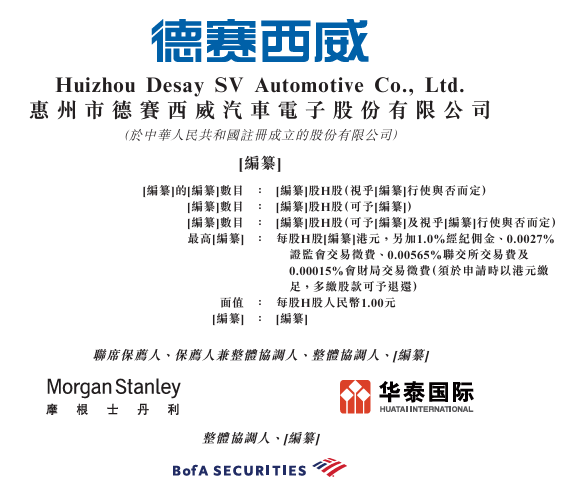
Against this backdrop, the global leader in smart cockpit domain controllers, with the highest market share, has officially knocked on the doors of the Hong Kong Stock Exchange, aiming for a dual “A+H” listing. Recently, Huizhou Desay SV Automotive Electronics Co., Ltd. submitted a prospectus to the Hong Kong Stock Exchange, planning to list on the main board in Hong Kong.
It is reported that the funds raised from this IPO will be mainly used to enhance smart manufacturing capacity, make strategic investment acquisitions, and strengthen the full-stack engineering and mass production capabilities of software and hardware. Previously, Desay SV was listed on the Shenzhen Stock Exchange on December 26, 2017, and currently has a total market value of about 63 billion yuan.
As of now, Desay SV has built a platform-based product and service system covering smart cockpits and intelligent driving in the smart vehicle field. Its products and services have covered over 80 automakers worldwide. In 2025, the company held an 8.4% market share in smart cockpit domain controllers, ranking first globally.
Financial data shows that Desay SV’s performance has maintained steady growth in recent years. In 2023, 2024, and 2025, the company’s total revenue was 21.908 billion yuan, 27.618 billion yuan, and 32.557 billion yuan, respectively; corresponding net profits were 1.542 billion yuan, 2.018 billion yuan, and 2.473 billion yuan, with cumulative net profit over three years exceeding 6 billion yuan.
From an Audio Factory to a Smart Driving Leader
Evolving from a joint venture audio factory into a technology company with the world’s largest market share in intelligent driving domain controllers, Desay SV’s rise is a model of the autonomous transformation of China’s automotive supply chain.
Its predecessor can be traced back to the China Europe Electronics Industry Co., Ltd., established in 1986, a joint venture between Dutch Philips, Hong Kong金山, and Huizhou Industrial Development Corporation (predecessor of Desay Industries), primarily engaged in car audio business.
In 2010, the Desay Group completed the acquisition of the 70% stake held by foreign partners, and the company was renamed “Huizhou Desay SV Automotive Electronics Co., Ltd.”, marking a key turn from a joint venture to a Chinese-controlled company, and began to delve deeper into in-vehicle infotainment systems and broader automotive electronics fields.
Since then, the company has precisely seized two key industry dividends: around 2017, it made early moves in the trend toward larger screens in new energy vehicle cockpits, consistently ranking first in the domestic market share for large cockpit screens; starting in 2020, as the penetration rate of advanced driver-assistance systems rapidly increased, it quickly became a core supplier for mainstream domestic automakers, leveraging its product matrix of domain controllers, millimeter-wave radar, and cameras.
Currently, Desay SV’s products and services cover over 80 automakers worldwide, with a customer network spanning major automotive markets. The company has established business cooperation with nine of the top ten global automakers by sales in 2025 and all of the top fifteen automakers in China by sales, including global giants like Toyota, Volkswagen, Hyundai, General Motors, Stellantis, BYD, SAIC, Ford, and Geely, as well as mainstream Chinese brands such as Li Auto, Xiaomi, XPeng, Zeekr, Great Wall Motor, and Chery.
The company’s main business focuses on three segments: smart cockpits, intelligent driving, and connected services. The 2025 financial report shows that its smart cockpit business revenue reached 20.585 billion yuan, accounting for 63.23% of total revenue, with annualized sales from new project orders exceeding 20 billion yuan; intelligent driving business revenue was 9.7 billion yuan