It’s Like Visiting the Home of a ‘Dear Brother’: Chinese President Xi Jinping Ahead of Pakistan Trip
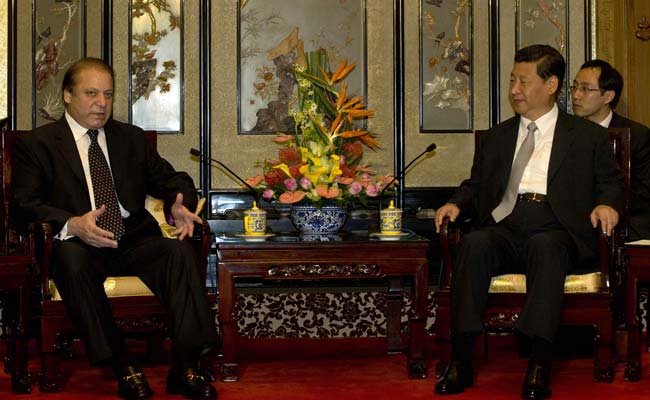
File Photo: Chinese President Xi Jinping with Pakistan’s Prime Minister Nawaz Sharif
Beijing: President Xi Jinping today said his first trip to Pakistan is like visiting the home of his "own brother" as he vowed to firm up China’s strategic ties with its all-weather friend by making progress on various fronts, including the $46 billion bilateral economic corridor.
"This will be my first trip to Pakistan, but I feel as if I am going to visit the home of my own brother," Xi said in an article for Pakistani media ahead of his visit.
"I look forward to working with Pakistani leaders during the visit to explore the general framework for bilateral cooperation, make substantial progress in the China-Pakistan Economic Corridor and practical cooperation in other fields and push for the furtherance of bilateral ties at a higher level," he said in the signed article.
Pakistan is the first stop of President Xi’s first overseas trip this year.
The Chinese President is to visit the country tomorrow and Tuesday before attending the Bandung Conference in Indonesia.
During his visit, Xi will meet with his Pakistani counterpart Mamnoon Hussain, Prime Minister Nawaz Sharif and other Pakistani leaders for in-depth exchange of views on bilateral relations and discuss issues of common interest.
He is expected to unveil a host of projects under the corridor linking China’s Xinjiang province with Gwadar port through Pakistan-occupied Kashmir (PoK).
China and Pakistan need to align development strategies more closely to realise the dreams of the two peoples, he said.
"We need to enhance strategic coordination, deepen practical cooperation and work together for common development. We will build the China-Pakistan community of common destiny and set a fine example for such efforts by China and its neighbouring countries," Xi said.
The two countries need to align economic and trade strategies more closely to deepen economic integration, said the ruling Communist Party General Secretary.
He gave particular importance to the China-Pakistan Economic Corridor, which is located where the Silk Road Economic Belt and the 21st Century Maritime Silk Road meet.
"We need to form a ‘1+4’ cooperation structure with the Economic Corridor at the center and the Gwadar Port, energy, infrastructure and industrial cooperation being the four key areas to drive development across Pakistan and deliver tangible benefits to its people," he said.
In the article, he also highlighted the need to boost security cooperation, intensify people-to-people and cultural exchanges and coordinate diplomatic strategies between the two countries.
China-Pakistan Economic Corridor
The China-Pakistan Economic Corridor (CPEC) is a major infrastructure and economic development project that connects Gwadar Port in southwestern Pakistan to China’s Xinjiang region via a network of highways, railways, and pipelines. Launched in 2013 as a flagship initiative of China’s Belt and Road Initiative, CPEC aims to enhance regional connectivity, energy security, and trade between the two countries. Its history involves significant Chinese investment and collaboration with Pakistan, with the goal of transforming Pakistan into a regional economic hub.
Bandung Conference
The Bandung Conference, officially the Asian-African Conference, was a historic meeting held in Bandung, Indonesia, in April 1955. It brought together leaders from 29 newly independent Asian and African nations to promote economic and cultural cooperation and to oppose colonialism and neocolonialism. The conference was a pivotal moment in the development of the Non-Aligned Movement and the “Bandung Spirit” of solidarity among developing countries.
Xinjiang province
Xinjiang, officially the Xinjiang Uyghur Autonomous Region in northwest China, is a vast and culturally rich area historically known as a central hub on the ancient Silk Road. Its history spans millennia, with influences from various nomadic groups and empires, and it became part of China during the Qing dynasty in the 18th century. Today, it is known for its diverse ethnic cultures, dramatic landscapes, and significant economic development projects.
Gwadar port
Gwadar Port is a deep-sea port located on the Arabian Sea in southwestern Pakistan, near the Strait of Hormuz. Its development began in the early 2000s with Chinese investment as a key part of the China-Pakistan Economic Corridor (CPEC), transforming a small fishing village into a major strategic and commercial hub. Historically, the area was under Omani rule until 1958, when it was purchased by Pakistan, and today it serves as a vital gateway for regional trade and energy routes.
Pakistan-occupied Kashmir (PoK)
Pakistan-occupied Kashmir (PoK) refers to the portion of the Kashmir region that is administered by Pakistan, comprising the Azad Kashmir and Gilgit-Baltistan territories. The region came under Pakistani control following the first Indo-Pakistani war of 1947–48, and its status remains disputed between India and Pakistan. India claims the entire former princely state of Jammu and Kashmir, including PoK, while Pakistan administers it as a de facto separate entity.
Silk Road Economic Belt
The Silk Road Economic Belt is a modern development initiative proposed by China in 2013, aiming to revive and expand the ancient Silk Road trade routes through enhanced infrastructure, economic cooperation, and cultural exchange across Central Asia, the Middle East, and Europe. Historically, the original Silk Road was a network of trade paths established over 2,000 years ago, facilitating the exchange of goods, ideas, and cultures between the East and West. Today, this belt represents a key component of China’s Belt and Road Initiative, fostering regional connectivity and economic growth.
21st Century Maritime Silk Road
The 21st Century Maritime Silk Road is a key component of China’s Belt and Road Initiative, launched in 2013 to enhance maritime cooperation and economic integration across Southeast Asia, South Asia, Africa, and Europe. It revives the historical maritime trade routes of the ancient Silk Road, aiming to boost infrastructure, trade, and cultural exchange through port development, shipping lanes, and investment projects. This modern initiative reflects China’s strategy to promote global connectivity and shared development, building on centuries-old maritime traditions.
Gwadar Port
Gwadar Port is a deep-sea port located on the southwestern coast of Pakistan in Balochistan, strategically positioned near the Strait of Hormuz. Its development began in the early 2000s, with China taking a leading role in construction and operations as part of the China-Pakistan Economic Corridor (CPEC). Historically, the area was a small fishing village until the port’s modern expansion transformed it into a key hub for regional trade and energy routes.