
-
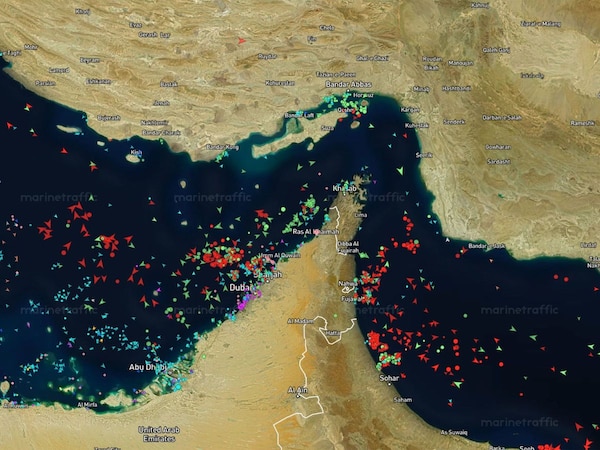
Iran-US Tensions: The IRGC claims that control over the Strait of Hormuz has been tightened again to its previous strict level. Iran accuses the United States of not fulfilling its promises to lift sanctions on Iranian ships, which it has termed ‘maritime piracy’. Consequently, strict surveillance is now being maintained over this crucial maritime route, and tight control over Hormuz will continue until the US fully restores freedom of navigation.
Previously, Iran had issued a stern warning to the US President. A post on social media stated that the Strait of Hormuz, through which until recently about one-fifth of the world’s oil trade passed, will not remain open if the American blockade continues.
US Blockade Will Continue
This statement came when the US President said that the US blockade on ships heading to Iranian ports will continue until our dealings with Iran are 100% complete. This blockade was announced last weekend after talks with Iran ended without any agreement.
Tehran Had Also Issued a Warning
Following a ceasefire agreement in Lebanon, Iran had temporarily reopened Hormuz on Friday, raising hopes for peace talks. However, Tehran warned that if the recent blockade of Iranian ports by the US Navy continues, it could close this crucial waterway again.
Hormuz is Open for the Remaining Duration of the Ceasefire
An announcement on social media stated that the Strait of Hormuz, a narrow and vital route for global energy trade, is open to all commercial ships for the remaining duration of the 10-day ceasefire mediated by the United States.
Strait of Hormuz
The Strait of Hormuz is a strategically vital maritime chokepoint connecting the Persian Gulf with the Gulf of Oman and the wider Indian Ocean. Historically, it has been a key trade route for centuries, but in the modern era, its significance is defined by the transit of about one-fifth of the world’s oil supply. This has made it a focal point of geopolitical tensions and international security concerns for decades.Iran
Iran, historically known as Persia, is a country in Western Asia with one of the world’s oldest continuous major civilizations, dating back to the Elamite kingdoms in the 4th millennium BCE. It is home to numerous UNESCO World Heritage Sites, including the ancient ceremonial capital of Persepolis, which was the center of the vast Achaemenid Empire founded by Cyrus the Great in the 6th century BCE. Today, Iran’s rich cultural heritage is reflected in its architecture, poetry, and traditions, shaped by successive empires and its 1979 Islamic Revolution.United States
The United States is a federal republic in North America, founded in 1776 after declaring independence from Great Britain. Its history is marked by westward expansion, industrialization, and its emergence as a global superpower in the 20th century, shaped by diverse immigration and a complex legacy of ideals and conflicts. Culturally, it is a highly influential mosaic, known for its contributions to technology, entertainment, and democratic governance.IRGC
The Islamic RevolutionaryStrait of Hormuz
The Strait of Hormuz is a strategically vital maritime chokepoint connecting the Persian Gulf with the Gulf of Oman and the wider Indian Ocean. Historically, it has been a key trade route for centuries, but in the modern era, its significance is defined by the transit of about one-fifth of the world’s oil supply. This has made it a focal point of international geopolitical tensions and naval presence for decades.Iran
Iran, historically known as Persia, is a country in Western Asia with one of the world’s oldest continuous civilizations, dating back to the Elamite kingdoms of the 4th millennium BCE. It is renowned for its profound cultural heritage, including the ancient Achaemenid Empire, the Persian literary tradition of poets like Rumi and Ferdowsi, and significant Islamic architectural sites like Isfahan’s Naqsh-e Jahan Square. Today, Iran is a modern nation-state that remains a central repository of Persian art, history, and culture, deeply influenced by both its pre-Islamic Zoroastrian past and its Shia Islamic identity.Persia
Persia, historically referring to the vast empire centered in modern-day Iran, was one of the world’s most influential ancient civilizations, founded by the Achaemenid dynasty in the 6th century BCE. Its rich cultural legacy includes advancements in administration, art, and Zoroastrian religion, with iconic sites like Persepolis. The name “Persia” was used internationally for the region until 1935, when the country officially adopted the name “Iran.”Persepolis
Persepolis was the ceremonial capital of the Achaemenid Empire, founded by Darius I around 518 BCE in modern-day Iran. Its magnificent ruins, including grand staircases and palaces, symbolize the empire’s wealth and power until it was looted and burned by Alexander the Great in 330 BCE. Today, it is a UNESCO World Heritage Site and one of the most significant archaeological sites from the ancient world.Achaemenid Empire
The Achaemenid Empire, founded by Cyrus the Great around 550 BCE, was the first great Persian Empire, stretching from the Balkans to the Indus Valley. It is renowned for its monumental architecture, such as the palaces at Persepolis, and its innovative administrative system that governed a vast, multicultural realm. The empire fell to the conquests of Alexander the Great in 330 BCE.Cyrus the Great
Cyrus the Great was the founder of the Achaemenid Empire, the first Persian Empire, in the 6th century BCE. He is renowned for establishing a model of tolerant and respectful governance, as evidenced by the Cyrus Cylinder, often called one of the first charters of human rights. His legacy is commemorated at his tomb in Pasargadae, Iran, a UNESCO World Heritage Site.United States
The United States is a federal republic founded in 1776 after declaring independence from Great Britain, with its modern government established by the Constitution in 1789. Culturally, it is a vast and diverse nation built on immigration, known for its global influence in areas like technology, entertainment, and democratic ideals. Key historical sites range from colonial landmarks like Independence Hall to symbols of its expansion and civil rights movement, such as the Statue of Liberty and the National Mall.Great Britain
Great Britain is a large island in the North Atlantic, comprising the nations of England, Scotland, and Wales. Its long and influential history includes the Roman conquest, the formation of the medieval kingdoms, and its central role in the British Empire and the Industrial Revolution. Today, it is the largest part of the United Kingdom, renowned for its global cultural, political, and historical impact.Related news

‘The country knows you were already naked… impoverished’, who did PM Modi get angry at in the Meerut rally?
From the land of Meerut, Prime Minister Narendra M...
Abhishek’s ‘Santiniketan’ faces demolition as Kolkata Municipal Corporation issues notice.
Bulldozers to run at Abhishek's Shantiniketan now!...
Team India will play a Test series against Sri Lanka, why did Bangladesh fall into trouble?
Indian Test team. File photo India will play two T...
Bangladeshis top crimes among foreigners in India! 3,091 arrested across the country in one year.
Shocking report from the National Crime Records Bu...
Which is India’s Oldest High Court? Where a New Path of Justice Began
In India, High Courts were established to strength...