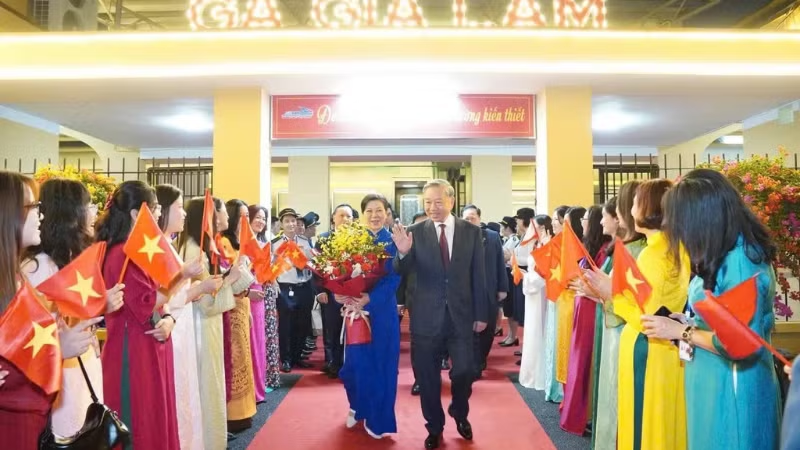
Special flight returns General Secretary and President to Vietnam, concluding successful state-level visit to China.
On the afternoon of April 17, the special train carrying the General Secretary, President, and the delegation arrived safely at Gia Lam Station. The image of the train crossing border routes not only ensured safety but also carried symbolic meaning regarding the relationship between the two countries.
The Standing Deputy Secretary of Lang Son Province, along with provincial leaders, welcomes General Secretary and President To Lam and his wife, along with the Vietnamese high-level delegation, at Dong Dang Station (Lang Son) after concluding their working visit to China.
The visit by General Secretary and President To Lam and his wife, along with the Vietnamese high-level delegation, was highly successful, contributing to deepening the Comprehensive Strategic Cooperative Partnership and moving towards building a Community with a shared future.
To serve the special train transporting the General Secretary and President from Dong Dang Station to Hanoi, the railway sector implemented a particularly strict preparation procedure. A comprehensive review of the route from Lang Son to Hanoi was conducted; simultaneously, there was close coordination with ministries, sectors, and local authorities along the railway line to ensure safety at crossings and critical areas.
Functional forces were deployed on standby to regulate traffic and maintain the railway safety corridor.
Leadership of the railway transport company along with staff at Dong Dang Station (Lang Son).
In addition, an experienced train crew, highly skilled technicians, and exemplary service personnel were mobilized to operate the special train, ensuring it ran on schedule, smoothly, and with absolute safety.
According to the schedule, the special train carrying General Secretary and President To Lam and the high-level delegation departed from Nanning Station (Guangxi, China) to Dong Dang Station (Lang Son), then continued its journey to Gia Lam Station, the capital Hanoi, on the same afternoon.
Expanding the railway tracks to ensure safety for the special train.The railway sector successfully completed the task of ensuring the special train journey.
The excellent completion of the task not only affirms the organizational and operational capacity of the Vietnamese railway sector but also demonstrates the high sense of responsibility of its officers and staff in serving major political events of the country.
Gia Lam Station
Gia Lam Station, located in Hanoi, Vietnam, is the country’s oldest railway station, built by French colonial authorities and opening in 1902. It served as the original terminus of the historic North-South railway line until Hanoi Station was completed in 1905, after which it became a key technical and freight hub. Today, it remains an active station primarily handling cargo and maintenance operations.
Hanoi
Hanoi is the capital of Vietnam, with a history spanning over a thousand years since its establishment as the capital of the Đại Việt kingdom in 1010. It is renowned for its well-preserved French colonial architecture in the Old Quarter, ancient temples like the Temple of Literature, and its pivotal role as the political and cultural heart of the country throughout various dynasties and modern conflicts.
Dong Dang Station
Dong
Gia Lam Station
Gia Lam Station, located in Hanoi, Vietnam, was the country’s first railway station, opening in 1902 during the French colonial period. It served as the original terminus of the historic North-South railway line until being superseded by Hanoi Station in 1976. Today, it remains an active station for trains to northern destinations like Hai Phong and Lang Son.
Hanoi
Hanoi is the capital of Vietnam, with a history spanning over a thousand years since its establishment as the capital of the Đại Việt kingdom in 1010. It is renowned for its well-preserved French colonial architecture in the Old Quarter, ancient temples like the Temple of Literature, and its pivotal role as the political and cultural heart of the country throughout various dynasties and modern conflicts.
Dong Dang Station
Dong Dang Station is a railway station in Lạng Sơn Province, northern Vietnam, located near the border with China. It is historically significant as the terminus of the Vietnamese railway line connecting to the Chinese rail network at the Youyi Guan (Friendship Pass) border gate. The station and its connecting line have long been a vital trade and transport link between the two countries, with its importance rooted in colonial-era infrastructure development and modern cross-border cooperation.
Lang Son
Lang Son is a mountainous province in northern Vietnam, historically significant as a strategic gateway and trade route between Vietnam and China. It is most famous for the Đồng Đăng Market and the Nhi Thanh and Tam Thanh cave pagodas, which contain centuries-old inscriptions and altars. The area was also the site of several pivotal battles during the French colonial period and the Sino-Vietnamese War in 1979.
Nanning Station
Nanning Station is the main railway station in Nanning, the capital of Guangxi Zhuang Autonomous Region in southern China. Originally opened in 1951, it was significantly rebuilt and modernized in the 2000s to become a major high-speed rail hub, connecting the city to the national network and serving as a key gateway to Southeast Asia.
Guangxi
Guangxi is an autonomous region in southern China known for its stunning karst landscapes, most famously around Guilin and along the Li River. Historically, it has been home to various ethnic groups, notably the Zhuang people, and was a significant part of ancient trade routes and a cultural frontier in imperial China. Today, it is a major tourist destination and a vital economic corridor connecting China to Southeast Asia.
China
China is one of the world’s oldest continuous civilizations, with a recorded history spanning over 4,000 years, marked by successive dynasties and profound cultural, philosophical, and technological contributions. Today, it is a vast modern nation-state officially known as the People’s Republic of China, home to iconic cultural sites like the Great Wall, the Forbidden City, and the Terracotta Army, which reflect its immense historical depth and enduring global influence.
North-South railway line
The North-South railway line is a major railway corridor in Vietnam, connecting the capital Hanoi in the north with Ho Chi Minh City in the south. It was originally constructed in stages during the French colonial era, with the final link completed around 1936. The line, which spans over 1,700 kilometers, has been a vital economic and transportation artery for the country for nearly a century.