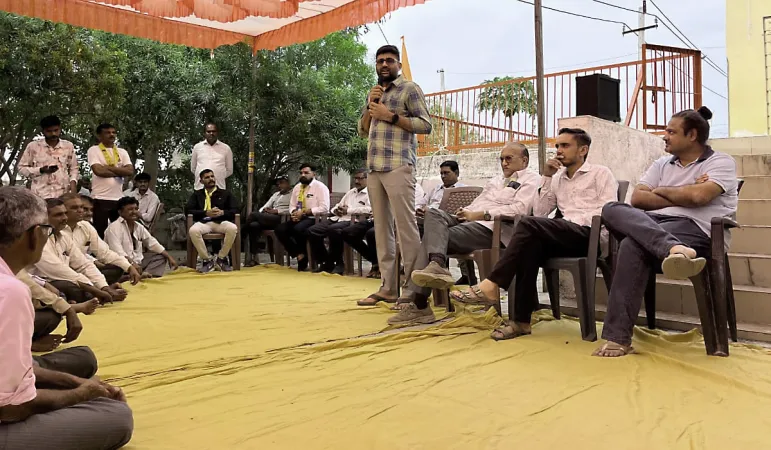
Gopal Italia’s Victory Trust Meeting: Attacking the BJP government on farmers’ issues and electricity bills. Appeal to support AAP for change.
Gopal Italia’s Victory Trust Meeting: The Aam Aadmi Party’s war cry in Visavadar on farmers’ pressing issues
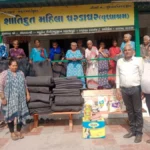
Junagadh/Visavadar: With an eye on the upcoming local body elections in Gujarat, the Aam Aadmi Party has intensified its campaign. Visavadar MLA Gopal Italia has increased public outreach in his constituency. On April 17, Gopal Italia’s Victory Trust Meetings and ‘Khatla’ (cot) meetings were organized in various villages of Visavadar taluka. The MLA personally visited villages like Dalkhaniya, Sarsiya, Dharangani, and Nesadi, engaging directly with farmers to understand their difficulties.
The Punjab Model and the issue of procurement at support price
Addressing the gathering, Gopal Italia stated that the true government is one that understands the people’s pain. Because the Aam Aadmi Party is in government in Punjab and Delhi, the welfare of common people is being achieved there. During his Victory Trust Meeting, citing Punjab’s example, he said that there the government buys 100% of the farmers’ produce at the support price. Farmers do not have to stand in line for hours or wait for payments for three months.
Criticizing the situation in Gujarat, he said that here farmers are troubled by worries about receiving messages and their produce being selected. In the Victory Trust Meeting, he demanded that farmers’ produce should be purchased properly and they should be paid immediately. It is not right in a democracy to discriminate and do injustice to farmers based on political bias.
Outrage against injustice in crop insurance and electricity bills
Raising farmers’ economic issues, Gopal Italia stated that Gujarat is the only state in the entire country where the crop insurance scheme is not implemented properly. Despite raising questions in the Assembly, the government does not give a clear answer. In the Victory Trust Meeting, he also cornered the government on the issue of electricity bills. He alleged that while electricity bills worth 1500 crore rupees of big companies in Morbi, Surat, and Rajkot remain pending, no action is taken, but if a common man has two thousand rupees pending, his connection is immediately cut.
He added that this government is not formed by the people’s blessings but by pressure and spreading illusions. Through the Victory Trust Meeting, he appealed that, “True change will come only if the public votes with an open heart and happily.” The time has now come to defeat the forces that get votes by exploiting people’s fear and greed.
A call to the public for change
At the end of the election campaign, Gopal Italia appealed to make all candidates win with a genuine majority. He said, “We are common people, we do not have a lot of money, but we have unwavering faith in serving the public.” The workers and public present at the Victory Trust Meeting showed readiness to bring change by pressing the button on the broom symbol.
Key Highlights:
Khatla meetings in Dalkhaniya, Sarsiya, and Dharangani in Visavadar.
Victory Trust Meetings in Nonghanvadar, Sanosara, and Umarala.
Demand for 100% procurement at support price in Gujarat, like in Punjab.
Demand for the government to answer on implementing the crop insurance scheme.
Burning issues raised in the meeting:
Injustice to farmers in electricity bills and policies favoring big industrialists.
Delays in government procurement processes and political discrimination.
Appeal for building a fear-free and corruption-free Gujarat.
According to reports, after Gopal Italia’s Victory Trust Meetings, the Aam Aadmi Party’s graph is continuously rising in the rural areas of Junagadh district. Farmers are now dissatisfied with the BJP’s ‘package’ policies and are looking towards the AAP model for a permanent solution.