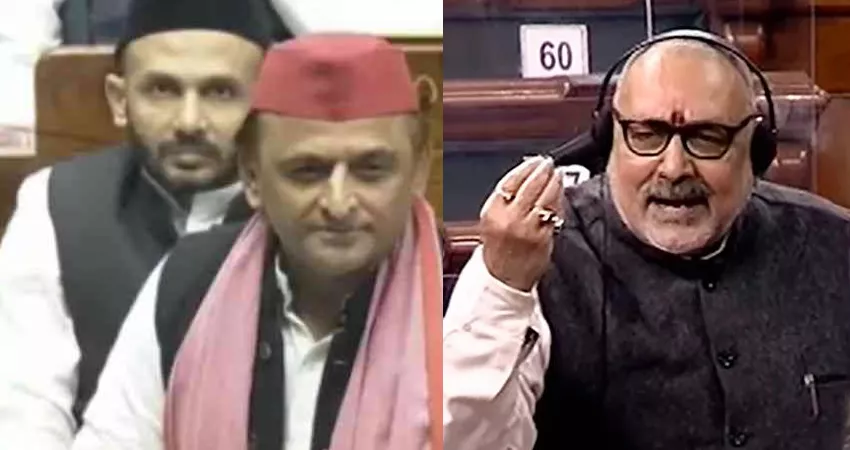
While supporting the bills related to amending the women’s reservation law and the formation of a delimitation commission on Thursday, leaders of the ruling National Democratic Alliance (NDA) said women have had to wait for years for reservation. Meanwhile, the opposition alleged that the government’s approach could weaken the country’s federal and democratic structure.
The ‘Constitution (131st) Amendment Bill 2026’, the ‘Delimitation Bill, 2026’, and the ‘Union State Law (Amendment) Bill, 2026’ were introduced in the Lok Sabha on Thursday for discussion and passage. During this three-day session of Parliament, the ‘Nari Shakti Vandan Act’ (women’s reservation law) is being amended to implement it by 2029, which will ensure 33 percent reservation for women in the Lok Sabha and state legislative assemblies.
A BJP MP expressed confidence within the Parliament House complex that the amendment to the women’s reservation law would receive broad support in Parliament. He said, “Women have been waiting for years and their patience is now wearing thin. This bill will be passed collectively.” Dismissing the opposition’s apprehensions regarding the delimitation process, he said it would not discriminate against any state, particularly southern states.
Number of Lok Sabha seats may increase to implement women’s reservation
A BJP MP described the initiative as historic, stating it would lead to a significant increase in women’s participation in governance. According to the draft constitutional amendment bill, after delimitation based on the 2011 census, the number of Lok Sabha seats could be increased from the current 543 to a maximum of 850 to implement women’s reservation before the 2029 general elections.
Furthermore, the number of seats in state and union territory legislative assemblies will also be increased to ensure 33 percent reservation for women, and the allocation of seats reserved for women will be done rotationally across various constituencies.
A JD(U) MP criticized the opposition’s objections, asking why delimitation was being opposed when nothing had happened yet? She said it is in the interest of women. Opposition leaders have expressed serious concern over the proposed delimitation process. A Congress leader said his party supports women’s reservation but opposes the associated delimitation proposal.
NDA’s total strength in Lok Sabha is 292
A Congress MP said she had given a procedural notice against this proposal. She alleged that the delimitation bill is a direct attack on the Constitution and would affect the rights of southern states. She said an increase in seats could create an imbalance between northern and southern states, making wide consultation with states on the issue essential.
A Samajwadi Party leader said his party is not against women’s reservation, but opposes the manner in which the government is bringing it. He said delimitation based on the 2011 census would not ensure fair representation.
A Shiv Sena (UBT) MP expressed similar concern, while a DMK MP said his leader had burned a copy of the bill during a rally in Salem yesterday in protest. The NDA’s total strength in the Lok Sabha is 292, while major opposition parties have 233 MPs. Passing a constitutional amendment bill requires a two-thirds majority of members present and voting in the house.
Lok Sabha
The Lok Sabha is the lower house of India’s bicameral Parliament, located in New Delhi. It was established under the Constitution of India in 1952, succeeding the Imperial Legislative Council, and serves as the primary legislative body where elected representatives introduce, debate, and pass national laws. Its history reflects India’s transition to a democratic republic after gaining independence in 1947.
Parliament House complex
The Parliament House complex in Canberra is the seat of Australia’s federal government, officially opened in 1988 to replace the provisional Parliament House. Its modern design, built into Capital Hill, symbolizes democratic openness, while its forecourt mosaic is based on Indigenous Australian art, acknowledging the continent’s long history before European settlement.
Constitution
The Constitution of the United States, drafted in 1787 and ratified in 1789, is the supreme law of the nation and the world’s oldest written national constitution still in use. It established America’s federal government structure and fundamental principles, including the separation of powers and a system of checks and balances, and its first ten amendments, known as the Bill of Rights, guarantee essential individual liberties.
Nari Shakti Vandan Act
The “Nari Shakti Vandan Act” is not a physical place or cultural site, but a landmark Indian legislation. Officially the Constitution (One Hundred and Sixth Amendment) Act, 2023, it mandates the reservation of one-third of seats for women in the Lok Sabha (India’s lower house of Parliament) and state legislative assemblies. This historic act, passed after decades of advocacy, aims to significantly enhance women’s political representation in India.
National Democratic Alliance (NDA)
The National Democratic Alliance (NDA) is not a physical place or cultural site, but a major political coalition in India. It was formed in 1998 under the leadership of the Bharatiya Janata Party (BJP) to contest general elections, and it has been the ruling coalition in the central government for multiple terms, most notably since 2014.
BJP
“BJP” refers to the Bharatiya Janata Party, which is a major political party in India, not a physical place or cultural site. It was founded in 1980, with ideological roots in the Bharatiya Jana Sangh (established 1951), and it advocates for Hindu nationalist principles and conservative policies. The party has grown to become one of the world’s largest political parties, playing a dominant role in Indian politics since the late 1990s and holding a parliamentary majority since 2014.
JD(U)
“JD(U)” does not refer to a specific place or cultural site. It is the acronym for the Janata Dal (United), a major regional political party in India, primarily active in the state of Bihar. Its history dates back to political realignments in the late 1990s, evolving from the broader Janata Dal movement.
Congress
“Congress” most commonly refers to the United States Congress, the legislative branch of the U.S. federal government. Established by the Constitution in 1789, it is a bicameral body consisting of the Senate and the House of Representatives, responsible for making federal laws. Its design, with two chambers representing states and population proportionally, was a key compromise during the nation’s founding to balance power between large and small states.