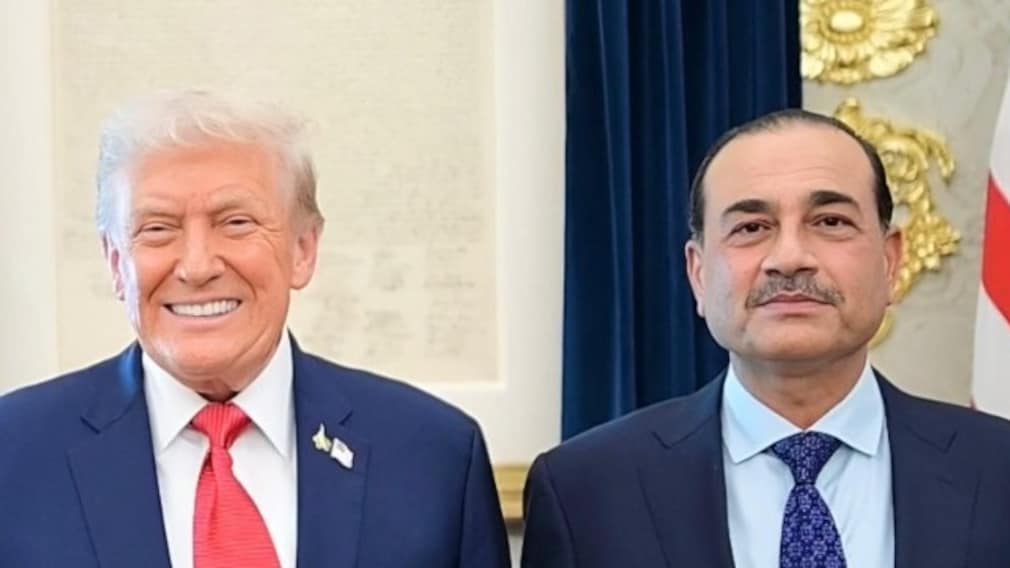
The photograph of Pakistan’s Army chief being received by Iran’s Foreign Minister in Tehran this week has its real backdrop not in the Iranian capital – the real context lies in the White House Oval Office. A uniformed Pakistani general serving as America’s most trusted diplomatic courier in one of the world’s most dangerous standoffs is striking. But once you understand how Donald Trump runs American foreign policy, it is entirely predictable. Trump does not send career diplomats when things get serious. He sends people he has personally decided to trust. Right now, that man is Asim Munir.
To understand why, you have to understand not just the President but the remarkable structural symmetry between the two states he and Munir respectively represent.
Two Systems, One Illogic
Pakistan and the United States are not obvious analogues. One is a nuclear-armed developing state with a GDP per capita below $1,500, perpetually on IMF life support, where the military has historically governed from behind civilian facades. The other is the world’s largest economy, a constitutional republic with 2.5 centuries of institutional continuity. And yet, under their current leaderships, both countries are governed by a strikingly similar operating logic: institutions are weak or weakened, personalities dominate, and outcomes depend less on process than on who knows whom and what they have to offer each other.
In Pakistan, this is a structural condition. The military has always been the institution that actually decides. Civilian governments come and go; the army remains. Munir has simply made this arrangement more explicit than most predecessors.
In Trump’s Washington, institutional erosion is more recent but directionally similar. Pakistani officials quickly diagnosed it: access to this White House runs through Trump family businesses as much as through the State Department. Career diplomats and inter-agency processes still formally exist, but they are increasingly decorative. What matters is the personal relationship with the President, and what you can offer him and his circle.
The Art of the Offer
Islamabad understood that in a personalised system, the entry point is commerce and flattery, not diplomatic convention. The courtship was methodical. The first move was counterterrorism. Pakistani intelligence helped the US capture a key Islamic State-Khorasan operative responsible for the Abbey Gate bombing, the kind of concrete, nameable result Trump could announce and claim as his own.
Then came the commercial offers. A crypto venture in which the Trump family holds substantial interests sent executives to Islamabad, where Pakistan signed an MoU on stablecoin adoption. Munir personally welcomed the delegation, signalling an alignment between Pakistan’s military and Trump-linked business entities. Pakistan simultaneously pitched claims to trillions of dollars in rare-earth minerals, and a US firm subsequently signed an MoU with a military-owned Pakistani company to develop rare-earth resources. Neither offering rests on fully verified foundations, but in a system where personal enthusiasm substitutes for institutional due diligence, the offer is the relationship.
Recognising Each Other
Into this environment walked Munir, and Trump responded to him in a register he reserves for a very specific kind of leader. Both men operate in systems where formal rules are negotiable, loyalty is personal rather than institutional, and the consolidation of authority in a single figure is treated not as a problem but as a solution.
PM Modi is also a strongman by any reasonable definition, but one – according to Trump’s view – ‘burdened’ by institutions that retain real force: courts that rule against the government, a federal structure with genuine provincial weight, a meritorious bureaucracy with its own inertia. For Trump, accustomed to leaders who can simply decide, mediation registers as friction. Munir has none of these ‘pitfalls’.
The White House lunch was unprecedented, the first time a US president hosted Pakistan’s Army chief alone, without civilian officials present. Trump called Munir his “favourite field marshal”, a knowing nod to the recently bestowed title that made Munir only the second Pakistani ever to hold it. The civilian-military distinction that organises conventional democratic diplomacy simply does not structure Trump’s thinking.
What Was Discussed In The Oval Office
The Oval Office meeting between Trump and Munir was notable for what surrounded it as much as what was reported from it. No American officials were present for portions of the discussion