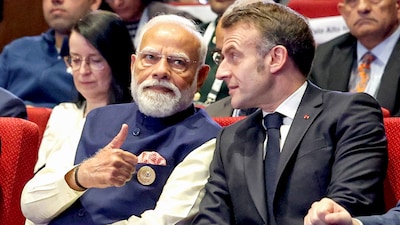
PM Modi said that India and France would continue working closely to support peace and stability in the region and beyond.
Prime Minister Narendra Modi spoke with French President Emmanuel Macron, with both leaders expressing concern over the situation in West Asia and calling for the urgent restoration of safety and freedom of navigation in the Strait of Hormuz. In a post on X, PM Modi said the two leaders discussed the escalating regional crisis and agreed on the need to secure one of the world’s most strategically important maritime routes.
Read more:
“Received a phone call from my dear friend President Emmanuel Macron. We discussed the situation in West Asia and agreed on the need to urgently restore safety and freedom of navigation in the Strait of Hormuz,” PM Modi wrote. He added that India and France would continue working closely to support peace and stability in the region and beyond.
Focus On Critical Trade Route
The Strait of Hormuz remains one of the world’s most vital shipping corridors, carrying a significant share of global oil and gas exports. Any disruption to the narrow waterway can have immediate consequences for global energy markets, freight movement and insurance costs. International concern has risen sharply amid ongoing tensions in West Asia, with several countries urging de-escalation and protection of commercial shipping.
What’s The Latest On US-Iran Talks?
PM Modi and Macron’s phone call comes as a Pakistani delegation landed in Tehran, marking the latest diplomatic push to revive talks between the United States and Iran since the two sides agreed to a fragile two-week ceasefire last week after nearly six weeks of fighting. The truce, which expires on April 22, has created a small window for negotiations to end the war, which has killed more than 4,000 people across West Asia, overwhelmingly in Iran and Lebanon.
The first round of talks was held last week in Islamabad under Pakistani mediation but failed to secure an understanding or agreement between Tehran and Washington. The US President said that the war is “very close to being over” and has signalled that a second round of talks could resume within days, again potentially in the Pakistani capital.
India
India is a vast South Asian nation with one of the world’s oldest continuous civilizations, dating back over 5,000 years to the Indus Valley. Its history is marked by the rise of major religions like Hinduism and Buddhism, successive empires, Mughal rule, and British colonization before gaining independence in 1947. Today, it is a densely populated and diverse republic renowned for its rich cultural heritage, including countless historical monuments, diverse languages, and profound philosophical traditions.
France
France is a Western European country with a rich and influential history, dating from Celtic and Roman settlements to its formation as a unified kingdom under the Capetian dynasty. It became a global center of art, philosophy, and politics, notably through the Enlightenment and the French Revolution of 1789, which profoundly shaped modern democratic ideals. Today, France is renowned for its diverse cultural heritage, iconic landmarks like the Eiffel Tower and Notre-Dame Cathedral, and its enduring global impact on cuisine, fashion, and the arts.
West Asia
West Asia, also known as the Middle East, is a transcontinental region at the crossroads of Europe, Africa, and Asia. It is historically renowned as the “Cradle of Civilization,” home to the world’s earliest known civilizations like Mesopotamia and the ancient empires of Persia and Babylon. The region is profoundly significant as the birthplace of major world religions, including Judaism, Christianity, and Islam.
Strait of Hormuz
The Strait of Hormuz is a strategically vital maritime chokepoint connecting the Persian Gulf with the Gulf of Oman and the wider Indian Ocean. Historically, it has been a key trade route for centuries, but in the modern era, its significance is defined by the transit of about one-fifth of the world’s oil supply. Its geopolitical importance has made it a focal point of regional tensions and international security concerns for decades.
United States
The United States is a federal republic founded in 1776 after declaring independence from Great Britain, with its modern government established by the Constitution in 1789. Culturally, it is a vast and diverse nation built on immigration, known for its global influence in areas like technology, entertainment, and democratic ideals. Key historical sites range from colonial landmarks like Independence Hall to symbols of its expansion and civil rights movement, such as the Statue of Liberty and the National Mall.
Iran
Iran, historically known as Persia, is a country in Western Asia with one of the world’s oldest continuous civilizations, dating back to the Elamite kingdoms of the 4th millennium BCE. It is home to numerous UNESCO World Heritage sites, including the ancient ceremonial capital of Persepolis and the stunning Islamic architecture of Isfahan’s Naqsh-e Jahan Square. The modern Islamic Republic, established in 1979, is built upon a rich cultural heritage shaped by empires like the Achaemenid, Sassanian, and Safavid, which have left a profound legacy in art, science, and literature.
Pakistan
Pakistan is a modern nation-state established in 1947 as a homeland for Muslims of British India, with a rich history rooted in the ancient Indus Valley Civilization. Its cultural landscape is a tapestry of diverse ethnic groups, languages, and traditions, heavily influenced by Islamic heritage as well as Persian, Central Asian, and South Asian legacies. Key historical sites include the archaeological ruins of Mohenjo-daro, the Mughal-era Badshahi Mosque in Lahore, and the mountainous Silk Road outposts of the Hunza Valley.
Tehran
Tehran is the capital and largest city of Iran, officially becoming the national capital in 1796 under the Qajar dynasty. Today, it is a major political and economic center, home to significant modern landmarks and cultural sites like the Golestan Palace, a UNESCO World Heritage site that reflects the opulent Qajar-era architecture.