|
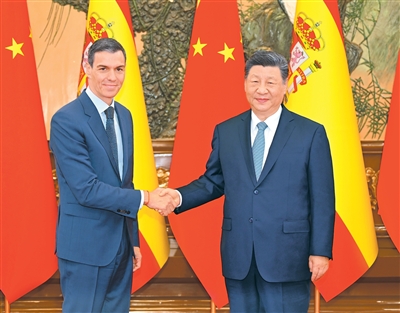
On the morning of April 14, President Xi Jinping met with Spanish Prime Minister Pedro Sánchez, who was on an official visit to China, at the Great Hall of the People in Beijing. |
On the morning of April 14, President Xi Jinping met with Spanish Prime Minister Pedro Sánchez, who was on an official visit to China, at the Great Hall of the People in Beijing.
Xi Jinping pointed out that despite a volatile and intertwined international situation, China-Spain relations have maintained steady development, forging a relationship with strategic resilience. An important lesson from this is making correct decisions based on common interests. Facts have proven that deepening cooperation serves the interests of the peoples of both countries, aligns with the trend of the times, and strengthens the capability and confidence of both sides to pursue independent development paths. Both sides should always place the development of China-Spain relations in an important position in their respective foreign policies and support each other in safeguarding national sovereignty and territorial integrity. China integrates long-term strategic goals with phased objectives, demonstrating historical patience by formulating and implementing successive five-year plans. We have the resolve to firmly advance Chinese modernization and the vision to share development opportunities with the world through high-standard opening up, injecting confidence and momentum into global economic growth through our own development. The two sides should seize opportunities, jointly pursue innovation-driven development, strengthen cooperation in areas such as trade, new energy, and the smart economy, encourage cultural, educational, scientific research, and sports exchanges, and achieve more results in the comprehensive strategic partnership between the two countries, bringing more benefits to the peoples of both nations.
Xi Jinping emphasized that today’s world is fraught with chaos and faces a contest between justice and power politics. How a country treats international law and the international order reflects its worldview, its view of order, its values, and its sense of responsibility. Both China and Spain are principled and uphold justice. They should enhance communication, consolidate mutual trust, and engage in close cooperation to oppose the world regressing to the law of the jungle, jointly defend true multilateralism, uphold the international system with the United Nations at its core and the international order based on international law, promote an equal and orderly multipolar world and universally beneficial and inclusive economic globalization, and advance the building of a community with a shared future for mankind.
Sánchez stated that his four visits to China over the past four years demonstrate the high importance both sides attach to Spain-China relations. Investments and cooperation by Chinese companies in Spain have strongly promoted Spain’s economic development. Spain firmly adheres to the One-China principle, highly values China’s status as a major country, and is firmly committed to developing a Spain-China partnership with strategic resilience. Spain hopes to strengthen cooperation in trade, investment, new energy, and other fields, and promote people-to-people exchanges. Faced with a complex and severe international situation and frequent conflicts and disputes, only by upholding multilateralism and promoting a multipolar world can lasting peace be brought to humanity. Spain actively supports the four major global initiatives proposed by President Xi Jinping and is willing to maintain close communication and coordination with China to jointly address challenges in international geopolitics, trade protectionism, climate change, and other areas, and to uphold international law and multilateralism. Spain opposes a “new Cold War” and “decoupling and severing supply chains,” and supports enhanced communication, understanding, and cooperation between Europe and China. The healthy development of EU-China relations serves the common interests of both sides and is conducive to world peace and stability.
Wang Yi attended the meeting.