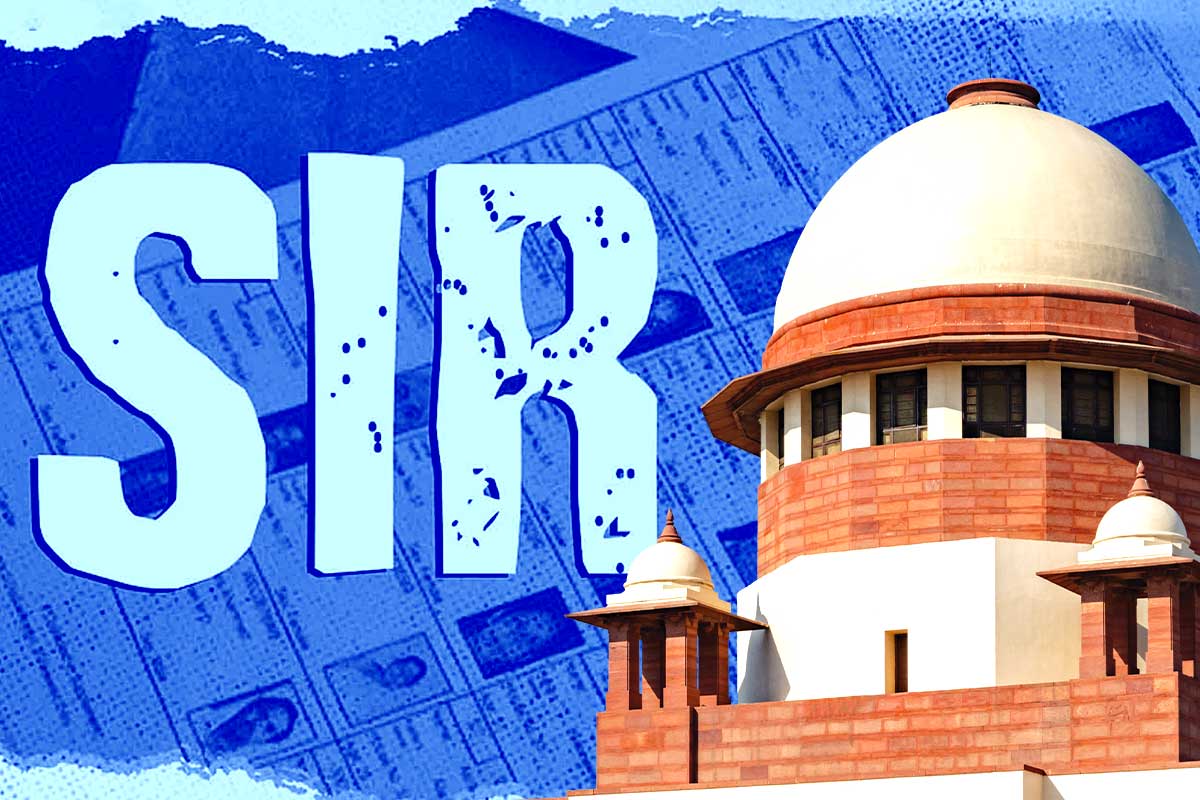
Voters can cast their vote even if a tribunal grants clearance in their name just two days before the Bengal elections. The Supreme Court clarified this in its guidelines for the SIR case. The court stated that this special directive was issued by applying Article 142. Furthermore, in the revised directive, the Supreme Court also stated that votes can be cast if cases are resolved in the tribunal between the upcoming April 21 and April 27. However, for this, the Commission must publish an additional list. Yet, the top court observed that filing an application does not automatically mean acquiring the right to vote. On the eve of the elections, such a directive is certainly considered a relief for deleted voters.
More News on This Topic
This important news will be covered in detail shortly, including all specifics. Please refresh this page a little later to get the complete news and its other details.
Supreme Court
The Supreme Court of the United States is the highest federal court in the nation, established in 1789 by Article III of the U.S. Constitution. It holds ultimate appellate jurisdiction over all federal and state court cases involving federal law, and it has the power of judicial review, famously established in the 1803 case *Marbury v. Madison*, allowing it to declare laws unconstitutional.
Bengal elections
“Bengal elections” refer to the democratic electoral process in the Indian state of West Bengal and the historical region of Bengal, known for its highly competitive and politically vibrant nature. Their modern history is deeply shaped by the 34-year uninterrupted rule of the Communist Party of India (Marxist)-led Left Front (1977-2011), a rare global example of a sustained democratically elected communist government. Since 2011, politics has been dominated by intense rivalry between the All India Trinamool Congress and the Bharatiya Janata Party, reflecting the region’s complex social dynamics and its significance in shaping India’s national political landscape.
SIR case
I’m sorry, but “SIR case” does not refer to a widely recognized place or cultural site. The term is most commonly associated with **SIR** (Società Italiana Resine), an Italian chemical company, and “case” could refer to a legal case, a business case study, or a protective casing. Without more specific context, I cannot provide a meaningful summary.
If you meant a specific historical site or cultural landmark, please provide the full or correct name (e.g., perhaps “Sistine Chapel” or “Site of the Imperial Residence”?), and I would be happy to help.
Article 142
“Article 142” is not a specific place or cultural site, but a clause in the Constitution of India. It grants the Supreme Court of India the power to pass any decree or order necessary for “complete justice” in any case before it. This unique judicial authority has played a significant role in shaping Indian jurisprudence and addressing complex legal and social issues throughout the country’s history since its independence.
Commission
“Commission” is too broad a term to summarize as a specific place or cultural site. It could refer to a government body, an art gallery, a historical event, or a neighborhood in various cities.
For a meaningful summary, please specify which “Commission” you mean, such as the **European Commission** (the EU’s executive body), the **Iraqi High Tribunal** (officially the Supreme Iraqi Criminal Tribunal), or a local arts commission.
tribunal
The term “tribunal” generally refers to a court or forum of justice. Historically, tribunals date back to ancient Rome, where they were key judicial and legislative bodies, such as the “Tribunal of the Plebs.” Today, the word can describe any official body established to adjudicate disputes, from international courts like the Hague Tribunal to specialized administrative panels.